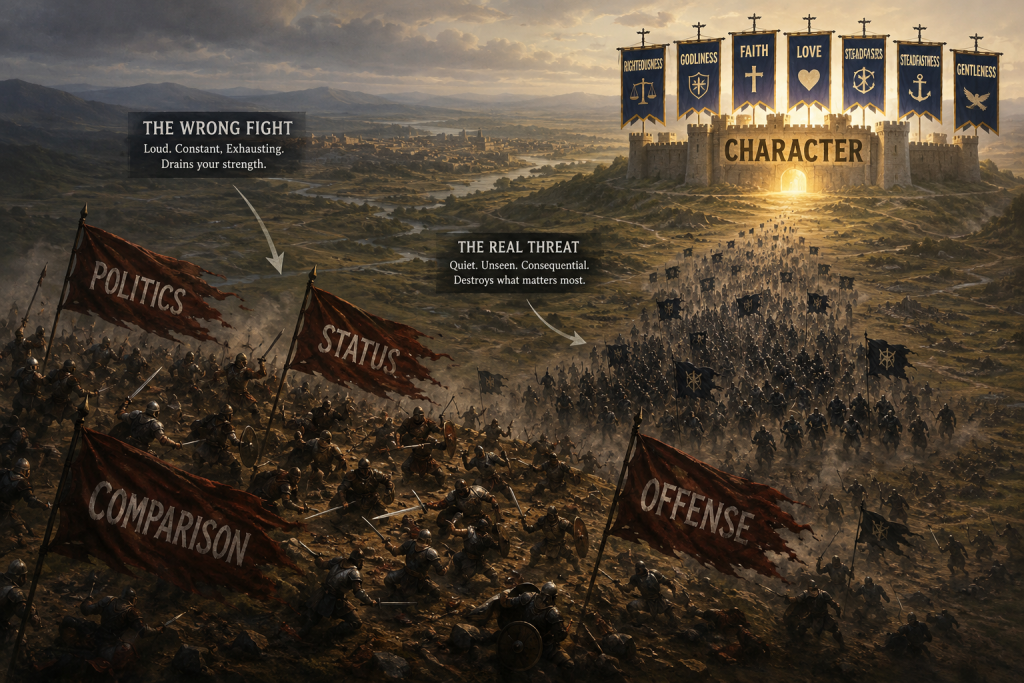
Imagine a battlefield viewed from above. In the foreground, soldiers are intensely fighting over a small hill marked “Politics,” “Status,” “Comparison,” and “Offense.” In the distance, almost unnoticed, an enemy force advances toward a glowing fortress labeled “Character.” Six banners fly from the fortress walls: Righteousness, Godliness, Faith, Love, Steadfastness, and Gentleness, illustrating that the true battle is not where the noise is, but where character is formed.
To translate…
Most people aren’t losing because they’re weak. They’re losing because they’re fighting the wrong battles. Discover how 1 Timothy 6 and Jeremiah reveal the six fights that actually matter, and why distraction is one of the enemy’s greatest strategies.
For your information we’re gonna make a number of references and were gonna talk about a number of concepts today like, 1 Timothy 6, fight the good fight, Jeremiah, distraction, Christian leadership, spiritual warfare, character, behavioral economics, attention, priorities, Compass, purpose, faith
There is an old military principle that has shaped wars for centuries.
You do not always have to overpower your enemy.
Sometimes you only have to distract them.
During World War II, the Allied forces executed Operation Fortitude, an elaborate deception campaign designed to convince Germany that the invasion would happen somewhere other than Normandy. Fake armies, inflatable tanks, false radio traffic, and double agents all pointed the enemy toward the wrong battlefield. Germany concentrated resources defending an attack that never came.
The Allies won before the first soldiers landed because the enemy was looking in the wrong direction.
The same strategy appears throughout Scripture.
The enemy rarely needs to convince us to abandon God altogether.
He simply needs us to fight the wrong battles.
Fighting Everywhere Except Where It Matters
Our days are filled with conflicts.
Arguments with a spouse.
Political outrage.
Social media debates.
Family drama.
Comparison.
Recognition.
Status.
Money.
These things consume enormous amounts of emotional energy.
Meanwhile, the things that Scripture repeatedly calls us to cultivate receive surprisingly little attention:
- Righteousness
- Godliness
- Faith
- Love
- Steadfastness
- Gentleness
Paul’s instruction to Timothy is remarkably specific.
“Fight the good fight of the faith.” (1 Timothy 6:12)
Notice what he does not say.
He doesn’t tell Timothy to fight every battle.
He tells him to fight the right ones.
The adjective matters.
Not every fight is the good fight.
The Dishes Were Never the Problem
Anyone who has spent time counseling married couples recognizes a familiar pattern.
The argument begins over dishes.
Or laundry.
Or forgotten errands.
Or who apologized last.
But those issues are rarely the real battle.
Underneath them usually sits something much deeper.
Pride.
Selfishness.
Fear.
Control.
Keeping score.
The dishes simply became the place where those deeper issues surfaced.
Visible conflict is often the symptom.
Character is usually the disease—or the cure.
That same pattern extends far beyond marriage.
The argument at work may not really be about the project.
The disagreement in church may not really be about theology.
The conflict inside a business partnership may not really be about money.
Often, the visible fight is simply revealing an invisible struggle already taking place.
Behavior Follows Attention
One of the recurring discoveries in behavioral economics is that people rarely make decisions based solely on stated values.
Behavior follows attention.
Attention follows incentives.
If my attention is consumed by comparison, my behavior slowly reflects envy.
If my attention is consumed by status, my decisions begin protecting image rather than integrity.
If my attention is consumed by fear, I begin making decisions that preserve comfort rather than faithfulness.
Character is not built in the crisis.
The crisis simply reveals what our attention has been shaping all along.
This explains why distraction is such an effective strategy.
It slowly redirects attention until character begins drifting without us noticing.
Jeremiah and the Wrong Battle
King Zedekiah believed he was fighting Babylon.
Jeremiah knew the real battle had begun years earlier.
The king was trying to preserve political control.
God was calling him to surrender.
The city fell long before the walls were breached.
It fell when God’s voice was repeatedly ignored.
Likewise, many of our greatest defeats begin long before the visible collapse.
The battle is usually lost upstream.
Translating Every Conflict
Instead of asking,
“What am I arguing about?”
try asking,
“What virtue is this situation testing?”
Complaint about money becomes a question of contentment.
Conflict with a spouse becomes a question of love.
Political outrage becomes a question of faith.
Being overlooked becomes a question of humility.
Difficult people become an opportunity for gentleness.
Unexpected suffering becomes a test of steadfastness.
Every visible conflict can be translated into an invisible opportunity for formation.
That is where the real battle exists.
The Pipeline
Most people fight at the end of the pipeline.
Wise people fight near the beginning.
Wrong incentives
↓
Wrong attention
↓
Wrong priorities
↓
Damaged character
↓
Broken relationships
↓
Visible conflict
Scripture consistently works in the opposite direction.
Jesus changes identity.
Identity reshapes desires.
Desires redirect attention.
Attention forms habits.
Habits shape character.
Character transforms relationships.
Healthy relationships become a witness to the world.
The battle has always been upstream.
The Six Worth Fighting For
Paul’s list in 1 Timothy remains profoundly practical.
Fight for righteousness.
Fight for godliness.
Fight for faith.
Fight for love.
Fight for steadfastness.
Fight for gentleness.
These are not passive virtues.
They require discipline.
They require surrender.
They require saying no to dozens of lesser battles that constantly compete for our attention.
A Better Question
Most evenings we ask ourselves,
“What happened today?”
A better question is,
“What fight did I spend my energy on today?”
An even better one is,
“Did that fight make me more righteous, more loving, more faithful, more steadfast, more gentle, or more like Christ?”
If not, perhaps the enemy accomplished exactly what he intended.
Not by defeating you.
Simply by distracting you.
Because the greatest victories often belong to those who refuse to waste their strength on battles that never truly mattered in the first place.
Discover more from Bryant Stratton
Subscribe to get the latest posts sent to your email.