There is a recurring mistake in development, investing, and cross-cultural business.
People begin too far away from the place where value actually lives.
They start in capitals.
They start with ministers, agencies, investment conferences, consultants, slide decks, and national strategies.
They start with capital.
They start with the question:
How do we get permission to build something here?
But in many places, especially where traditional leadership, family systems, customary land rights, local reputation, and informal trust networks still matter, the more useful question is:
What already exists here that nobody has properly connected yet?
That is a different way of seeing a community.
It is closer to Acres of Diamonds than conventional development theory.
The diamond may already be beneath your feet.
The problem is not always absence.
Sometimes it is perception.
Start Where the Opportunity Actually Lives
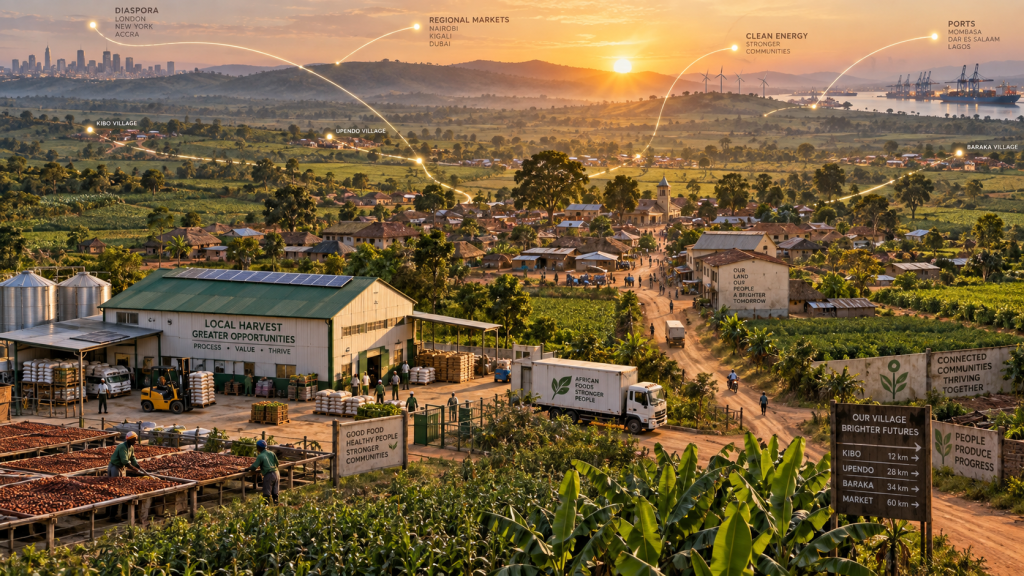
Imagine a rural district with agricultural production, young people looking for work, underused land, unreliable electricity, strong local relationships, and access to a regional market.
From a distance, it may look like a poor village.
From another map, it might look like:
- productive land
- labor
- social cohesion
- logistics potential
- processing demand
- diaspora relationships
- energy demand
- export potential
- underused human capital
The physical place has not changed.
The observer has.
This is where development becomes a question of perception before it becomes a question of finance.
One person sees dirt.
Another sees a processing hub.
One person sees subsistence farming.
Another sees aggregation, cold storage, packaging, export, and local energy demand.
One person sees a village that needs help.
Another sees a community that already possesses most of the components required to create value, but lacks coordination, capital, market access, or technical infrastructure.
That distinction matters.
Because the second perspective changes how you enter.
You do not arrive as a savior.
You arrive as a guest.
The Chief Is Not the Shortcut
In some communities, a traditional leader may be one of the most important people to speak with.
But the reason is not simply that a chief can “give you land.”
That way of thinking is too crude.
Traditional leaders can serve as interpreters of the local map.
They may understand:
- which families have historical claims
- where previous investors created resentment
- which local entrepreneurs are actually trusted
- which conflicts are still active beneath the surface
- who possesses legitimacy without formal title
- which promises people remember
- what outsiders repeatedly misunderstand
That is valuable intelligence.
But traditional authority is not necessarily ownership.
Land can involve overlapping rights between families, customary authorities, governments, communities, tenants, women, younger generations, or lineage groups.
So the correct sequence is not:
Chief → land → project.
It is closer to:
local leadership → community understanding → rights clarification → shared interests → small proof of value.
The chief can open a map.
The community still has to live inside it.
Build Value Before You Ask for Scale
This is where the model diverges sharply from traditional large-project development.
Do not begin with the billion-dollar master plan.
Begin with something visible.
Something useful.
Something people can point to.
Maybe the community grows a crop but sends it elsewhere for processing.
Then the first opportunity is not “agricultural transformation.”
It may simply be:
aggregation + processing + reliable power + buyer.
Maybe farmers lose a large share of their production because there is no cold storage.
Then the opportunity is not a national food-security platform.
It is:
cold storage + logistics + market access.
Maybe mineral production leaves the area with almost no local value addition.
Then the question becomes:
What economically viable processing can happen closer to the source?
The principle is simple:
Add value where value is currently leaking out.
This creates something far more powerful than a presentation.
It creates evidence.
A Working Facility Changes the Meaning of the Place
Before something exists, everyone is interpreting a promise.
The community is asking:
Will these people actually show up?
Will they disappear?
Will the jobs materialize?
Will the land still belong to us?
Will the benefits go somewhere else?
Capital is asking:
Is this place investable?
Can anything actually be built?
Can local actors execute?
Will government cooperate?
Will the community support it?
A functioning asset changes the conversation.
Now there is:
- employment
- product
- cash flow
- activity
- equipment
- customers
- reputation
- evidence
The project leaves a trace.
And traces modify perception.
The place that looked speculative six months earlier begins to look real.
That is where something interesting happens.
You stop chasing everyone.
People begin approaching you.
Build Something Worth Approaching
This may be one of the simplest principles in the entire model.
Build something worth approaching.
A local leader hears that people are getting paid reliably.
A neighboring community wants to understand what is happening.
A government official starts asking questions.
A diaspora entrepreneur hears about it through family.
A buyer realizes there is consistent production.
A capital provider sees an operating model instead of a concept.
The gravitational field changes.
At the beginning, you are pursuing relationships.
After enough visible value exists, relationships begin moving toward the project.
That is economic gravity.
And economic gravity is more powerful than persuasion.
The Village as the First Complete Unit
We often treat villages as the smallest and least sophisticated part of an economic hierarchy.
That may be backwards.
A village is one of the smallest places where nearly every major variable becomes visible at once:
- land
- families
- governance
- conflict
- trust
- labor
- skills
- culture
- ownership
- resources
- needs
- aspirations
- markets
- infrastructure
It is a complete human system.
That makes it an extraordinarily useful place to learn.
You can test whether your assumptions survive reality.
Can people actually work together?
Are the economics sound?
Do benefits reach the people expected to receive them?
Can disputes be resolved?
Does outside capital strengthen the community or merely extract from it?
Can local operators take increasing responsibility?
Does the project create opportunities beyond itself?
Those questions become much harder to hide inside a village.
And that is useful.
Opportunity Zones Can Be Discovered
Governments often define opportunity zones administratively.
A boundary gets drawn.
Tax incentives are created.
A policy declares that investment should flow there.
But another kind of opportunity zone can emerge organically.
Imagine several nearby communities where one has agriculture, another has logistics, another has an energy resource, another has skilled labor, and a regional city has access to financing or export infrastructure.
Individually, each asset may look incomplete.
Together, they form a system.
The zone appears when the relationships become visible.
That means an opportunity zone can sometimes be discovered before it is designated.
The map follows the economic reality rather than creating it.
This fits a larger principle:
The opportunity often exists before anyone has the language to describe it.
That is the lesson of Acres of Diamonds.
The value is already present.
Someone simply has to see the field differently.
Meaning Matters More Than Most Investment Models Admit
This gets especially important when diaspora communities enter the picture.
Someone living in Chicago, London, Atlanta, New York, Paris, or Toronto may already be economically successful.
Their rational default may be to continue investing in familiar markets.
Then something changes.
A parent dies.
They visit a family village.
They begin thinking about what their children know about their ancestry.
They realize that their professional expertise might actually be useful in the region their family came from.
Now an opportunity in Africa no longer appears as simply an emerging-market investment.
It becomes connected to:
- family
- identity
- legacy
- professional capability
- responsibility
- belonging
The underlying asset may be the same.
The meaning changes.
And when meaning changes, perceived opportunity cost changes with it.
A person may be willing to tolerate more complexity, more travel, more learning, or a longer time horizon because the opportunity is doing more than producing financial return.
It is connecting previously separate parts of their life.
That is a very different kind of capital.
Common Ground Before Capital
Cross-cultural deals frequently fail because people attempt to coordinate economics before they coordinate meaning.
The investor asks:
What is the return?
The community asks:
What happens to us?
The government asks:
How many jobs?
The local leader asks:
Who controls the land?
The diaspora participant asks:
Is this somewhere I belong?
The operator asks:
Can we actually execute?
Those are not competing questions.
They are different maps of the same opportunity.
The starting point is to identify where the maps overlap.
Often that common ground is surprisingly basic:
- family
- dignity
- meaningful work
- children
- stability
- fairness
- trust
- stewardship
- belonging
- responsibility
Those shared concerns do not eliminate cultural differences.
They make coordination possible despite them.
Cross-cultural trust does not require everyone to see the world the same way.
It requires enough common ground to build something together.
This Is Where Finders Guild Fits
The role of a network like Finders Guild is not merely to match money with deals.
It is to make the surrounding system legible.
A serious scouting report should ask:
Who matters here?
Who is trusted?
Who can actually execute?
What already exists?
Where is value leaving the community?
What does each participant care about?
What happened before?
What would make a reasonable person stay committed when things become difficult?
Where is the smallest viable place to begin?
That produces several overlapping maps:
Meaning Map
Why does this matter to the people involved?
Trust Map
Who can credibly connect whom?
Capability Map
Who can actually produce an outcome?
Resource Map
What assets already exist?
Opportunity Map
What becomes possible when the other maps overlap?
The project emerges from the overlap.
Not from any single database.
The Kingmaker Comes Later
The same model can eventually identify people worth backing over long periods of time.
But that should happen through observation.
Not favoritism.
Suppose a local operator consistently:
- tells the truth when something is wrong
- protects the community from bad deals
- protects investors from bad information
- executes small projects successfully
- creates jobs
- resolves disputes
- communicates clearly
- develops younger people
- distributes benefits fairly
- refuses opportunities they cannot execute
That behavior leaves traces.
Those traces become reputation.
Eventually the network has evidence that this person is unusually good at turning relationships, capital, and opportunity into durable outcomes.
That is when additional capital should move toward them.
The network has not appointed a king.
It has discovered a steward.
The same thing can happen at the community level.
A village that repeatedly demonstrates:
- reliable governance
- clear rights
- strong operators
- dispute resolution
- transparency
- community participation
- successful execution
becomes easier to invest in.
Trust compounds.
Reputation becomes infrastructure.
The Larger Pattern
The deepest principle is not really about Africa.
It is about how people discover value.
Human beings routinely overlook what is closest to them.
We chase more contacts while ignoring the relationships we already have.
We chase new markets while failing to understand the market beneath our feet.
We chase larger projects while overlooking the small system that could prove the entire thesis.
We chase distant purpose while neglecting our families.
We chase scale before building legitimacy.
The same cognitive error appears at every level.
The correction is surprisingly simple:
Look again.
Look at the land.
Look at the people.
Look at the relationships.
Look at the skills.
Look at the history.
Look at the values.
Look at what is leaving the community without enough value being retained.
Then build the smallest thing that demonstrates a better possibility.
Do it well enough that people notice.
Do it responsibly enough that people trust it.
Do it visibly enough that others can evaluate it.
And then let the next opportunity come toward you.
The strongest opportunity zones may not begin as zones at all.
They may begin with one village.
One respected relationship.
One useful asset.
One problem solved.
One visible proof.
And a group of people willing to stay present long enough to discover the diamonds beneath their feet.
Discover more from Bryant Stratton
Subscribe to get the latest posts sent to your email.