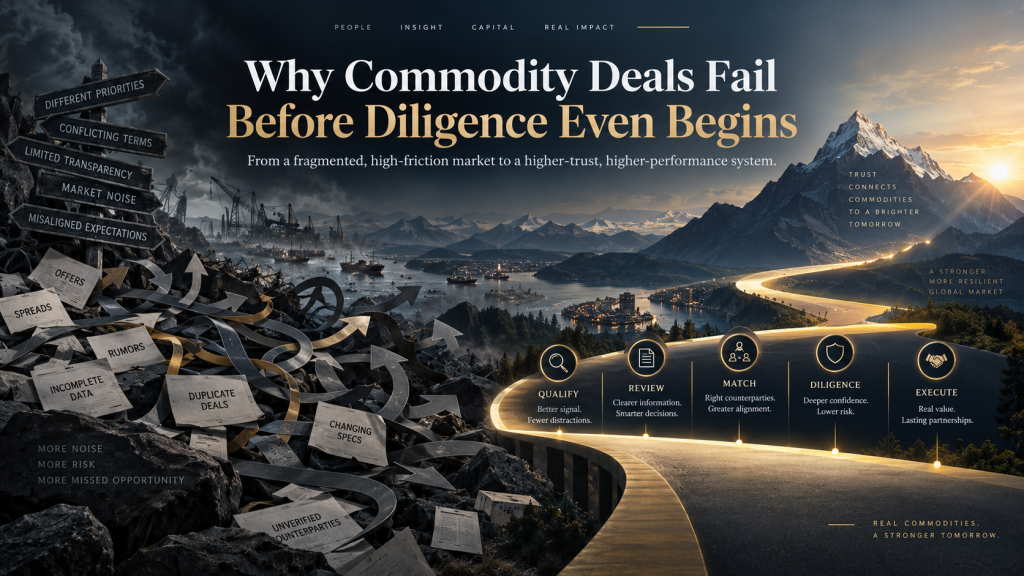
From a Fragmented, High-Friction Market to a Higher-Trust, Higher-Performance System
Most commodity deals do not fail because the underlying asset is bad.
They fail earlier.
They fail because the people, information, incentives, and authority around the transaction are not organized well enough for the deal to become executable.
In fragmented commodity markets, opportunities are often circulated through multiple intermediaries before anyone clearly establishes who the principals are, who has authority, what the mandate actually says, whether the procedure is commercially workable, or whether the economics make sense.
At that point, the transaction begins to behave less like a professional process and more like a lottery.
The solution is not simply more deal flow.
It is a better operating system around the deal flow.
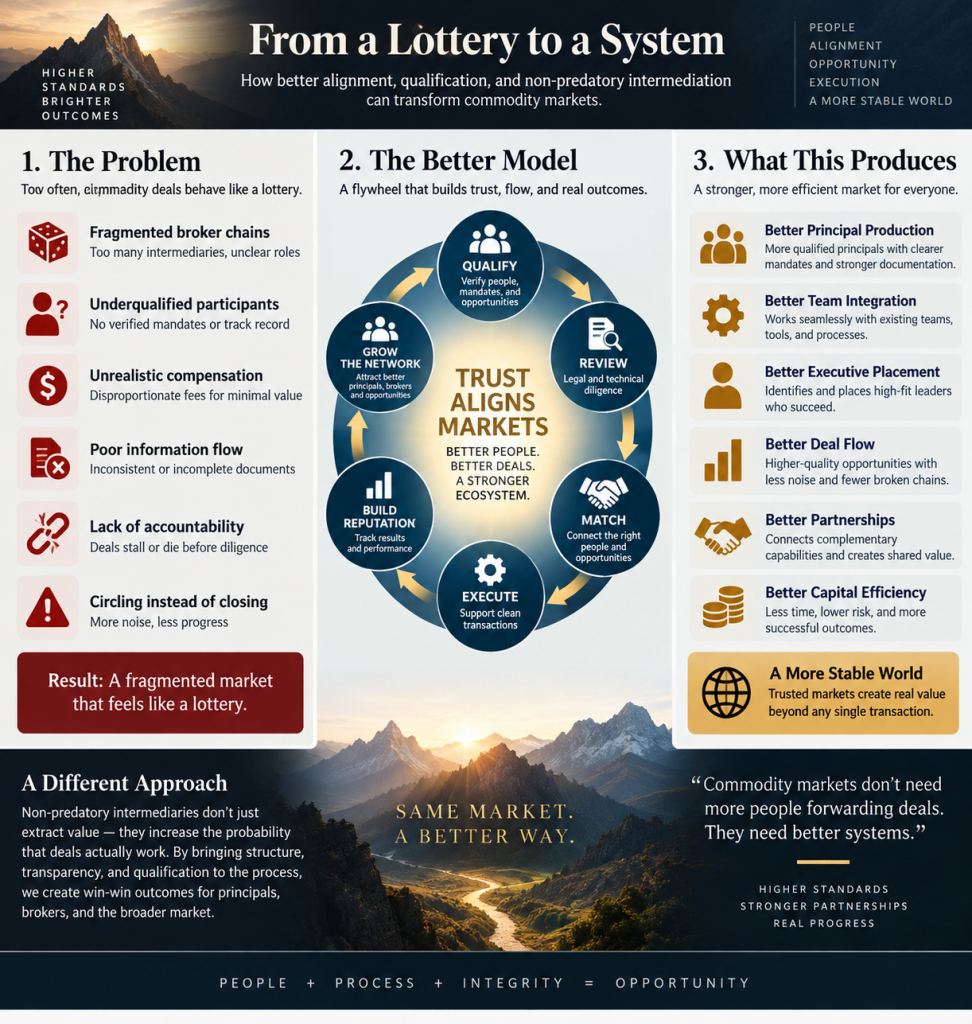
The Lottery Problem
One of the most common patterns in commodity brokerage is circulation without progression.
An opportunity enters the market.
It gets forwarded.
Someone forwards it again.
Another broker believes they know a buyer.
Someone else knows a seller.
More parties become involved.
Documents are copied and modified.
Procedures change.
Commission expectations accumulate.
Eventually, the opportunity has traveled a long distance without getting materially closer to a transaction.
The number of people touching the deal creates the appearance of momentum.
But meetings are not momentum.
Forwarded documents are not momentum.
More intermediaries are not necessarily momentum.
The transaction has momentum when uncertainty is being removed.
That means answering increasingly specific questions:
- Who is the principal?
- Who represents them?
- Is that representation verified?
- What exactly is being bought or sold?
- What quantity is actually available?
- What procedure will the principal accept?
- Who has authority to alter that procedure?
- What documentation is required?
- What economics are available?
- What still prevents the transaction from moving?
Without those answers, the market behaves statistically.
People increase the number of attempts and hope something eventually connects.
That may produce occasional success.
It does not produce a reliable system.
Qualification Fails Before Diligence
The first question should not be:
Can I move this deal?
It should be:
Is this opportunity qualified enough to deserve movement?
That distinction matters.
Formal legal, financial, compliance, technical, assay, sanctions, KYC, AML, title, and counterparty diligence all have important roles.
A brokerage operating layer should not attempt to replace those professionals.
The problem occurs earlier.
Professional diligence is frequently asked to review opportunities that have not yet passed basic commercial qualification.
Before deeper diligence, someone should already know:
- who each party claims to be,
- who introduced them,
- whether authority has been demonstrated,
- whether the mandate is current,
- what product or asset is actually involved,
- whether quantities align,
- whether the proposed procedure is internally coherent,
- whether the economics remain possible after the chain is paid,
- and what specific question requires professional review.
That is not legal diligence.
It is transaction hygiene.
And when transaction hygiene is missing, expensive professional resources are used to discover problems that should have been identified much earlier.
The Compensation Problem
Intermediaries can create enormous value.
A great introduction may create a transaction that otherwise would never have existed.
A skilled broker can identify the right principal, understand what matters to them, protect a relationship, keep information moving, reconcile expectations, identify problems early, and preserve enough trust for a transaction to reach closing.
That work deserves compensation.
But transaction size and intermediary contribution are not the same thing.
A large transaction does not automatically make every introduction enormously valuable.
This becomes especially problematic when a long chain of people each expects economics simply because the opportunity passed through their hands.
Eventually, the compensation structure itself becomes a closing risk.
The right question is:
What value did this participant actually contribute?
That contribution may include:
- direct principal access,
- a verified mandate,
- buyer qualification,
- seller qualification,
- originating the opportunity,
- documentation,
- commercial structuring,
- negotiation,
- transaction coordination,
- legal or technical expertise,
- relationship management,
- solving an execution problem,
- or carrying the transaction through closing.
Compensation should follow contribution.
That creates a healthier market than allowing every participant to anchor their expectations to the gross size of the transaction.
If the intermediary economics consume the buyer’s available discount, distort the seller’s proceeds, or make the transaction commercially irrational, the structure has failed.
A deal should not die because the people helping it close made closing impossible.
Professionalism Is an Operating-System Problem
It is easy to describe these markets as having an unprofessional broker problem.
There is truth in that.
But it is incomplete.
Professional people can produce poor outcomes inside poorly designed systems.
Consider an environment with:
- no shared source of truth,
- unclear roles,
- multiple versions of documents,
- no consistent qualification standard,
- unclear authority,
- inconsistent communication,
- hidden economic expectations,
- no ownership of next steps,
- and no record of prior performance.
That environment rewards forwarding.
It does not reward disciplined execution.
A better system makes professional behavior easier.
It asks participants to become progressively clearer as an opportunity advances.
The process becomes:
Qualify → Review → Match → Diligence → Execute → Learn
Every step should reduce uncertainty.
If it does not, the transaction is probably circling.
A Better Operating Model
The opportunity is not to eliminate brokers.
It is to make good brokers substantially more effective.
The same applies to lawyers, principals, diligence providers, operators, and other specialists.
A trusted operating layer can help coordinate the interfaces between them without pretending to replace their expertise.
The basic model is straightforward.
Qualify
Establish basic identity, authority, mandate, product, procedure, and opportunity information.
Review
Identify inconsistencies, missing information, obvious commercial problems, and questions requiring legal, technical, compliance, or financial expertise.
Match
Bring the opportunity to counterparties whose actual requirements align with the deal.
Diligence
Allow qualified professionals and principals to conduct the deeper work required to establish confidence.
Execute
Move toward transaction with clearly defined owners, responsibilities, economics, documents, and next steps.
Capture
Record what happened.
Who performed?
Where did the transaction break?
Which procedures worked?
Which counterparties were reliable?
What should the network learn?
Grow
Use those results to improve future matching, qualification, and trust.
That is the flywheel.
Better participants generate better information.
Better information produces better matches.
Better matches produce more successful transactions.
Successful transactions create evidence.
Evidence creates trust.
Trust attracts stronger participants.
And the network improves.
What This Produces
The value of a better operating layer extends well beyond one commodity transaction.
Better Principal Production
A strong network should not merely produce more names.
It should produce more qualified principals.
That means people entering the system with:
- clearer mandates,
- stronger documentation,
- known requirements,
- better context,
- and fewer unnecessary layers between them and the transaction.
Better principal production increases the quality of everything downstream.
Better Team Integration
Deal environments often contain significant expertise that is poorly connected.
Legal professionals understand one layer.
Senior brokers understand another.
Operators understand execution.
Principals understand their own constraints.
Technology can organize information.
Communities contain relationships and context.
The opportunity is to integrate these capabilities without turning everyone into the same role.
Better integration creates:
- clearer ownership,
- greater situational awareness,
- faster escalation,
- better access to resources,
- and fewer duplicated efforts.
The goal is not centralized control.
It is coordinated intelligence.
Better Executive Placement
The same principles apply to people.
A résumé tells you something.
A relationship tells you more.
Observed performance tells you considerably more.
Communities built around actual work can become powerful environments for identifying leadership.
You can see:
- who follows through,
- who understands complexity,
- who creates trust,
- who can receive feedback,
- who protects relationships,
- who thinks commercially,
- who brings other capable people with them,
- and who becomes more useful as situations become difficult.
That can create a better executive-placement environment than evaluating people only through conventional recruiting signals.
The person is not simply matched to a title.
They are matched to an operating environment where there is evidence they can perform.
Better Deal Flow
More deal flow is not automatically better.
Higher-quality deal flow is better.
A healthy system should reduce:
- duplicate opportunities,
- unverified mandates,
- broken chains,
- inconsistent documentation,
- irrelevant offers,
- and endless forwarding.
That allows the right opportunities to receive more attention.
Less noise can produce more transactions.
Better Partnerships
Partnerships become easier to build when contributions are visible.
One party may bring capital.
Another may bring technology.
Another brings a principal relationship.
Another brings operational capacity.
Another understands regulatory requirements.
Another owns distribution.
Another has the community.
A good operating layer helps everyone see those contributions and establish a structure that reflects them.
That creates partnerships based on complementary capability rather than vague enthusiasm.
Better Capital Efficiency
Poor coordination is expensive.
It consumes:
- executive time,
- legal time,
- diligence resources,
- travel,
- reputation,
- opportunity cost,
- attention,
- and relationship capital.
Every bad fit prevented early preserves resources for stronger opportunities.
Every unnecessary intermediary removed simplifies economics.
Every qualified counterparty identified earlier reduces wasted cycles.
Every lesson captured prevents the organization from relearning the same thing repeatedly.
Capital efficiency is not only financial.
It is the efficiency with which the network uses its people, information, relationships, time, and trust.
Why Non-Predatory Intermediaries Win
A predatory intermediary optimizes for extraction.
A high-quality intermediary optimizes for transaction health.
Those incentives produce very different behaviors.
A non-predatory intermediary may:
- tell a participant their economics are unrealistic,
- remove themselves when they are unnecessary,
- decline to circulate an unqualified opportunity,
- protect confidential information,
- disclose conflicts,
- challenge a weak mandate,
- ask uncomfortable questions,
- recommend a specialist,
- or tell both sides that a deal should not proceed.
That can appear contrary to short-term self-interest.
Over time, it creates something more valuable.
Trust.
The network learns that this person does not simply send opportunities.
They improve them.
They protect attention.
They reduce risk.
They increase the probability that serious opportunities receive serious treatment.
That reputation compounds.
Commodity Deal Review Checklist
Before circulating another opportunity, review the current state of the transaction.
Identity & Authority
☐ Do we know who each party actually is?
☐ Is the mandate verified?
☐ Who makes the decision?
☐ Who has authority to negotiate?
☐ Who ultimately signs?
☐ Is anyone claiming authority they have not demonstrated?
Deal Structure
☐ Is the product or asset clearly defined?
☐ Is the quantity clear?
☐ Is the location known?
☐ Is the proposed procedure coherent?
☐ Does the counterparty accept that procedure?
☐ Is the pricing commercially realistic?
☐ Are the roles of everyone in the chain clear?
Documentation
☐ Do the documents tell the same story?
☐ Are names, entities, quantities, locations, and procedures consistent?
☐ Are documents current?
☐ Are there unexplained edits or discrepancies?
☐ Has the appropriate legal or compliance review occurred?
☐ Do we know which questions still require professional diligence?
Economics
☐ Who expects to be paid?
☐ For what contribution?
☐ Are all commissions disclosed?
☐ Are the economics commercially realistic?
☐ Could intermediary fees prevent the deal from closing?
☐ Does compensation reflect contribution?
Process Health
☐ What is the next decision?
☐ Who owns it?
☐ What information is missing?
☐ Where does this type of transaction normally stall?
☐ Is there a single source of truth?
☐ Are we reducing uncertainty?
☐ Or are we simply circulating the opportunity?
Counterparty Fit
☐ Does the buyer actually buy this product?
☐ Does the seller actually control this product?
☐ Do their procedures align?
☐ Do their volumes align?
☐ Do their jurisdictions align?
☐ Do their timelines align?
☐ Is there a credible reason these parties should transact together?
Outcome Test
Before advancing the deal, ask:
☐ Would a serious principal be comfortable receiving this opportunity in its current form?
☐ Would an experienced lawyer understand the structure?
☐ Would a diligence professional know exactly what needs to be verified?
☐ Can everyone explain their role?
☐ Is the transaction economically viable?
☐ Is the next step obvious?
If the answer to several of these questions is no, the opportunity may not need more circulation.
It may need more work.
Review the Health of Your Brokerage
A brokerage should be able to examine itself using the same framework.
Ask:
- What percentage of opportunities are properly qualified before circulation?
- How often are mandates independently confirmed?
- How many intermediaries typically exist between your team and a principal?
- How often do documents conflict?
- How frequently do commission expectations become a problem?
- What percentage of opportunities reach professional diligence?
- What percentage reach principal-to-principal conversations?
- Where do transactions most frequently stall?
- Which participants repeatedly create successful outcomes?
- Which behaviors repeatedly destroy them?
- Does your network remember these results?
- Are you becoming more accurate over time?
If those questions are difficult to answer, the brokerage may have a data problem before it has a deal-flow problem.
You cannot improve what the system does not observe.
The Real Opportunity
The biggest opportunity in commodity brokerage may not be another marketplace.
It may be the coordination infrastructure surrounding the market.
A system that helps establish:
Who is real?
Who has authority?
What is actually being offered?
What does the counterparty need?
What information can be trusted?
Who contributes what?
What economics are reasonable?
What happens next?
That is not merely lead generation.
It is market infrastructure.
And because the principles are fundamentally about people, incentives, information, and coordination, the model can extend beyond commodities.
The same operating logic can improve:
- partnerships,
- executive placement,
- internal team integration,
- principal development,
- capital deployment,
- community building,
- and organizational decision-making.
The underlying problem is the same.
Put the right people around the right opportunity with the right information, incentives, authority, and process.
Then let performance compound.
Closing
Commodity markets do not need more people forwarding deals.
They need better systems for determining who should be involved, what each person contributes, which information can be trusted, and how a transaction should progress.
The market stops behaving like a lottery when probability replaces hope.
Qualification improves probability.
Professional review improves probability.
Better matching improves probability.
Realistic economics improve probability.
Clear authority improves probability.
Trust improves probability.
And when those things become part of the system rather than dependent on luck, good brokers become more valuable, strong principals become easier to serve, professional resources are used more intelligently, and more legitimate opportunities have a chance to close.
Same market. Higher standard. Better outcomes.
Want the Checklist or a Brokerage Health Review?
If you would like a copy of the Commodity Deal Review Checklist, the accompanying infographic, or want to walk through the current health of your brokerage, broker network, or deal process, reach out directly:
Bryant Stratton
Finders Guild
Bstratton@findersguild.com
We can review where transactions currently stall, how opportunities are being qualified, where information and incentives are breaking down, and which changes are most likely to improve deal quality and closing probability.
Discover more from Bryant Stratton
Subscribe to get the latest posts sent to your email.