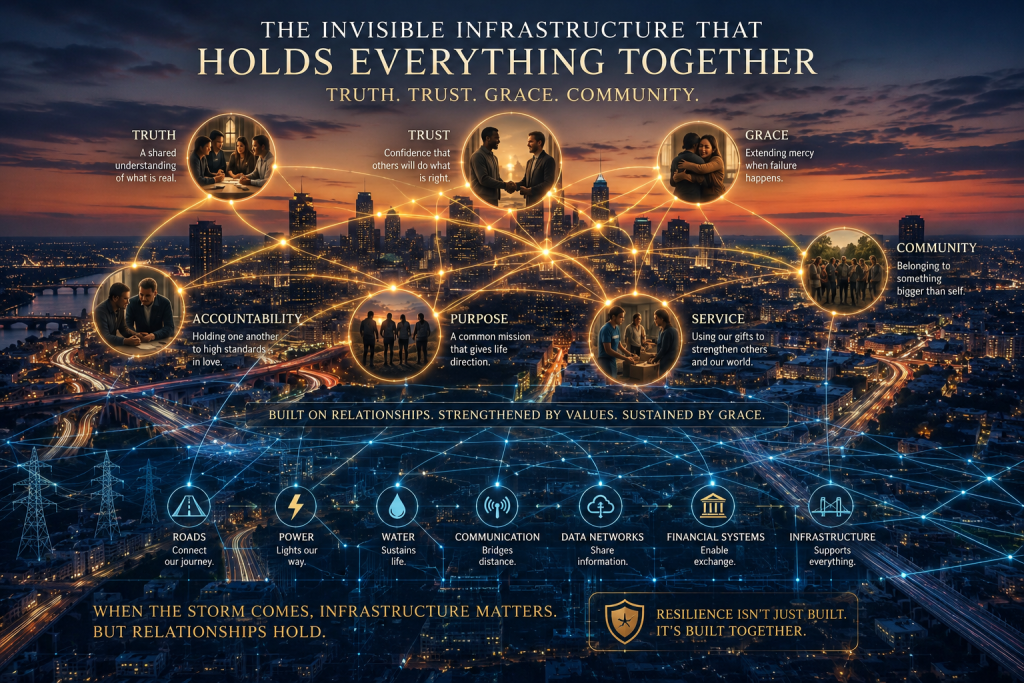
Why Truth, Trust, Grace, and Community Matter More Than Ever
Most people think resilience comes from money.
Build a bigger savings account.
Buy more insurance.
Diversify your investments.
Acquire more assets.
All of those things matter.
But history repeatedly shows that societies do not collapse first because they run out of money. They collapse because they run out of trust.
The roads may still work.
The power may still be on.
The banks may still be open.
Yet something deeper breaks.
People stop believing one another.
Communities fragment.
Families isolate.
Institutions lose credibility.
The invisible infrastructure begins to fail.
And invisible infrastructure is often more important than the visible kind.
Water is a utility.
Electricity is a utility.
Telecommunications are a utility.
But there are social utilities as well:
- Trust
- Truth
- Reputation
- Accountability
- Grace
- Shared purpose
Without them, physical infrastructure eventually becomes meaningless.
A city can have roads and power and still be broken.
A company can have capital and customers and still be dying.
A family can have a house and income and still be falling apart.
The real question is not whether we have enough resources.
The question is whether we have enough resilience.
The Church Understood Something We Forgot
In Paul’s letter to Timothy, he describes the church as “the household of God” and “a pillar and buttress of the truth.”
Most people hear those words as purely religious language.
But there is something profoundly practical underneath them.
Paul describes a community that exists to preserve truth, reinforce one another, carry burdens together, and remain faithful through storms.
The church was never intended to be a weekly event.
It was designed as a resilience system.
The early Christians gathered together.
They ate together.
They prayed together.
They served one another.
They corrected one another.
They forgave one another.
There are more than 150 “one another” commands in Scripture.
Why?
Because resilience is relational.
People survive together.
Or they fail alone.
Grace Is Relational Insurance
One insight becomes obvious when viewed through a systems lens.
Insurance exists because accidents happen.
Grace exists because mistakes happen.
Insurance says:
“When something breaks, there is a process for recovery.”
Grace says:
“When someone breaks, there is a process for recovery.”
Both are shock absorbers.
Both allow growth.
Both reduce fragility.
Both increase resilience.
A family without grace becomes brittle.
A company without grace becomes fearful.
A community without grace becomes transactional.
Without grace, every failure becomes fatal.
Without accountability, every failure becomes normalized.
Healthy systems require both.
The Storm Reveals Everything
One of the most powerful truths in leadership is that storms do not create foundations.
They reveal them.
When uncertainty arrives, we discover what has actually been governing us.
Not what we claimed.
Not what we posted online.
Not what we put in the mission statement.
The storm exposes reality.
It reveals:
- What we truly value.
- What we truly trust.
- What authority we actually follow.
- What relationships can bear weight.
This is true for individuals, families, churches, companies, and nations.
Every system eventually encounters a storm.
The question is whether it has built enough resilience beforehand.
The Authority Question
The deepest question beneath every community is simple:
Who or what gets the final vote?
Every person eventually reaches a moment where truth and preference collide.
Reality and desire collide.
Principle and convenience collide.
The resilient person settles this question before the crisis arrives.
The resilient community settles this question before the storm arrives.
Without a governing principle, every decision becomes negotiable.
Every value becomes flexible.
Every commitment becomes temporary.
Eventually, the entire structure drifts.
Strong communities require something higher than personalities.
Something higher than popularity.
Something higher than emotion.
Whether that authority is Scripture, shared principles, or a clearly defined mission, resilient systems always possess a center.
Building the Utility of the Future
The next generation of value creation may not be technological.
It may be relational.
The world is increasingly connected digitally and increasingly disconnected socially.
We have more communication than ever.
Yet loneliness is rising.
We have more information than ever.
Yet confusion is rising.
We have more platforms than ever.
Yet trust is falling.
Perhaps what is needed is not another app.
Not another network.
Not another marketplace.
Perhaps what is needed is infrastructure for trust itself.
Communities that help people:
- Tell the truth.
- Build relationships.
- Carry burdens.
- Recover from failure.
- Develop capability.
- Create meaningful impact.
The future belongs to communities that can do what institutions increasingly struggle to do:
Create resilience.
The Simple Equation
After years of studying leadership, communities, faith, systems, and human behavior, the pattern seems remarkably simple:
Truth without grace becomes harsh.
Grace without truth becomes chaos.
Accountability without trust becomes coercion.
Trust without truth becomes manipulation.
But when truth, trust, grace, and accountability work together, something remarkable emerges:
Resilience.
And resilient people build resilient families.
Resilient families build resilient communities.
Resilient communities build resilient nations.
The utility we forgot to build may be the one we need most.
Not a utility of electricity.
Not a utility of money.
A utility of trust.
A utility of grace.
A utility of truth.
A utility of people learning how to carry one another’s burdens while continuing to move forward together.
Discover more from Bryant Stratton
Subscribe to get the latest posts sent to your email.