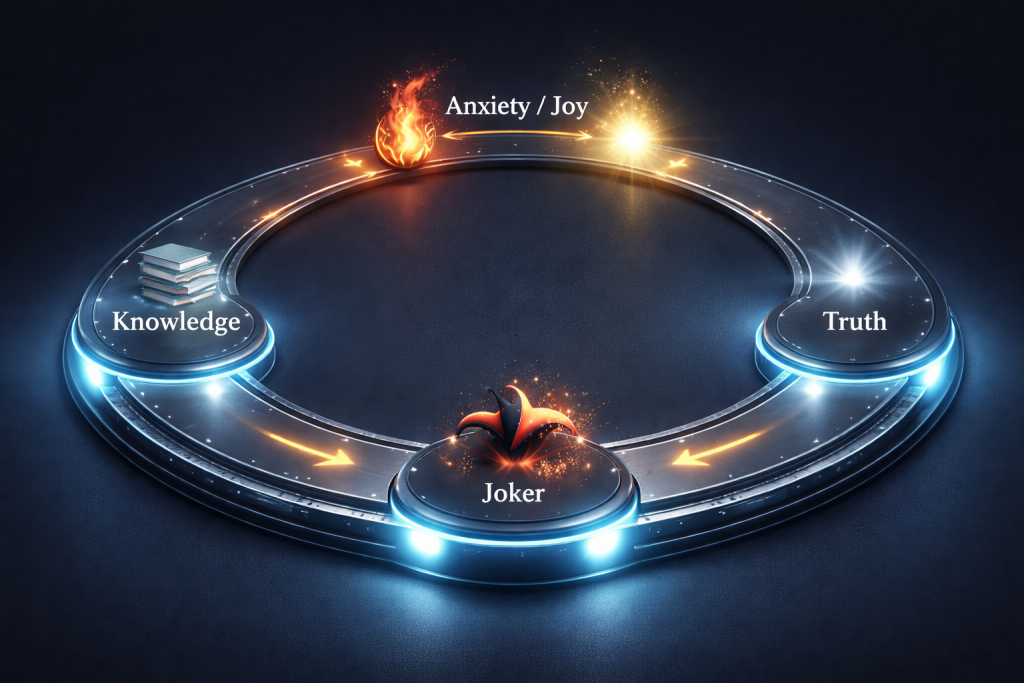
The Conveyor Belt of Understanding: Knowledge, Anxiety, Truth, and the Joker
We keep pretending the mind works like a staircase.
First you learn. Then you think. Then you know. Then you act.
That is false.
Human understanding moves more like a conveyor belt. You gather knowledge, hit the threshold of anxiety and joy, confront truth, get broken open by the joker, and then return to knowledge changed by the whole passage.
That pattern is not abstract. It is ordinary life. A founder thinks he understands the market until reality humiliates him. A husband thinks he understands the marriage until one sentence reveals he has been living inside his own explanation. A leader thinks he knows the room until one contradiction, one joke, or one collapse exposes the fragility of his frame.
That is why this map matters. It is not decorative. It is diagnostic.
Knowledge
Knowledge is where most people begin. It is memory, explanation, structure, category, skill, language. It is what lets a person move with some competence in the world. But knowledge has a weakness. It tends to overestimate itself. People confuse what is named with what is known. They confuse clean language with real contact.
Einstein pointed to the edge of this problem when he wrote, “The most beautiful thing we can experience is the mysterious.”
That is the crack in the wall of mere knowledge. Mystery is what appears when the map is no longer enough.
Anxiety / Joy
The threshold is emotional before it is philosophical. Real contact with deeper reality often produces two things at once: anxiety and joy.
Anxiety says, “My map may be wrong.”
Joy says, “Something more real may be arriving.”
Arjuna names this moment directly: “I am confused about my duty.” In another translation, he says he is “besieged with anxiety and faintheartedness.” Both versions point to the same thing, a crisis serious enough to break borrowed certainty.
Source: Bhagavad Gita 2.7, Vedabase
Source: Bhagavad Gita 2.7, alternate translation
This is the part weak people try to skip. They want truth without disorientation. They want clarity without surrender. They want conclusions without cost.
Truth
Truth is not merely information. It is not just opinion stated forcefully. Truth clarifies, but it also judges. It strips away ornamental explanations and asks whether your life can bear the weight of what your mouth says.
Gandhi wrote, “Truth is within ourselves.” He also argued that truth must exist in thought, speech, and action.
That is harder than modern people want. Most want truth as language, not alignment. They want to say true things while living falsely.
The Joker
Then the system reaches its most dangerous and most necessary station: the joker.
The joker is not merely comedy. He is disruption, paradox, inversion, absurdity, contradiction, and mockery of false structure. He is what reveals whether your truth is alive or brittle.
Nietzsche put it this way: “one must still have chaos in one, to give birth to a dancing star.” [oai_citation:3‡Wikisource](https://en.wikisource.org/wiki/Thus_Spake_Zarathustra/Prologue?utm_source=chatgpt.com)
Source: Nietzsche, Thus Spake Zarathustra
That line is usually abused by unserious people. The stronger reading is simpler: no living truth is formed without passing through disorder, pressure, and destabilization.
The joker humiliates false certainty. He exposes the polished lie. He reveals whether the room is in contact with reality or only performing agreement.
Stillness Inside the Cycle
Not every disruption should be answered with more force. Sometimes the mind becomes clearer when you stop thrashing.
Alan Watts wrote, “Muddy water is best cleared by leaving it alone.” That line is commonly attributed to The Way of Zen.
That does not mean passivity as an excuse. It means frantic interference can deepen distortion. The joker unsettles the water. Wisdom refuses to churn it further.
Back to Knowledge
After disruption, you do not stay in chaos. You rebuild. But if the cycle was real, the knowledge you return to is no longer the same. It has passed through emotion, contact, exposure, paradox, and correction. It is less proud. Less decorative. Less dependent on appearances.
That is the deeper tension inside the map.
- Too much knowledge without truth becomes sterile formalism.
- Too much anxiety without movement becomes paralysis.
- Too much claimed truth without the joker becomes dogma.
- Too much joker without truth becomes nihilistic play.
- Too much stillness without responsibility becomes drift.
The whole point is movement.
Einstein gives the opening, mystery. Arjuna gives the honest crisis. Gandhi gives the demand for alignment. Nietzsche gives the necessity of chaos. Watts gives the discipline not to thrash when the system destabilizes. Together, they do not form a perfect doctrine. They form something more useful, a map of how a human being is actually changed.
An Actionable Frame
When you are stuck, do not ask only what you know.
Ask where you are on the belt.
- Are you hiding inside knowledge because truth might cost you status?
- Are you in anxiety, mistaking disorientation for failure?
- Have you touched truth but refused to align your life to it?
- Has the joker already exposed your false structure, and you are still pretending he did not?
- Are you churning muddy water because stillness feels like loss of control?
That is the real use of the model. It tells you where distortion is entering the process.
Discover more from Bryant Stratton
Subscribe to get the latest posts sent to your email.