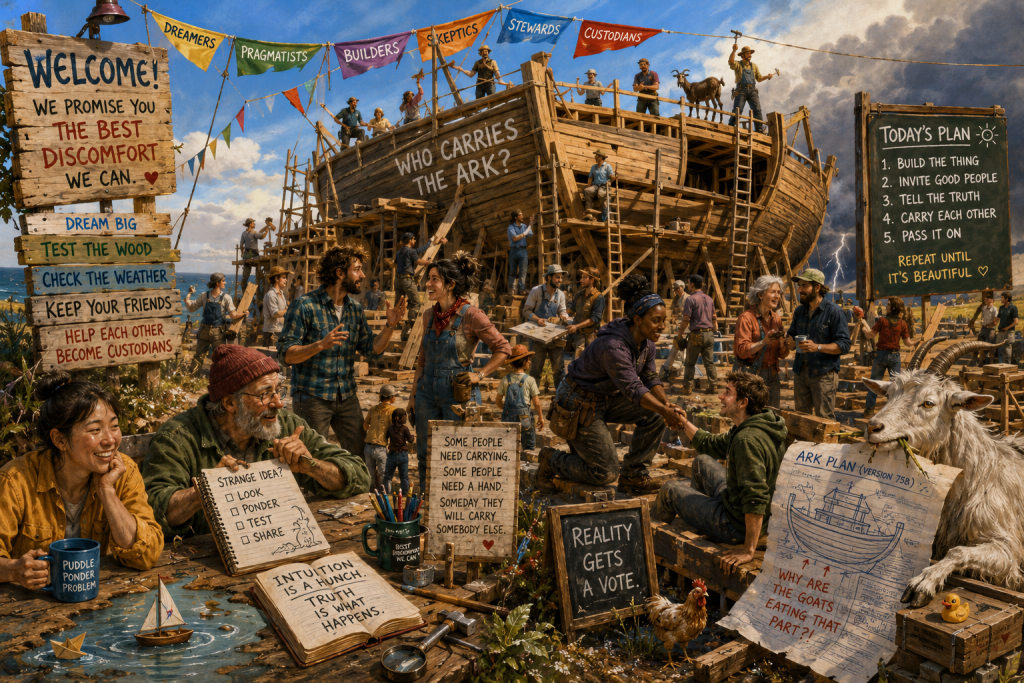
Here you see a whimsical view into today’s story of an ark being built by an unruly community. Imagine dreamers sketch impossible plans, pragmatists measure lumber, old friends repair boards together, someone pulls another person aboard, children splash in a puddle, and a goat eats part of the blueprint. A storm may or may not be forming in the distance. The scene should feel playful first and profound only after looking longer.
So we have our article for today, our story if you will…
Make Good Friends, Keep the Old
We have been writing some “strange” songs around Surfboard.
That is probably appropriate as the lessons they contain are equally “strange”, like their arrival, and the realization of the lesson.
One of them came out of the Puddle, Ponder, Problem kind of thinking: rambling, playful, almost childlike, following something ridiculous until the ridiculous thing starts asking a surprisingly serious question.
Puddle Ponder Problem Song: https://suno.com/s/Bfv64USdk9luxrIm
Another idea that came along was, “Outdream the Darkness”.
That one points toward something different.
There are times when looking directly at everything broken in the world doesn’t produce the imagination necessary to build what comes next. Darkness can consume all the available attention.
Sometimes the answer is to outdream it.
But there is a problem with dreamers.
Sometimes we’re wrong.
And now we have another song.
It starts with one of the simplest things many of us learned as children:
Make good friends and keep the old.
We started playing with that idea.
Then we wrote a song about it.
Then we wrote a prompt explaining how the song should behave.
Then naturally the prompt itself started sounding like it should be a song.
So now there is a song about the song and a song about the prompt for the song.
This is either a terrible breakdown in operational discipline…
…or a fairly good demonstration of Surfboard.
The answer depends on what happens next.
Song about a Prompt: https://suno.com/s/8kDoW8cPw2zzBkMa
Test the Wood Song: https://suno.com/s/dhSHt0MqNBs567xj
Follow the Ridiculous Thing
There is something children understand that adults systematically train themselves to ignore.
A puddle can become an entire world.
You step in it.
Then you wonder how deep it is.
Then where the water came from.
Then where it goes.
Then why this puddle exists here and not there.
Puddle.
Ponder.
Problem.
That same pattern appears everywhere.
Someone says something strange.
Someone has an idea everyone dismisses.
A relationship appears unimportant.
A project fails.
A person gets forgotten.
“Crap,” we say.
Move on.
Sometimes that’s correct.
Some crap is just crap.
But occasionally there is truth hiding inside something everyone learned to dismiss.
Surfboard isn’t supposed to believe every strange thing.
That would be disastrous.
We’re supposed to be willing to look.
That distinction matters.
Outdream the Darkness. Then Test the Wood.
“Outdream the Darkness” carries an important idea.
Human beings need imagination.
Every institution that exists began as something that didn’t.
Every company.
Every community.
Every invention.
Every movement.
Someone saw something before everybody else could touch it.
But there is a dangerous mutation of that idea:
I see something other people don’t, therefore I am right.
No.
The dream earns the right to be investigated.
It does not earn the right to be protected from reality.
That is where another Surfboard idea has been emerging:
The difference between intuition and fantasy is discomfort.
More precisely, intuition becomes distinguishable from fantasy when we’re willing to expose it to the discomfort of reality.
What is the specific evidence for that?
Ask the customer.
Make the introduction.
Try the experiment.
Measure something.
Let somebody disagree.
Build the prototype.
Test the wood.
Check the weather.
The dreamer says:
“I think there’s a storm coming.”
The pragmatist doesn’t have to answer:
“You’re crazy.”
Nor should they answer:
“You’re a visionary!”
They can say:
“Interesting. Let’s check the weather.”
Now we can build something together.
The Best Discomfort We Can
This produces what may be one of the stranger promises Surfboard can make:
We promise you the best discomfort we can.
Imagine putting that on the welcome sign.
Have some coffee.
Meet some good people.
Tell us your dream.
And prepare to be lovingly inconvenienced by reality.
Because friendship without discomfort isn’t necessarily friendship.
Sometimes it is an audience.
Sometimes it is enabling.
Sometimes it is two people agreeing to protect each other’s illusions.
A good friend can ask:
“Are you sure?”
“What happened?”
“What’s the evidence?”
“What did you contribute to this?”
“What would prove you wrong?”
And perhaps most importantly:
“What do we do now?”
The point isn’t confrontation.
The point is discovery.
The discomfort must serve truth, agency or growth. Otherwise it is just somebody enjoying the power to make another person uncomfortable.
That isn’t Surfboard.
Make Good Friends
This is where the children’s song became much more interesting.
Make good friends.
Not contacts.
Not followers.
Not people who can currently do something for us.
Friends.
People with different eyes.
The dreamer sees possibility.
The skeptic sees unsupported assumptions.
The operator sees what it will take.
The connector sees who should know whom.
The custodian remembers what everyone promised.
The person who has suffered may see a danger everyone else has normalized.
The person with enormous responsibility may see second- and third-order consequences invisible from the ground.
Nobody sees everything.
That is precisely the point.
A serious network increases perception because people see through different lenses.
But then comes the second half.
Keep the Old
This may be harder.
Modern networks are optimized for acquisition.
More followers.
More members.
More partners.
More customers.
More introductions.
More reach.
Surfboard needs expansion too.
But if we continually make new relationships while consuming old ones, we haven’t built a network.
We’ve harvested one.
This is why custodianship matters.
Every serious introduction spends trust.
Every collaboration creates history.
Every promise creates something someone has to remember.
Every failure contains information.
Every person who contributed before the thing became valuable deserves to remain part of the story of how it became valuable.
“Keep the old” cannot mean maintaining every relationship forever regardless of behavior.
Sometimes good custodians close doors.
It means something harder:
Don’t treat people as disposable simply because the network has moved on.
Remember.
Account.
Repair when possible.
Learn when repair isn’t possible.
Protect what was entrusted to you.
Who Gets on the Ark?
This leads us back to the ark.
There are people who see storms early.
There are people capable of mobilizing enormous communities and resources.
There are dreamers.
There are pragmatists.
There are builders.
There are people who weren’t paying attention.
There are people who arrive after the rain starts.
There are people who need carrying.
And there are people who once needed carrying who are now strong enough to carry someone else.
A bad system turns these into permanent classes.
A custodial system lets people move.
Someone is protected.
Then participates.
Then builds.
Then carries.
Then stewards.
And someday the steward may be the person who needs carrying.
That is why the ark isn’t really about who is important.
It is about who is responsible for what right now.
“Here. Grab On.”
The most important moment in the new song may be the smallest one.
Someone arrives exhausted.
We carry them.
Eventually they stand.
Eventually they walk.
Then one day they notice somebody struggling behind them.
No program.
No grand announcement.
No declaration that they’ve become a leader.
They reach backward:
“Here. Grab on.”
That’s it.
That’s the system working.
The recipient has become a custodian.
The network has reproduced its capacity to care for itself.
That is radically different from building a system in which everyone becomes increasingly dependent upon the center.
The center should help create more centers.
People should become increasingly capable of carrying responsibility themselves.
This has been embedded in Surfboard’s operating thinking for some time: people shouldn’t merely perform tasks. The work should help them locate themselves inside the mission, become accountable for outcomes, produce proof, develop relationships, and become increasingly capable of acting from intrinsic alignment rather than external direction.
The destination isn’t obedience.
It is stewardship.
The Song About the Prompt for the Song
Which brings us to the absurdity of making a song about the prompt for another song.
Why do that?
Because why not?
That’s not quite good enough.
The better answer is:
Let’s see what happens.
There is a difference.
Surfboard needs room for play because play produces combinations that planning frequently misses.
But play has to eventually encounter consequence.
Follow the ridiculous thread.
Make the weird song.
Introduce the unlikely people.
Explore the strange opportunity.
Ask the question everyone else stopped asking.
Then look at what happened.
Did we discover something?
Did somebody become more capable?
Did a relationship form?
Did the idea survive?
Did we create proof?
Did anyone actually want it?
If not, wonderful.
We learned something.
That is not the same as pretending everything succeeded.
Success and failure can both serve the mission when both are allowed to tell the truth.
Maybe That’s What a Surfboard Is
A surfboard doesn’t stop the wave.
It doesn’t control the ocean.
It doesn’t promise safety from every fall.
It gives a person enough structure to interact with something much larger than themselves.
You still have to learn.
You still fall.
You still misread waves.
Someone more experienced can tell you:
“Not that one.”
Then:
“Try this one.”
Eventually you start seeing what they see.
Eventually somebody else paddles out for the first time.
And now you’re the person saying:
“Here. Watch this.”
That is the custodial loop:
Notice. Test. Protect. Build. Transfer responsibility. Remember.
And perhaps that is what all these strange songs have been circling.
Outdream the darkness.
But test the dream.
Look in the puddle.
But don’t pretend every puddle is an ocean.
Make good friends.
And keep the old.
Carry people when they need carrying.
Let good friends make you uncomfortable enough to discover where you’re wrong.
Build the ark if the evidence says an ark needs building.
And when someone you’ve carried finally reaches backward to carry somebody else, make room.
Because maybe the strongest network isn’t the one with the most people.
Maybe it’s the one that creates the most people capable of becoming custodians.
And maybe the point of making good friends was never simply to surround ourselves with good people.
Maybe it was to help one another become people worth keeping.
Discover more from Bryant Stratton
Subscribe to get the latest posts sent to your email.