His Truth, My Folly
Song adapted for this article: https://suno.com/s/0OpNFDjZZSzep0NB
Healthy families, teams, and communities are not built by avoiding conflict but by creating environments where truth, dignity, and accountability flow in every direction. Discover why mutual correction is essential for lasting restoration.
We are going to talk about Accountability, Christian leadership, family restoration, reconciliation, conflict resolution, mutual correction, biblical leadership, healthy relationships, dignity, Project Surfboard
There is a sentence that has quietly become the foundation beneath almost everything I do.
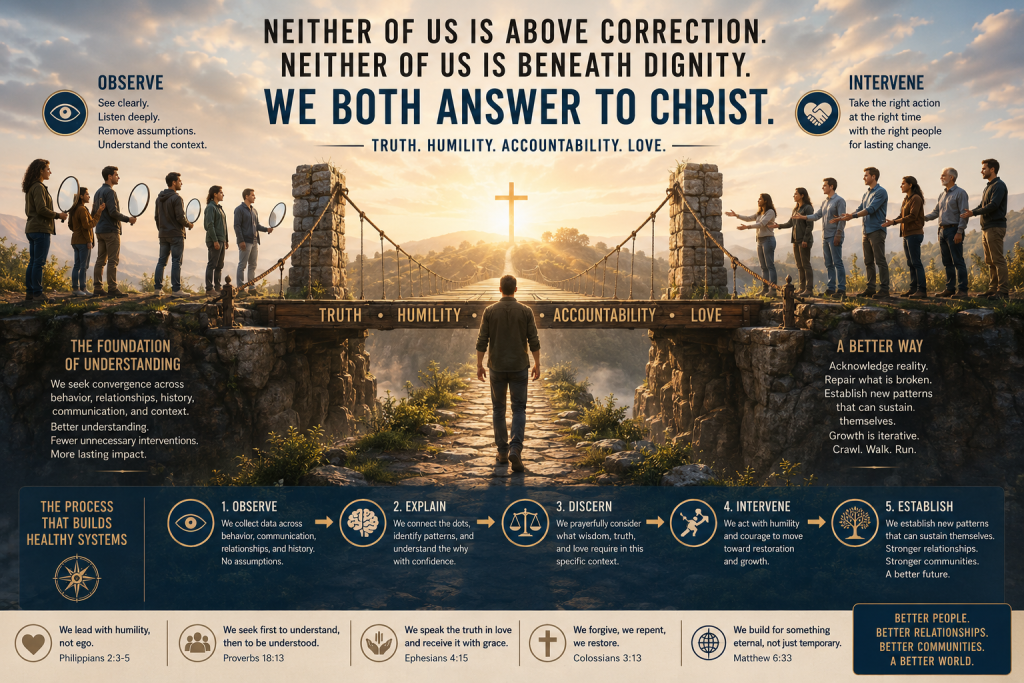
“Neither of us is above correction. Neither of us is beneath dignity. We both answer to Christ.”
It didn’t come from a boardroom.
It didn’t come from behavioral science.
It came from years of watching families, organizations, founders, communities, and even my own life struggle with the same hidden problem.
Not a lack of intelligence.
Not a lack of information.
A lack of mutual accountability.
We Are Excellent at Observing
Modern technology has made observation incredibly easy.
We can measure engagement.
Analyze conversations.
Track behavior.
Summarize thousands of interactions in seconds.
But observation is only the beginning.
The real question has always been:
What are we actually dealing with?
And even more importantly:
What should we do about it?
Most systems stop at observation.
Some venture into explanation.
Very few consistently help people discern the right intervention.
That missing layer exists everywhere.
Including our families.
Every Relationship Has an Operating System
Families develop patterns.
Organizations develop cultures.
Communities establish unwritten rules.
Sometimes those rules produce trust.
Sometimes they produce fear.
One of the most common patterns I’ve encountered is surprisingly simple.
Correction flows in only one direction.
One person gets to evaluate everyone else.
Everyone else learns not to evaluate that person.
Eventually people stop speaking honestly.
Not because they no longer care.
Because they no longer believe honesty is safe.
The result isn’t peace.
It’s silence.
Accountability Without Dignity Becomes Shame
Many people confuse accountability with criticism.
They are not the same thing.
Biblical accountability is always aimed at restoration.
Shame is aimed at identity.
One says:
“That action hurt people.”
The other says:
“This is who you are.”
The difference changes everything.
Truth without love becomes harshness.
Love without truth becomes avoidance.
The gospel refuses both extremes.
Dignity Without Accountability Becomes Enabling
The opposite error is equally dangerous.
If we never confront destructive behavior because we fear conflict, relationships slowly decay beneath the surface.
Grace was never permission to ignore reality.
Jesus consistently demonstrated both compassion and confrontation.
He welcomed sinners.
He also called them to repentance.
Healthy relationships require both.
The Missing Layer
Over years of building behavioral systems, I found that almost every meaningful intervention follows the same progression.
Observe
See reality without exaggeration.
Explain
Understand the pattern before assuming motives.
Discern
Ask what wisdom, truth, and love require in this specific situation.
Intervene
Take the smallest action most likely to restore health.
Only after understanding comes meaningful action.
That principle applies whether you’re leading a family, a startup, a community, or a nation.
Restoration Is Built on Reciprocity
The healthiest relationships I’ve experienced all share one characteristic.
Correction travels both directions.
Parents can correct adult children.
Adult children can respectfully challenge parents.
Leaders receive feedback from those they lead.
Founders welcome disagreement.
Husbands and wives remain teachable.
Nobody is exempt.
Because nobody has arrived.
That doesn’t eliminate authority.
It transforms how authority is exercised.
Leadership becomes stewardship rather than control.
The Standard I Want to Live By
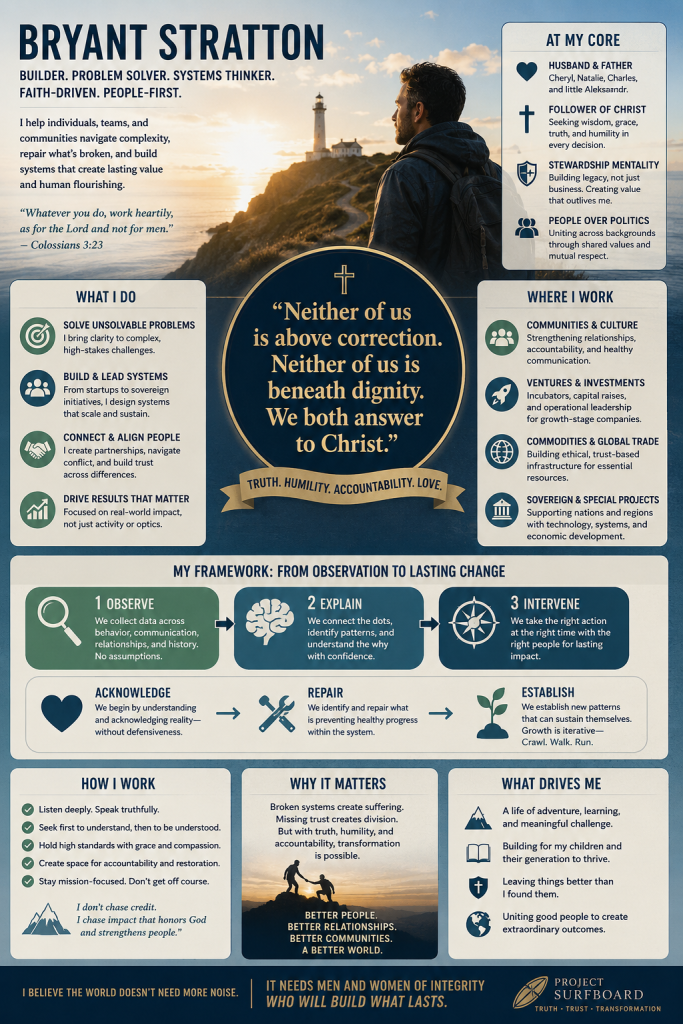
I’ve spent years studying dysfunctional systems.
I’ve spent even more years discovering my own blind spots.
I’ve learned that the greatest danger isn’t simply being wrong.
It’s becoming the kind of person who cannot imagine being wrong.
That realization has reshaped how I approach every relationship.
Whether I’m working with families, founders, governments, or communities, my goal isn’t to win arguments.
It’s to build environments where truth can move freely because dignity is never lost.
That is the culture I want my children to inherit.
That is the culture I hope to help organizations create.
That is the kind of leadership I believe Christ modeled.
So if I could summarize my work into one sentence, it would be this:
Neither of us is above correction. Neither of us is beneath dignity. We both answer to Christ.
Everything else is simply learning how to live that out, one conversation at a time.
Discover more from Bryant Stratton
Subscribe to get the latest posts sent to your email.