by Bryant Stratton
We all think culture begins with strategy.
With incentives.
With structure.
But the longer I study how humans actually move, the more I see that real social design begins someplace far simpler:
With safety.
With patience.
With the slow turning of something bigger than us.
I was reminded of this twice in my life — once by someone’s story about being in the desert at Burning Man, and once years ago when I wrote a small parable called
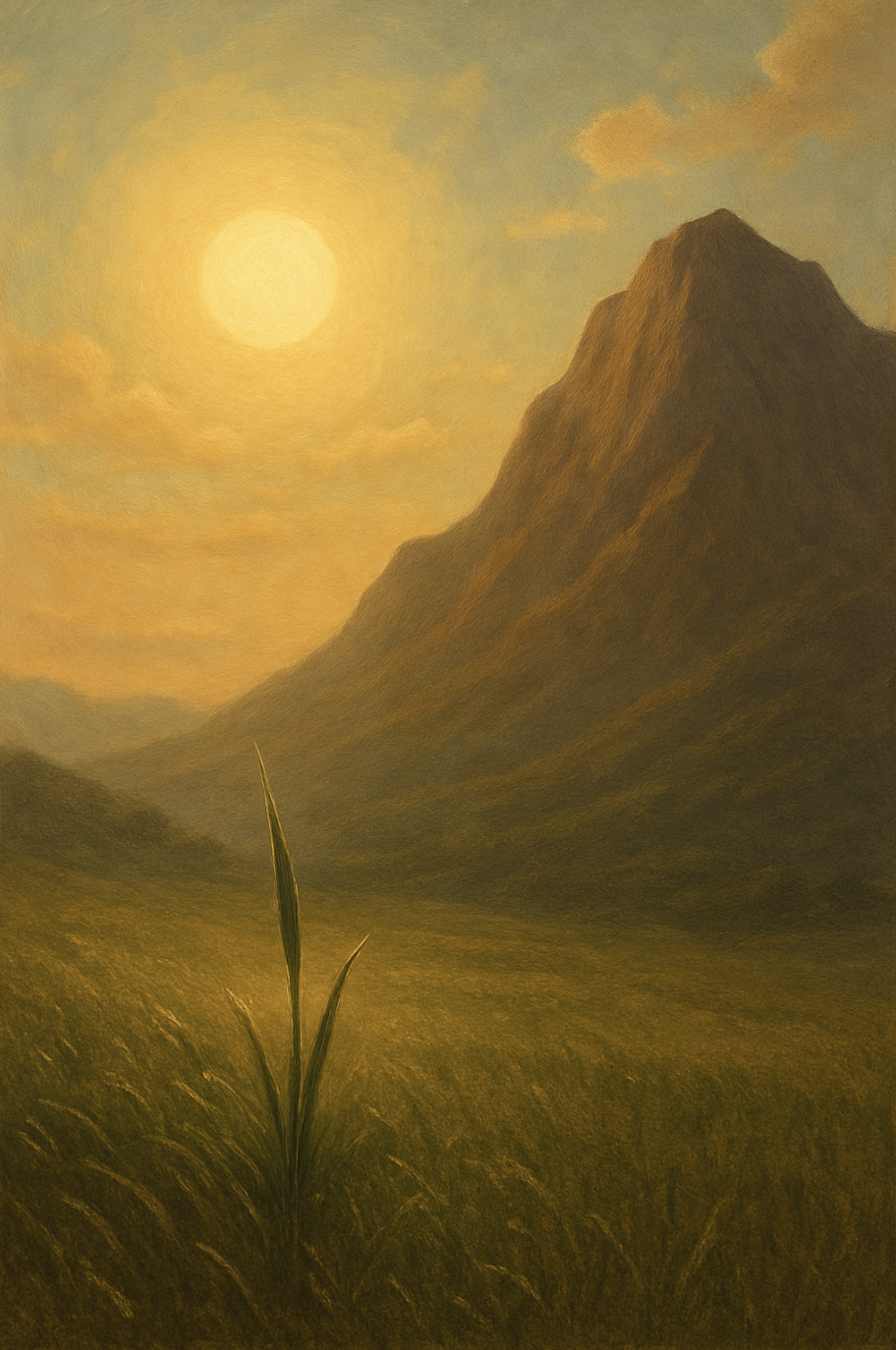
“The Sun, the Mountain, and the Blade of Grass.”
Both moments taught the same lesson.
The Jacket in the Desert
I will tell this story as I heard it…
One night at Burning Man, the desert temperature dropped fast.
I was with a friend from Israel. The wind cut through the fabric of our clothes like knives.
Nearby stood a man wearing a massive coat.
I walked up and said,
“I’m cold. May I wear your jacket for a little while?”
The stranger smiled — not with pity, but with relief — and said:
“Oh thank heaven!
I’ve been wondering where I might hang my jacket.”
Those words have stayed with me ever since.
There, in one sentence, was the entire blueprint for human systems:
- One man needed warmth.
- One man needed somewhere to give.
- Both needs met in a single moment of truth.
The man who was cold found safety.
The man with the jacket found purpose.
And those of us watching saw something eternal:
Human relationships move when truth meets generosity.
Safety creates belonging.
Belonging creates expression.
Expression creates value.
That’s the entire architecture of culture — in one jacket, on one cold night, in the middle of a desert.
The Mountain and the Blade of Grass
Years before that, I wrote a simple story:
Now it has a new meaning!
A blade of grass complained about the mountain’s shadow.
The mountain felt helpless — too large to move, too heavy to change.
Both wanted sunlight but neither knew how to shift.
It wasn’t until the sun spoke that the truth emerged:
“With patience I will move, as with all things.
You will each have your chance.”
I didn’t realize it at the time, but that parable was about safety and expression too.
Because the blade of grass wasn’t really asking the mountain to move.
It was asking: “Is there a place for me in this world?”
And the mountain wasn’t refusing out of stubbornness.
It was saying: “If I move too fast, I fall apart.”
This is all of us.
We grow in each other’s shadows.
We confuse size with power, stillness with stubbornness, fragility with weakness.
And we forget that the sun — time, patience, trust — eventually moves things we cannot move ourselves.
The Core of Social Design: Safety First, Expression Second
When I put these two stories together, something became clear:
We do not express ourselves until the world feels safe enough to hold our expression.
The grass needed sunlight.
The cold man needed warmth.
And all of us, in our own ways, need the same thing:
- A place where we can be honest.
- A place where we can grow.
- A place where our needs aren’t burdens.
- A place where our gifts aren’t wasted.
This is what all real culture is built on.
Not hype.
Not speed.
Not crushing outcomes.
Safety.
Once safety is present, people begin searching for where they fit:
Where they can contribute.
Where their gifts align with someone else’s needs.
Where their warmth has somewhere to go.
This is mutual interest.
And mutual interest, when safe, becomes expression.
Expression becomes innovation.
Innovation becomes culture.
Culture becomes covenant.
The Secret Pattern They Both Reveal
In both stories, the same truth sits underneath:
Nobody moves until they are safe.
Nobody expresses until they feel seen.
Nobody grows until the sun shifts.
And nobody gives until someone tells the truth about what they need.
When the cold man said, “I am cold,”
the jacket was offered.
When the blade said, “I need sunlight,”
the sun answered.
And in each case —
the world moved.
Not through force.
Not through convincing.
Not through pressure.
But through honest expression met by willing generosity.
That is the entire mechanism of social design.
That is the backbone of every covenant.
That is how the world turns.
The Point That Moves the World
The Burning Man story and the mountain story are the same lesson expressed two different ways:
The world shifts when truth is spoken into a place where generosity is waiting.
This is the fulcrum.
This is the “point to move the world on.”
Humans do not move because we are pushed.
We move because we are met.
When a person feels safe, they tell the truth.
When they tell the truth, the right person always steps forward.
When the right person steps forward, the world reconfigures around that moment.
This pattern — safety → truth → generosity → expression —
is how tribes form, companies form, movements form, and legacies form.
It’s how you build cultures that last.
It’s how custodial networks begin.
It’s why Finders Guild works.
It’s why covenant beats contract.
It’s why generosity beats hype.
It’s why the sun always moves.
We don’t need to force mountains to shift.
We just need to create places where blades of grass can speak,
places where jackets can be given,
and places where the sun has room to turn.
Because once safety exists,
people will always grow toward the light.
And that’s when the world starts moving.