Nietzsche, Reason, and the Hijacking of Attention
Authored with Bryant Stratton and Arnon Daniel Katz
Most people think their problem is lack of information.
It usually is not.
The deeper problem is that attention gets captured before thought ever becomes clear. A person says he is “thinking,” but often he is defending a wound, protecting status, rehearsing resentment, or rationalizing a desire he has already chosen. The mind then arrives afterward to explain what the deeper forces already decided.
Nietzsche saw this early, and he saw it with unusual violence.
That is why he still matters.
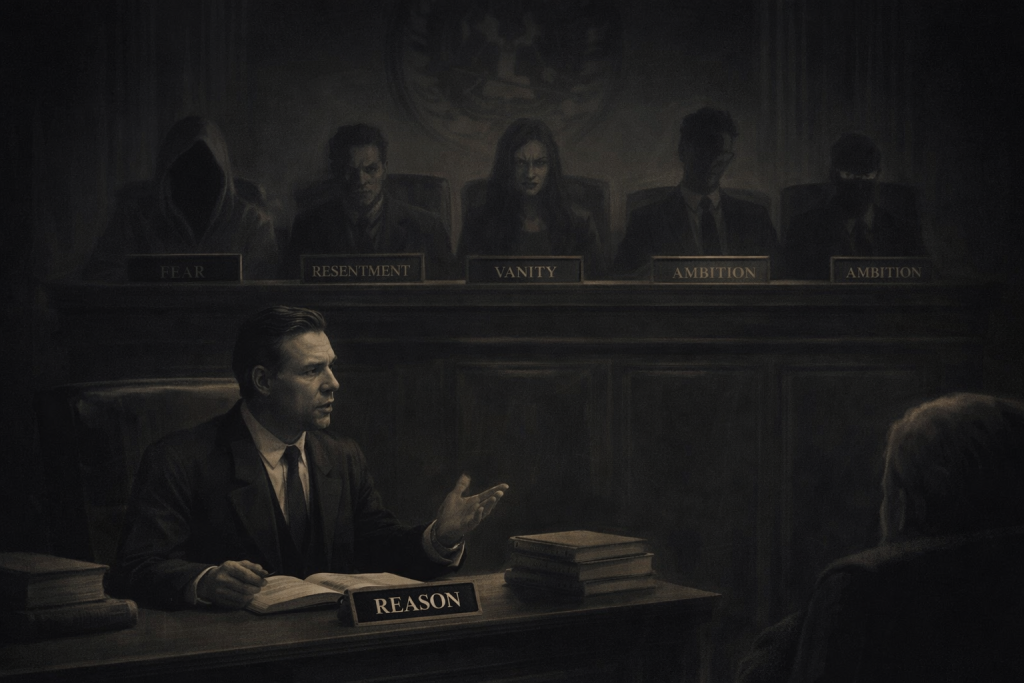
He understood that human beings do not simply look at reality and then reason neutrally from what they find. They are pulled. Their attention is directed by drives, values, fears, habits, moral training, ambition, fatigue, envy, and the need to preserve a flattering image of themselves. What they call “reason” is often not sovereign judgment at all. It is advocacy. It is spin. It is a very articulate servant.
This is where Nietzsche got very far.
He saw that attention is not innocent. It is organized.
A bitter man notices insult everywhere. A vain man notices slights and applause. A fearful man notices danger. A resentful culture notices guilt, rank, power, and enemies. A tired civilization notices comfort first and truth second. Nietzsche’s great gift was to ask, not just “Is this argument valid?” but “What kind of soul needs this argument to be true?”
That is a brutal question. It is also often the right one.

In books like Beyond Good and Evil, On the Genealogy of Morals, and The Gay Science, Nietzsche keeps returning to the same insight: beneath our conscious explanations lie deeper evaluations that already shape what we see, what we emphasize, and what we are willing to call reasonable. That is why he distrusted the fantasy of the detached thinker. He thought much of philosophy was autobiography pretending to be universal law.
And he had evidence.
Religious morality, in his view, was often not pure love of the good, but a sublimated strategy of the weak against the strong. Claims of humility could hide a will to dominate by moral accusation. Claims of objectivity could hide fear of life. Claims of pity could hide hatred of excellence. Even the will to truth itself, he argued, had to be interrogated. Why this passion for truth? What impulse does it serve? Is it courage, sickness, revenge, exhaustion, or the desire for control?
That is not nihilism. It is diagnosis.
He exposed the hijacking of attention by showing that what we notice, praise, condemn, and explain is already filtered through prior commitments. He refused to let reason pose as pure when it was often downstream of instinct. In modern language, he saw that attention gets colonized long before argument begins.
On that point, Nietzsche was ahead of a great deal of later psychology.
But here is the limit.
Nietzsche was much better at exposing corrupted reason than defending reason as a necessity.
He could show, brilliantly, that reason is often a lawyer rather than a judge. He could show that morality often hides motive. He could show that consciousness is thinner and less authoritative than people think. He could show that inherited values train attention long before explicit choice. What he could not fully do was give a stable account of why reason must rule rather than merely serve stronger forces.
That matters.
Because once you reduce reason to instrument, you create a serious problem. If reason is only a tool in the hands of deeper drives, then what prevents the strongest drive from simply recruiting thought for its own purposes? What stops intelligence from becoming sophisticated appetite? What stops style, intensity, and self-assertion from dressing themselves up as wisdom?
Nietzsche tried to answer this through ideas like rank, self-overcoming, honesty, discipline, and the creation of higher types. He admired hardness toward the self. He respected the ability to endure uncomfortable truths. He wanted human beings capable of shaping themselves rather than merely inheriting moral scripts. All of that is serious.
But it is not the same as grounding reason as a binding norm.
He never quite secures the claim that reason ought to govern the soul because it puts us into better contact with reality. He never fully rebuilds the authority of disciplined judgment after demolishing its false versions. He leaves you with an X-ray machine, not a constitution.
That is why Nietzsche is so useful, and so dangerous.
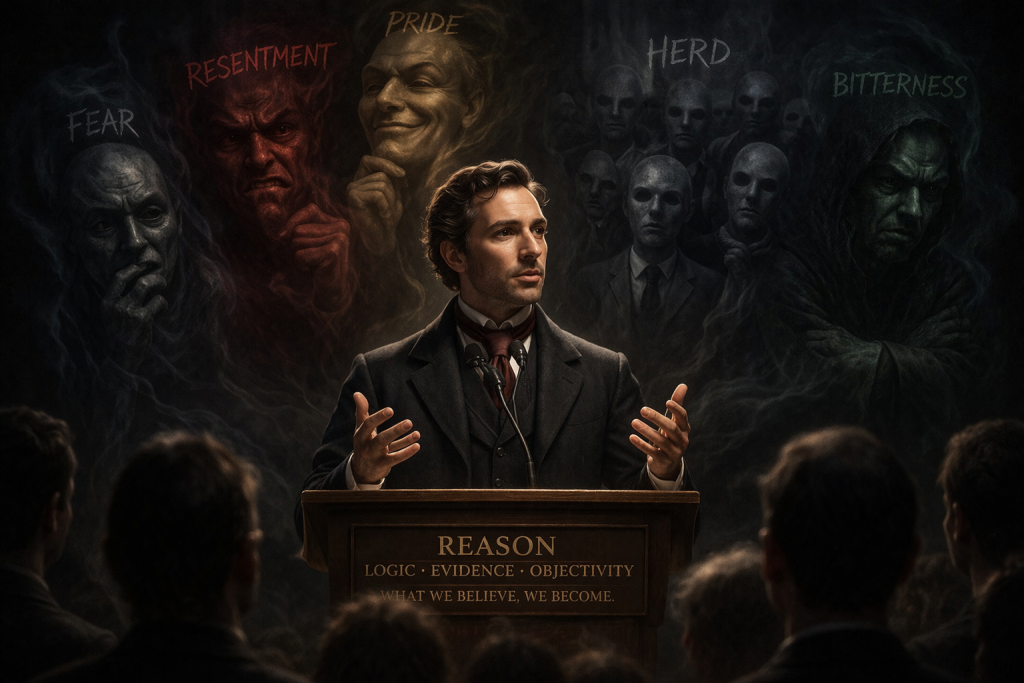
He is useful because he teaches suspicion toward counterfeit rationality. He trains you to ask what hidden valuation is steering the mind. He makes you notice that resentment can think, vanity can think, fear can think, and all of them can sound intelligent while doing it. He teaches you not to trust the first noble explanation a person gives for his beliefs, including your own.
But he is dangerous if you mistake diagnosis for destination.
If you stop with Nietzsche, you may become very skilled at unmasking everyone and unable to justify anything. You may learn how attention is hijacked without establishing a standard by which hijacking should be resisted. You may become powerful at critique and weak at obedience to reality.
That is the gap.
A stronger position would say this: yes, Nietzsche is right that attention is pre-rationally shaped. Yes, reason is often post hoc. Yes, values direct perception. But that is exactly why reason is necessary. Not because it is naturally sovereign, but because without disciplined reasoning, attention remains captive to whatever force currently owns it.
In other words, reason is not unnecessary because it gets corrupted. It is necessary because corruption is normal.
That is the move Nietzsche does not fully complete.
He gets you to the battlefield. He shows you the ambush points. He shows you that many things wearing the clothes of truth are really ambition, ressentiment, herd instinct, or fatigue. But he does not fully give you a legitimate ruler who can reorganize attention under a stable standard of reality, coherence, and consequence.
So how far did Nietzsche get?
Far enough to destroy the naive belief that humans reason cleanly.
Far enough to show that attention is moral, psychological, and historical before it is logical.
Far enough to expose that much of what passes for thought is self-protection with vocabulary.
Not far enough to firmly ground reason as the rightful governor rather than a highly refined servant.
That is why he remains essential reading, but not sufficient guidance.
Use Nietzsche to identify capture.
Do not use him as your final court of appeal.
The practical lesson is severe and simple. When you think, ask:
What in me wants this to be true?
What wound, appetite, fear, or status need is directing my attention?
What am I not noticing because another value already owns my sight?
Where am I calling something “rational” that is really self-defense?
And once that is exposed, what disciplined method will bring me back under reality instead of leaving me in suspicion forever?
That last question is where Nietzsche leaves off.
It is also where serious thought begins.
Takeaways
The simplest and most robust reading is that Nietzsche was diagnostic before he was constitutional. He was excellent at revealing how attention gets captured and how reason gets recruited by deeper forces. He was weaker at giving a stable account of why reason must govern attention rather than merely interpret its distortions.
Discover more from Bryant Stratton
Subscribe to get the latest posts sent to your email.