
A young king once found a candle burning on the floor of a room he had never entered before.
It was strange because it was his palace, or at least people had started telling him it was his palace. The crown had only been on his head for a few days, and everything around him still felt borrowed. The stone halls, the polished doors, the heavy tables where men spoke as if they already knew the future, all of it seemed to belong to someone older, someone more certain, someone who had not yet realized how easy it was to be surrounded by power and still not know where to stand.
The candle was small.
That was the first thing he noticed.
It was not the kind of flame people write songs about. It did not roar. It did not command the room. It simply burned there on the stone floor, quietly, almost stubbornly, with wax spilling out around it because no one had given it a holder. The flame was bright enough to make the room feel alive, but the wax was spreading into the cracks as if the candle had been trying to say something for a long time and no one had known how to receive it.
The king knelt down.
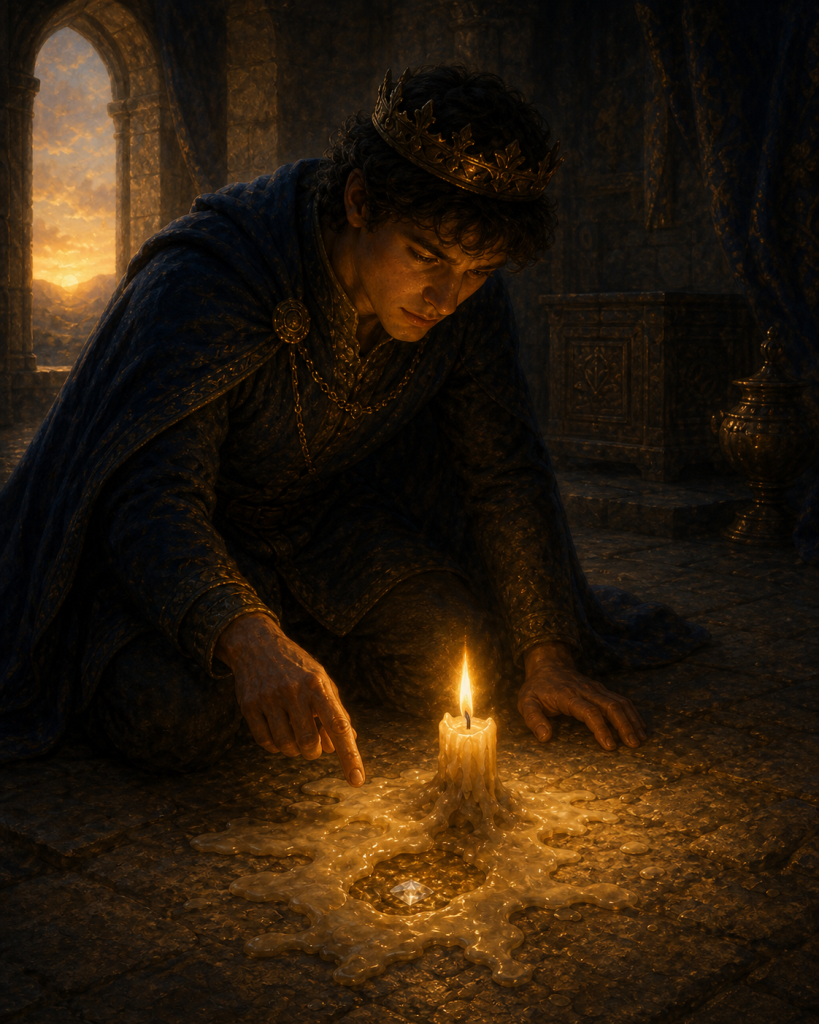
For a moment, he thought the problem was the candle.
Maybe it was burning in the wrong place. Maybe it was too exposed. Maybe it should not have been lit yet. Maybe it was wasteful to keep burning when no one was watching. He reached for it, and the wax ran over his fingers. It burned him, but he did not pull away right away, because he was still young enough to think that pain meant importance.
That may be where many of us begin.
Something in us burns before we understand what it is for. It comes out as speech for one person, silence for another. One person has to talk until the shape appears. Another has to walk for miles. Another has to build a rough version with their hands. Another has to sit quietly and let the noise settle. Another has to pray. Another has to clean the garage, drive through the night, draw a map, call a friend, write a page, or keep touching the same question until the question finally changes.
From the outside, these all look different.
Underneath, it may be the same thing.
We are trying to find our place again.
Something has moved inside us, and now the world has to be measured again around that movement. We are not only trying to express ourselves. We are trying to find right relation. Right relation to the fire. Right relation to the room. Right relation to the people around us. Right relation to the work in front of us. Right relation to God, consequence, love, responsibility, and the strange feeling that something new has already happened before we fully know what it means.
The young king did not know that yet.
He only knew that the candle was burning, and that it bothered him that no one had noticed.
So he picked it up and carried it into the first room.
Inside, his advisors were standing around a great map. They were drawing lines over villages they had never visited and rivers they had never crossed. They spoke with confidence, which is not the same as wisdom, but often wears the same clothes. They discussed taxes, roads, soldiers, borders, grain, bridges, and alliances. Every few moments one of them would move a stone marker across the map as if moving a life were that simple.
The king held the candle up.
No one looked.
He moved closer.
Still, no one looked.
The wax dripped onto the table, and one advisor brushed it away as if it were an inconvenience. The king felt anger rise in him, though he would not have called it anger. He would have called it clarity. He would have told himself that these men were blind, that they could not see what mattered, that they were so busy managing the kingdom that they had missed the living flame right in front of them.
But something quieter was also true.
He had not told them what kind of moment they were in.
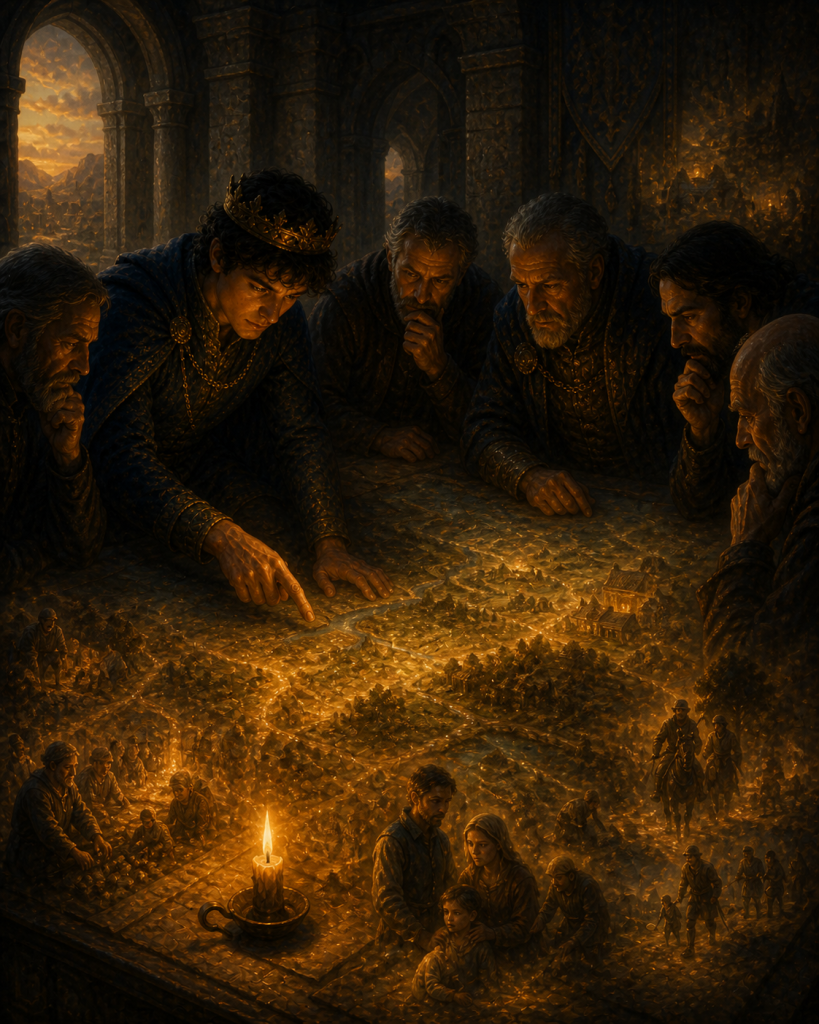
He had brought an unfinished fire into a room of finished plans and expected the room to know what to do with it. He wanted them to recognize the light without ever saying whether he was asking them to listen, decide, help, witness, build, challenge, or simply make room.
That is where so much pain begins.
Not because people are always cruel. Not because the fire is wrong. But because the room does not know what stage the fire is in.
Some people hear an unfinished thought and treat it like a final claim. Some see a first attempt and judge it like a finished work. Some feel the heat and assume danger. Some see the brightness and want to turn it into a performance before anyone has asked what it is for. Some want the candle put out because they do not want the room revealed. Some want to gather around it because they want warmth without responsibility.
The king left the room angry, carrying the candle badly.
In the next room, he found the singers.
They noticed the flame immediately.
This felt better.
They turned toward him as if he had brought the sun in his hand. They praised its brightness. They sang about its beauty. They told him no king had ever carried such a fire. The dancers began to circle him, and the light moved across their faces until he could no longer tell whether they loved the candle, loved him, loved the way they looked near the candle, or simply loved being near anything that made the room feel less ordinary.
For a while, he liked this room more.
It is easy to like the room that notices your fire.
It is easy to mistake attention for understanding.
But after a while, he saw that the candle was not being held there either. It was being consumed. The singers kept asking for more light. The dancers kept moving closer. The king kept lifting the candle higher, not because it needed to be higher, but because the room had taught him that higher meant more loved.
His arm began to ache.
The flame flickered.
The wax ran faster.
That was when he saw the danger. A fire can be ignored and wasted on the floor, but it can also be praised until it becomes a black hole. It can pull every eye toward itself. It can make one person, one idea, one wound, one dream, one relationship, one mission, or one audience so heavy with meaning that everything else begins to orbit around it. And because everyone is staring, it can feel like purpose, even when nothing real is being built.
The king left that room too.
This time he was not angry.
He was tired.
Near the back of the palace, in a room no one important seemed to enter, he found an old woman sweeping wax from the floor.
She did not bow.
She did not seem impressed by the crown or the candle or the fact that the young king was trying very hard to look like a man who understood his own life.
She looked at his burned hand.
Then she looked at the flame.
Then she looked at the wax running down the side.
“You are carrying it wrong,” she said.
The king almost laughed. “And how should a king carry fire?”
“The same way anyone else does,” she said. “With something under it.”
She reached up to a shelf and pulled down a plain iron holder.
There was nothing impressive about it. No jewels. No crest. No prophecy carved into its side. It was simple and old and strong enough to do the job. She set it on the table between them.
The king hesitated.
Part of him did not want the answer to be that ordinary.
That is also part of the problem.
We go searching for deserts, monuments, audiences, distant treasure, and some grand explanation for why the fire has been burning through our hands, and sometimes the first answer is much closer. It is not glamorous. It is a holder. A schedule. A boundary. A better room. A clearer agreement. A more honest sentence. A way of saying, “This is not finished yet,” before handing someone the thought as if they should already know what to do with it.
The king placed the candle in the holder.
Nothing dramatic happened.
That was the drama of it.
The flame did not become larger. It became steadier. The wax stopped spilling everywhere. The room did not become magical. No hidden choir began to sing. But the fire finally looked like it belonged somewhere.
The old woman went back to sweeping.
The king stared at the candle.
“What is this fire for?” he asked.
She kept sweeping.
“That depends where you place it.”
The answer irritated him because it gave him responsibility instead of certainty.
So of course, he left the palace and walked into the desert.
Most young kings do.
At the edge of the city, he met a traveler with a cracked leather bag and a face that looked like it had learned to stop being impressed by almost everything. The traveler looked at the candle in the plain iron holder and smiled as if he had seen this mistake before.
“You are going far away to find something close,” he said.
The king frowned. “You do not know where I am going.”
“That is how I know,” the traveler said.
The king did not like him, which often means the person has arrived at the right time.
“I am looking for treasure,” the king said.
The traveler looked down at the dust beneath their feet.
“You were standing on it.”
The king looked down too.
There was only dirt.
The traveler laughed softly.
“Most people expect diamonds to announce themselves. They do not expect them to be buried under the ground they keep stepping over.”
The king wanted to believe him.
But the desert was wide, and the horizon had a way of making faraway things feel more important than nearby things.
So he walked.

For many days, he carried the candle through open sand. At night, it gave him comfort. In the morning, it felt like a question. He met builders, merchants, poets, soldiers, and men who had spent their whole lives carving their names into stone so strangers would be forced to pronounce them after they were dead.
Some had bright fires.
Some had almost none.
Some had turned their fire into work that fed people. Some had turned it into noise. Some had hidden it because someone once mocked the flame when it was small. Some had demanded that others gather around it forever. Some had burned down their own homes and called the ash freedom.
The king watched all of them.
Slowly, he began to see that the question was not whether someone had fire.
Many people had fire.
The question was whether the fire had found its place in reality.
Could it warm without consuming? Could it reveal without humiliating? Could it guide without controlling? Could it help someone else see without needing to be praised for shining? Could it become a field, something people could move through and add to, instead of a center that demanded everyone orbit around it?
One evening, the king found the ruins of a monument in the sand.
Only two great legs remained, cracked and half-buried, standing above the desert as if they were still waiting for a body that would never return. Around them lay broken stones, fragments of a face, and a shattered hand that had once pointed outward toward some empire no one remembered clearly anymore.
The king held the candle up.
A voice came from behind the stones.
“I was going to build it higher.”
An old man sat in the shadow of the ruin, wrapped in cloth that may once have been royal. His eyes were tired, but not weak. They had the terrible calm of someone who had already met the consequence of his own greatness.
“Who are you?” the young king asked.
The old man smiled.
“I was almost remembered.”
The young king looked at the broken monument again.
Then he understood, or nearly understood, which is sometimes enough. This old man was not exactly him. But he was close enough to be dangerous.
“What happened?” the king asked.
The old man looked at the candle.
“I had a fire too.”
The wind moved through the broken stones.
“At first, I only wanted to use it to see. Then I wanted others to see what I saw. Then I wanted them to see me seeing it. Then I wanted the whole kingdom built around the evidence that I had seen something. After that, everything became material. People became material. Love became material. Time became material. Even God became material for the monument.”
The young king said nothing.
The old man pointed toward the ruin.
“That is what happens when the fire never finds its proper place. It keeps asking the world to become its holder.”
The king looked at his own candle.
The flame was small against the desert, but it no longer seemed weak.
“What should I do?” he asked.
The old man laughed, but not unkindly.
“You are still asking like a man who wants a command instead of a responsibility.”
The king hated that answer because it was true.
The old man leaned back against the stone.
“Go home. Look under the wax. Stop looking for a larger desert when the first treasure is buried in the room you avoided. Build holders before monuments. Choose rooms that know what stage the fire is in. And when they do not know, tell them.”
By morning, the old man was gone.
Maybe he had been real.
Maybe he had been a warning.
Maybe he had been the part of the young king that had not yet hardened into history.
The king turned back toward the city.
The walk home was slower. Not because the road had changed, but because he had. When he reached the palace, no one cheered. The advisors were still arguing over maps. The singers were still practicing. The old woman was still sweeping. The candle was still burning.
But now the king saw the rooms differently.
He went first to the advisors.
He placed the candle in its holder at the edge of the map, not in the center.
“I am not bringing this here so you can praise it,” he said. “And I am not bringing it here as a finished command. I am bringing it here because something needs to be seen before we decide.”
That changed the room.
Not completely.
Some men still wanted quick answers. Some wanted to control the meaning. Some wanted the candle gone because it revealed too much about the map. But at least now the king had named the moment. The fire was there to help them see, not to become the point of the meeting.
Then he went to the singers.
He placed the candle near the wall.
“This room may celebrate the fire,” he said, “but it may not feed on it.”
Some left.
That was good information.
Some stayed.
That was also good information.
Then he returned to the old woman.
She handed him the scraper before he asked.
Together, they knelt on the floor where the candle had first burned without a holder. They worked at the wax slowly, carefully, without turning the work into a speech. It took longer than the king wanted. Real things usually do.
At last, under one of the thickest places, the scraper struck something hard.
The king cleared the wax away.
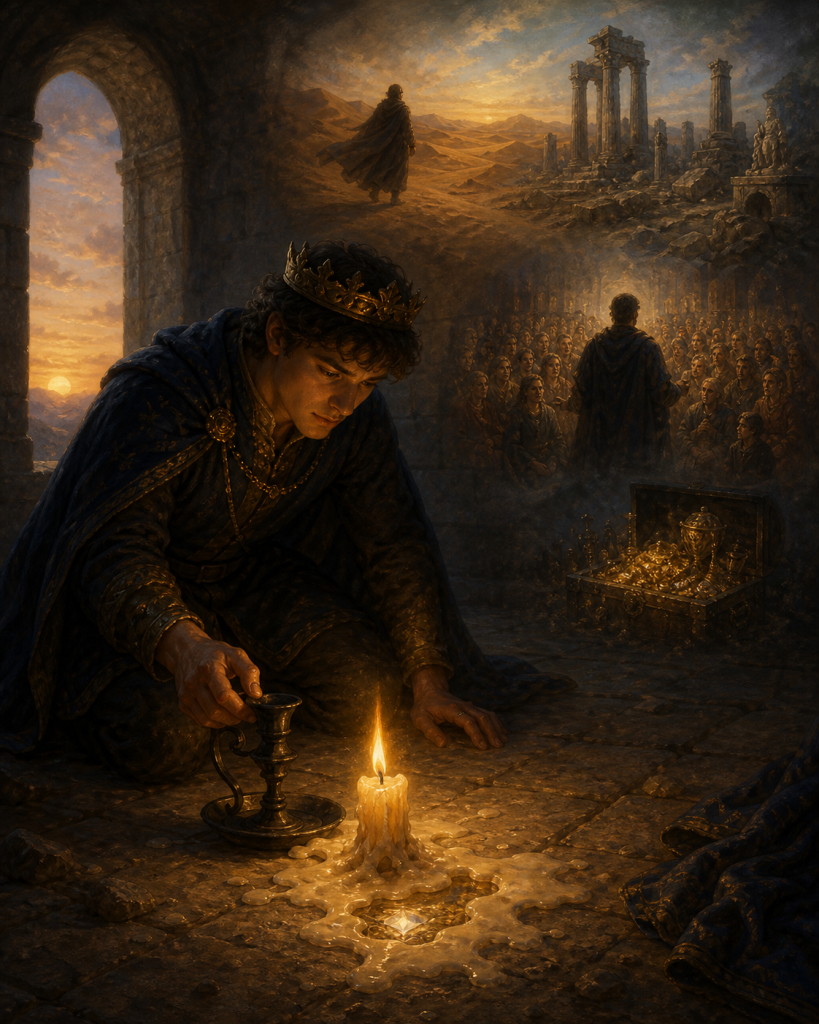
A small diamond caught the candlelight.
Not a mountain of treasure. Not a chest filled with gold. Not enough to build a monument. Just one clear stone hidden in the floor of the room where the fire had first been spilling everywhere.
The king laughed.
The old woman smiled without looking surprised.
“There is usually more underneath what we keep stepping over,” she said.
That stayed with him.
Not as a slogan. It was too alive for that. More like a small stone in the pocket, something he could touch when he was tempted to make life more dramatic than it needed to be.
And this is where I think I am seeing something more clearly in my own life.
The issue is not simply that I am a verbal processor. That is true, but it is not the deepest truth. Talking is one way I find the edge of what is real. It is one way the fog starts to organize. But someone else may draw it, build it, pray it, walk it, write it, or sit with it in silence until the shape appears. The method is not the center.
The deeper thing is orientation.
We are trying to find where the fire belongs.
That means the people around us matter. The room matters. The timing matters. The expectation matters. If the room thinks I am declaring when I am discovering, we will hurt each other. If the room thinks I am asking for agreement when I am actually asking for help finding the shape, we will create confusion. If the room thinks the first version is the final version, it will judge too early. And if I do not tell the room what kind of moment we are in, then I am asking people to hold a candle without handing them the holder.
That part is on me.
I cannot blame every room for not knowing how to receive unfinished fire. Some rooms are not built for it. Some people are not wrong, they are just not the right people for that stage. Some need a decision, not a discovery process. Some need the finished map, not the walk through the fog. Some can only listen for three minutes. Some can stay for three hours and help the whole thing become clearer without needing to own it.
That is not good or bad.
It is design.
And expectation setting may be one of the most merciful forms of design.
To say, “I am processing,” is different from saying, “I have decided.”
To say, “I need you to listen for the pattern,” is different from saying, “I need you to fix this.”
To say, “This is raw,” is different from handing someone the wax and asking why they got burned.
To say, “We are exploring,” is different from pretending the room has already agreed.
The right room does not worship the fire. It does not rush to put it out. It does not grab the candle and run away with it. It helps the fire find its place.
That may also be what feels so strange about this technology right now. It can hold a thread. It can sit with a thought long enough for the thought to become visible. It can help a verbal processor move faster because it does not get tired, offended, distracted, or afraid in the same way a person might. It can make the wax stop spreading for a moment.
But it can also make the voice too clean.
It can make the living thing sound finished before it is true. It can turn discovery into packaging. It can take the strange edges, the human pauses, the unfinished pressure, the exact place where the thought is still becoming, and smooth it into language that works but does not quite belong to me.
So even here, the fire still needs its place.
This tool cannot become the monument. It cannot become the audience. It cannot become the false treasure in the distance. It has to become part of the holder. Useful, but not ultimate. Helpful, but not sovereign. A way to see the thread, not a way to replace the hand that is holding it.
The young king did not become perfect after finding the diamond.
That would make the story less true.
Some days he still wanted the monument. Some days he wanted the singers to notice him. Some days he wanted the advisors to understand without him having to explain the stage of the thought. Some days he burned his hand again. Some days he still mistook brightness for the whole story.
But now he knew to look down.
He knew to ask where the wax was going.
He knew to ask whether the room understood the moment.
He knew that the fire was not there to prove him. It was there to help something real become visible, and then useful, and then shared.
Over time, the palace changed.
Not all at once. Not in the way people prefer when they want a story to feel clean. It changed because more candles found holders. More rooms learned the difference between discovery and decision. More people began to understand that attention is not the same as care, and praise is not the same as protection, and brightness is not the same as truth.
At dusk, small lights began appearing across the city.
A teacher lit one in a schoolroom.
A farmer lit one near a gate.
A mother lit one at a table.
A builder lit one beside unfinished stone.
A child lit one and watched the flame as if it were telling him something he would spend the rest of his life learning how to hear.
The king stood at the palace gate and saw the lights spreading, not as a monument to him, not as proof that he had mattered, but as evidence that the fire had found places where life could answer back.
And back in the first room, beneath the places where the wax had once spilled, there were still marks in the stone.
He did not remove all of them.
He needed a few to remain.
They reminded him that the fire had once been real before it had form. They reminded him that spilling was not the end of the story, but it was not the point of the story either. They reminded him that the treasure had been close, but not obvious, and that finding it required him to kneel where he had once only burned.
Maybe that is how it happens for many of us.
We begin by burning, or by noticing that something in us is already burning. Then we mistake the brightness for the whole thing. We carry it into the wrong rooms. We get angry when people do not see it, then tired when people do see it but do not know how to hold it. We search for deserts, monuments, audiences, and distant treasure, when the first work is often much closer, waiting under the wax on the floor.
Not asking us to stop burning.
Not asking us to become less alive.
Asking whether we will finally help the fire find the kind of place where it can give light to the life around it.
Discover more from Bryant Stratton
Subscribe to get the latest posts sent to your email.