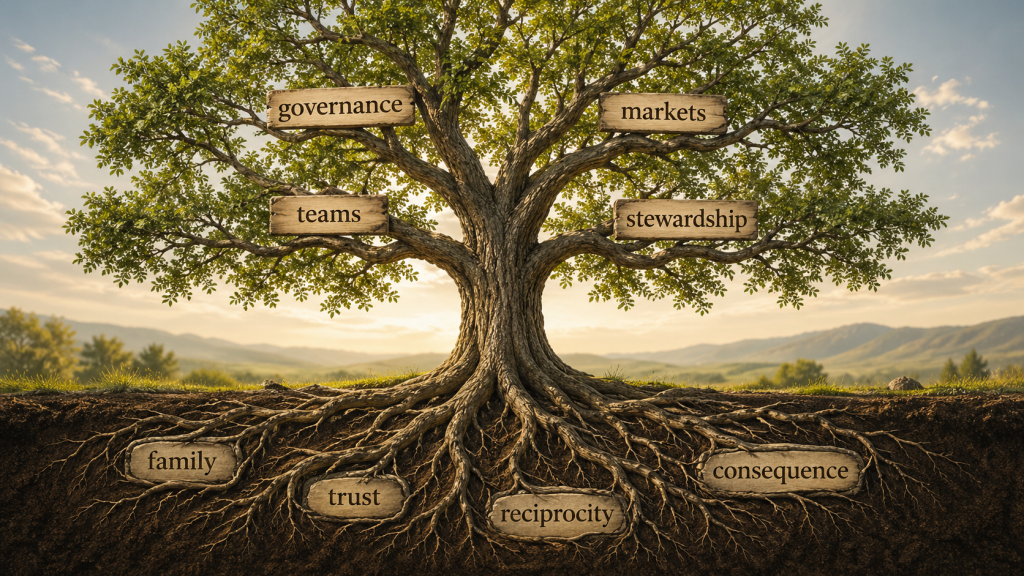
When Truth Becomes an Operating System
Confidence: 8.5/10.
There is a kind of morning where the room itself seems to be listening. A kitchen floor, a few papers, a person trying to explain something that is not yet explainable, and the strange feeling that the sentence “I am” is too small and too large at the same time. In the original “I am?” piece, that image sits near the center of the whole journey: a man on the floor five years earlier, trying to share his deepest thoughts with people close to him, believing he understood himself, only to discover that the adventure ahead would reveal how little he actually knew. The piece says that growth often arrives when it is not wanted, when life forces a choice between the nail in the coffin of the old self and the shedding of skin into something still continuous, but no longer the same. (Bryant Stratton)

That kitchen floor matters because it is not a stage. It is not a pitch room. It is not a conference. It is where philosophy stops being impressive and starts becoming expensive. It is where a person finds out whether the truths he speaks can survive misunderstanding, threatened loss, loyalty, fear, and the possibility that the people closest to him may not be able to come with him at the same speed. Later in that same article, the crisis becomes explicit: divorce had been threatened, writing became therapeutic, and the work was to remember what one stands for, to stay loyal and true even when it hurts, to respect another person’s reality, and to learn how to forgive without reacting. (Bryant Stratton)
That is the first hinge. Truth is not what a person says in peace. Truth is what remains when the nervous system has a reason to defend itself.
The second hinge appears in “When Truth Stops Being Philosophy and Turns Into an Operating System.” There, truth is no longer treated as an abstract moral category. It becomes behavioral. The article says we are entering a season where truth is no longer something people debate, perform, or claim as identity, because truth is becoming operational, visible in markets, communities, families, and emerging digital economies. Its central sentence is simple: truth does not live in beliefs anymore, it lives in behavior. (Bryant Stratton)
That sentence is the bridge between soul and system.

Subscribe to continue reading
Subscribe to get access to the rest of this post and other subscriber-only content.