An article on why many people feel muted, how near-TRUTH reframes social contracts, and why the next era will require coherence, surface-level adoption, and trustworthy idea transfer at scale.
The pattern is older than AI.
Most people do not live by first-principles understanding. They live by transferred trust. They copy what seems stable. They adopt what feels safe. They repeat what appears to work. That is not a defect in a few weak people. It is a structural fact about mass human behavior. Your own near-TRUTH work frames the crisis as one of coherence, cognitive overload, and institutional fragility in a post-industrial environment, which means the core problem is not just whether people can think deeply, but whether society can still transmit workable patterns under pressure.
This is where Joe, you’re muted becomes more than a phrase.
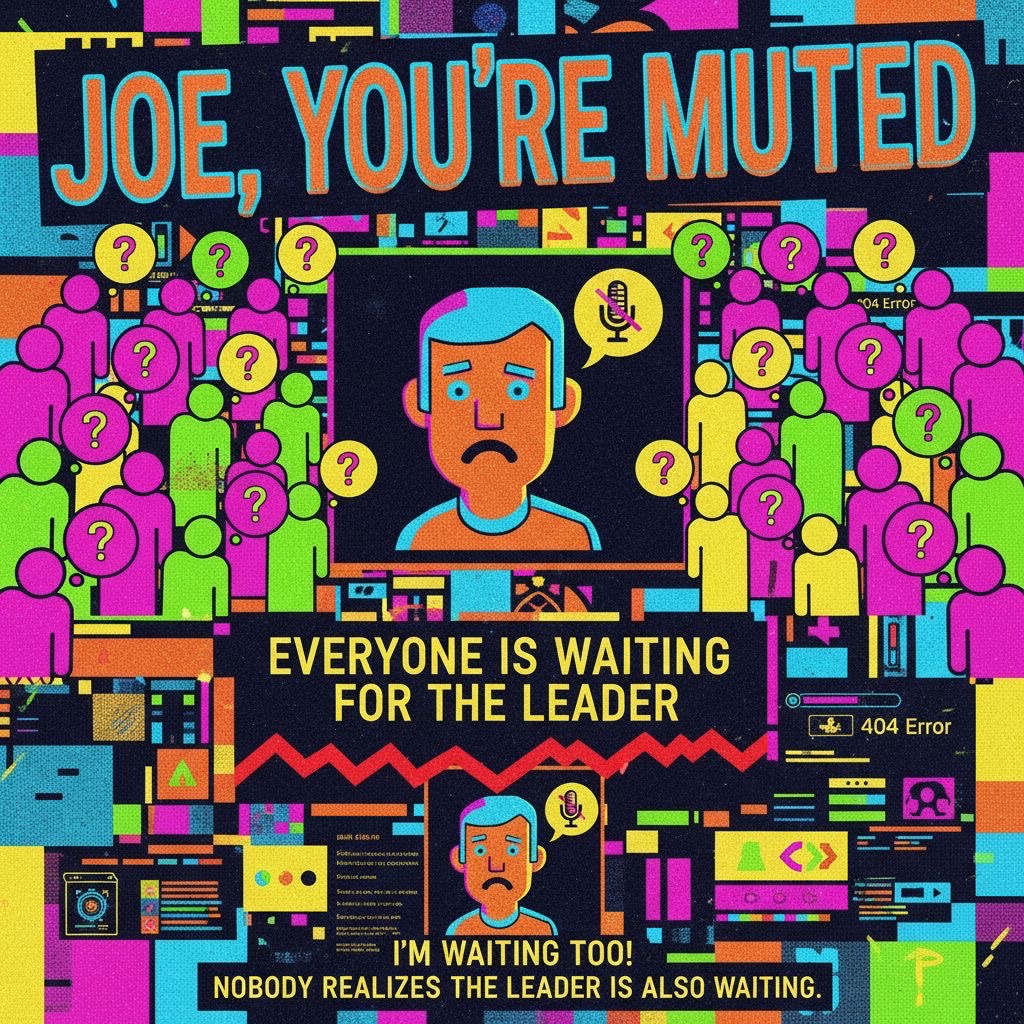


It is not only about a man who is not being heard. It is about a man who keeps creating conditions where others cannot safely receive him. He takes on too much. He speaks before the channel is ready. He confuses intensity for signal. He then softens the consequences with self-forgiveness before he fixes the structure. He is not muted by fate first. He is muted by preventable instability.
That matters because the next phase of society will punish instability harder than the last one did.
The labor market is already moving toward large-scale retraining and reskilling. The World Economic Forum’s Future of Jobs Report 2025 says 39% of key job skills are expected to change by 2030, and its 2026 reskilling work says job disruption could affect 22% of jobs by 2030, with 170 million new roles created and 92 million displaced. The OECD has also warned that current training supply may not be sufficient even for broad AI literacy, not merely elite technical specialization.
That means the fantasy that everyone will become a deep thinker is not serious.
Most people will continue to operate near the surface. They will still make an equally real and equally consequential bargain: “I will not master the whole system. I will copy what seems trustworthy in exchange for some level of security.” That is not glorious, but it is stable enough to build around. The real question is whether the patterns available for copying are coherent or corrupt.

This is where near-TRUTH becomes useful.
A functioning social contract in the next era cannot assume universal depth. It has to work for mixed populations: the few who can build from first principles, the many who learn through imitation, and the larger group who mostly absorb behavior through social osmosis. Your engineering and theory work both point toward coherence and governance as the essential problem, not abstract inspiration alone. The issue is whether behavior, incentives, and visible structure line up closely enough that people can adopt good patterns without fully understanding the machinery underneath.
That is why coherence alone is not enough.
Coherence is necessary, but not sufficient. A pattern can be internally coherent and still fail to spread. What society needs now is coherent self-replication. In plain terms, the system must be understandable enough, imitable enough, and safe-feeling enough that people at the surface level can copy it without collapsing it.
That is where “osmosis” matters.
Most adoption is not analytical. It is atmospheric. People feel the stability of a leader before they understand his framework. They feel whether a group is safe before they can explain its governance. They feel whether a pitch carries reality before they can summarize its logic. This is why bad ideas spread, and why good ideas often fail. Bad ideas are often simpler to imitate. Good ideas often demand too much cognitive load before trust has formed.
So the mute button is not only personal. It is civilizational.
When a leader is incoherent, overloaded, or emotionally unstable, others experience that as risk long before they can articulate why. They do not say, “Your pattern lacks transmissible coherence.” They simply stop trusting the channel. They mute him. They withdraw. They remain at the surface. Then the leader complains that people are shallow, when in fact he has failed to provide the felt security required for adoption.
That is the hard truth in Joe, you’re muted.
Joe may believe he is being ignored because others cannot handle depth. Sometimes that is true. But often Joe is muted because he is asking people to absorb a pattern that does not yet feel survivable. He wants others to follow signal while he is still radiating overload. He wants trust before he has made imitation safe. He wants resonance before he has built a form people can carry.

That is not persecution. That is failed transmission.
The steelman against your view is this: perhaps most people are not surface-level because of weakness, but because copying is often the most efficient adaptation strategy in complex environments. If so, then the burden shifts. The burden is on builders, leaders, and thinkers to create patterns that can be copied responsibly. Not dumbed down into lies, but compressed into forms that ordinary people can adopt without needing total comprehension.
That is where pitching becomes central.
Pitching is not merely persuasion. It is a compression technology for trust. A strong pitch transfers enough reality, enough direction, and enough emotional safety that another human can adopt the pattern before mastering the full system. In that sense, the power of pitching is the power of social replication. It is how ideas move from the coherent few to the imitative many without disintegrating on contact.
This is also why resonance matters.
Resonance is what happens when an idea is not only true enough to hold, but shaped well enough to travel. It lands in the nervous system before it lands in formal analysis. It gives people a feeling of stability, possibility, and continuity. That felt sense is not irrational noise. It is part of how humans evaluate legacy and security before language catches up.
People do not only choose ideas.
They choose felt futures.
They copy the pattern that seems most likely to preserve them, their children, their income, their dignity, or their belonging. Much of that choice happens below the level of explicit reasoning. That is why legacy work, governance work, and retraining work cannot be reduced to curriculum design. They are also architecture-of-trust problems.
So the next social contract must do three things at once.
It must remain coherent enough for serious builders.
It must remain compressible enough for ordinary adopters.
It must remain stable enough that people feel safe copying it.
Anything less will either become elitist abstraction or mass manipulation.
The practical implication is severe. The future does not mainly belong to the smartest framework. It belongs to the framework that can survive contact with normal people. A near-TRUTH system that cannot replicate through imitation will remain niche. A shallow system that replicates without integrity will spread and eventually break. The winning architecture is the one that preserves enough truth to hold under stress and enough simplicity to travel through a surface-level population.
That is the article hidden inside Joe, you’re muted.
The man who feels muted should not begin by blaming the crowd. He should ask whether he has become imitable in the right way. Whether his signal is stable enough to carry. Whether the security he wants others to feel is actually present in his behavior. Whether his life can be copied without damage.
Because in the coming retraining era, that is leadership.
Not merely seeing deeper.
Not merely saying more.
But building patterns others can safely absorb.
And that is where near-TRUTH stops being philosophy and becomes social infrastructure.
You can try this today:
Ask four questions of any idea, leader, movement, or social design:
Does it hold under pressure? If not, it is not coherent.
Can an ordinary person copy it without deep expertise? If not, it will not spread.
Does it create felt security without hiding reality? If not, people will mute it.
Does it transfer truth through behavior, not just explanation? If not, it will fail at legacy.
KISS version:
The simplest durable frame is this: most people learn by imitation, not deep analysis. So the next social contract must be coherent enough to be true, simple enough to copy, and stable enough to feel safe. “Joe, you’re muted” is what happens when a person or system fails that transmission test.
In your own life, look at which ideas actually spread in real groups. Not which ones are smartest on paper, but which ones ordinary people can absorb, repeat, and live.
Discover more from Bryant Stratton
Subscribe to get the latest posts sent to your email.