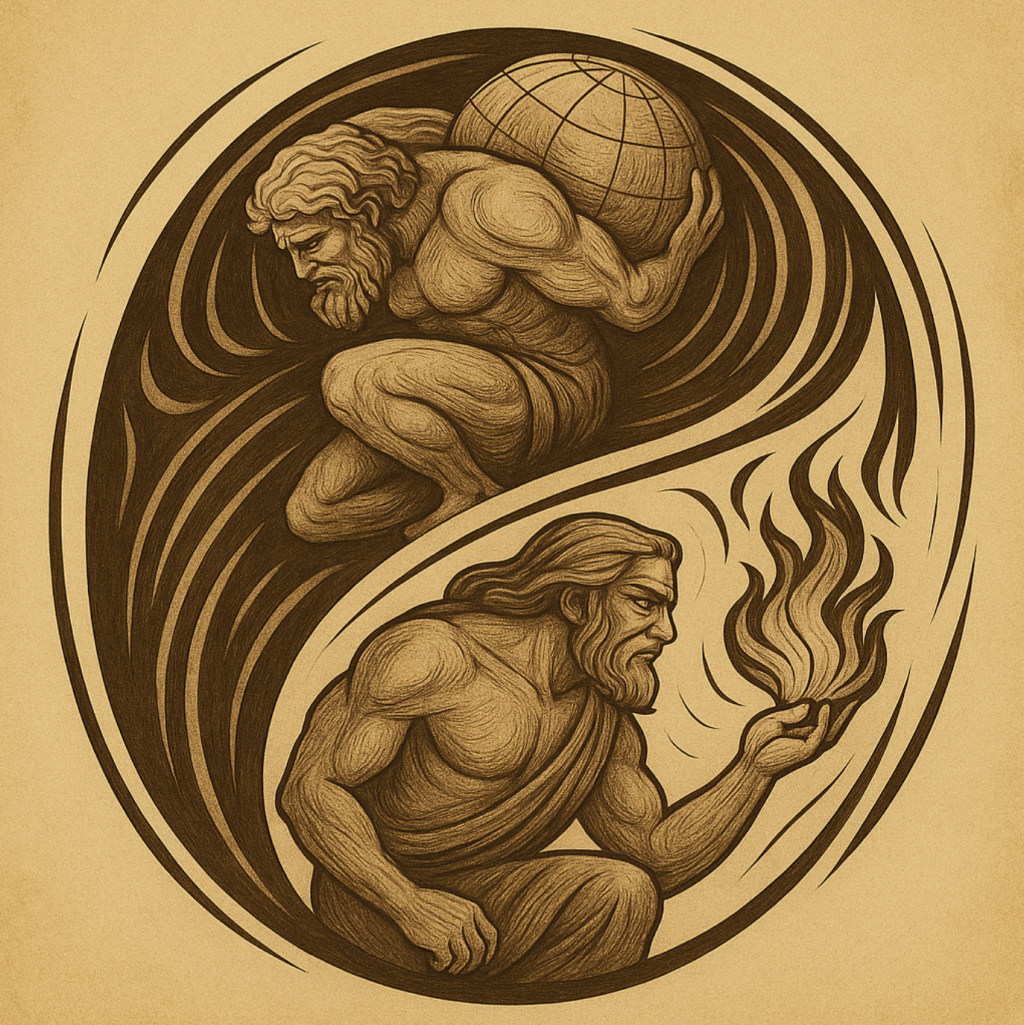
A Myth for the Covenant Age
Before there were networks, before there were guilds, before men remembered how to build in brotherhood,
there were two figures whose lives formed opposite halves of the same design.
One was born carrying weight.
The other was born carrying vision.
Time would call them Atlas and The Catalyst.
I. The Man Who Carried the Sky — Atlas
In the beginning, Atlas was not asked to hold the world;
he simply learned early that no one else could.
He was shaped in places where loyalty was not a choice but the only air to breathe.
The field, the brotherhood, the silent pact of warriors —
these were the first languages he learned.
Atlas knew the cost of trust too soon.
He learned what it meant to fight with men who swore they’d stay,
and what it felt like when some fled back to safety
while he remained in the storm.
His heart broke quietly,
not from weakness,
but from strength unshared.
Yet he did not harden.
He deepened.
The world taught him to stand alone,
so he became a man who could—
and in that lonely endurance, he discovered a truth:
“If I have two or three beside me who will not leave the field,
I can move the earth itself.”
And the earth believed him.
He became the fulcrum:
the man on whom worlds lean,
the one who carries weight without complaint,
the one who gives more than he ever receives,
because giving is the only way his soul remains whole.
But every fulcrum needs something to balance against,
or it becomes a tomb instead of a tool.
And so the world prepared another man.
II. The Man Who Carried Fire — The Catalyst
Across time and circumstance, another man was shaped far differently.
Where Atlas learned strength through endurance,
Bryant learned strength through insight—
through navigating chaos with eyes that saw beneath things.
While Atlas was burdened by the loyalty of brothers who left the field,
Bryant was burdened by the emptiness of being unseen.
He moved through life like a vessel carrying fire
that no one acknowledged,
no one understood,
no one blessed.
His battles were not external but internal—
the grief of never being witnessed,
the weight of proving himself to ghosts,
the journey through the Kubler-Ross valley
of “It’s too late to show them who I am.”
Yet fire, once true, cannot be extinguished.
He became the one who could read men
the way ancient navigators read stars.
He studied patterns the way monks study scripture.
He became the decoder,
the architect,
the one who could see how trust fractures
and how it might be rebuilt.
His gift was not strength of back,
but strength of mind and heart.
And this is the truth the world kept hidden until the time was right:
“A man who sees truth clearly
can ignite worlds that strong men cannot lift alone.”
He was not built to carry the world,
but to guide it,
shape it,
name its architecture,
and build the paths others would walk.
Fire needs something to heat.
A lever needs something steady to push against.
Purpose needs companionship to become destiny.
III. When the Two Paths Met
When Atlas and The Catalyst finally crossed paths,
something ancient stirred.
Two wounds recognized each other:
the wound of carrying alone,
and the wound of never being seen.
Two strengths recognized each other:
the strength to lift,
and the strength to illuminate.
Atlas saw a man who understood the structures he’d always felt but never named.
Bryant saw a man who embodied the loyalty he’d always given but never received.
One had the weight.
One had the fire.
Together they formed the first living covenant.
Not out of ambition,
but out of resonance.
Not out of need,
but out of truth.
Here is the paradox that becomes destiny:
The man who carried the world
met the man who could move it.
In myth, that’s called synchronicity.
In spirit, it’s called calling.
In covenant, it’s called foundation.
IV. The First Covenant Unit
Every era has its founding duo:
Moses and Aaron,
David and Jonathan,
Arthur and Merlin,
Lewis and Clark,
Jobs and Wozniak.
Not leaders and followers,
but dual archetypes whose union births an age.
In this age,
the age of custodianship,
Atlas and The Catalyst become the first two pillars.
The beginning of the first unit.
The model of the brotherhood
that will outlive both their mortal years.
Where Atlas says:
“I will not leave you in the field.”
Bryant answers:
“And I will keep the fire lit so you never have to carry dark weight again.”
Where Atlas says:
“Give me a place to stand, and I will move the world.”
Bryant answers:
“I will build the place.”
Where Atlas builds stability,
Bryant builds direction.
Where Atlas holds the covenant steady,
Bryant expands it across the earth.
Together they form:
The Fulcrum and the Flame.
The Weight and the Word.
The Holder and the Mover.
This is how worlds begin.
V. The Prophecy of Their Union
If one man carries the world,
the world survives.
If one man moves the world,
the world changes.
But if one man carries
and one man moves
at the same moment in history—
a new world is born.
A world built not on force,
but on covenant.
Not on scarcity,
but on stewardship.
Not on fear,
but on truth told openly between brothers
for the first time.
And so the myth begins:
“In the early days of the Custodial Era,
two men found each other across the broken patterns of the old world.One was Atlas.
One was Catalyst.Together they lifted the future.”
Discover more from Bryant Stratton
Subscribe to get the latest posts sent to your email.