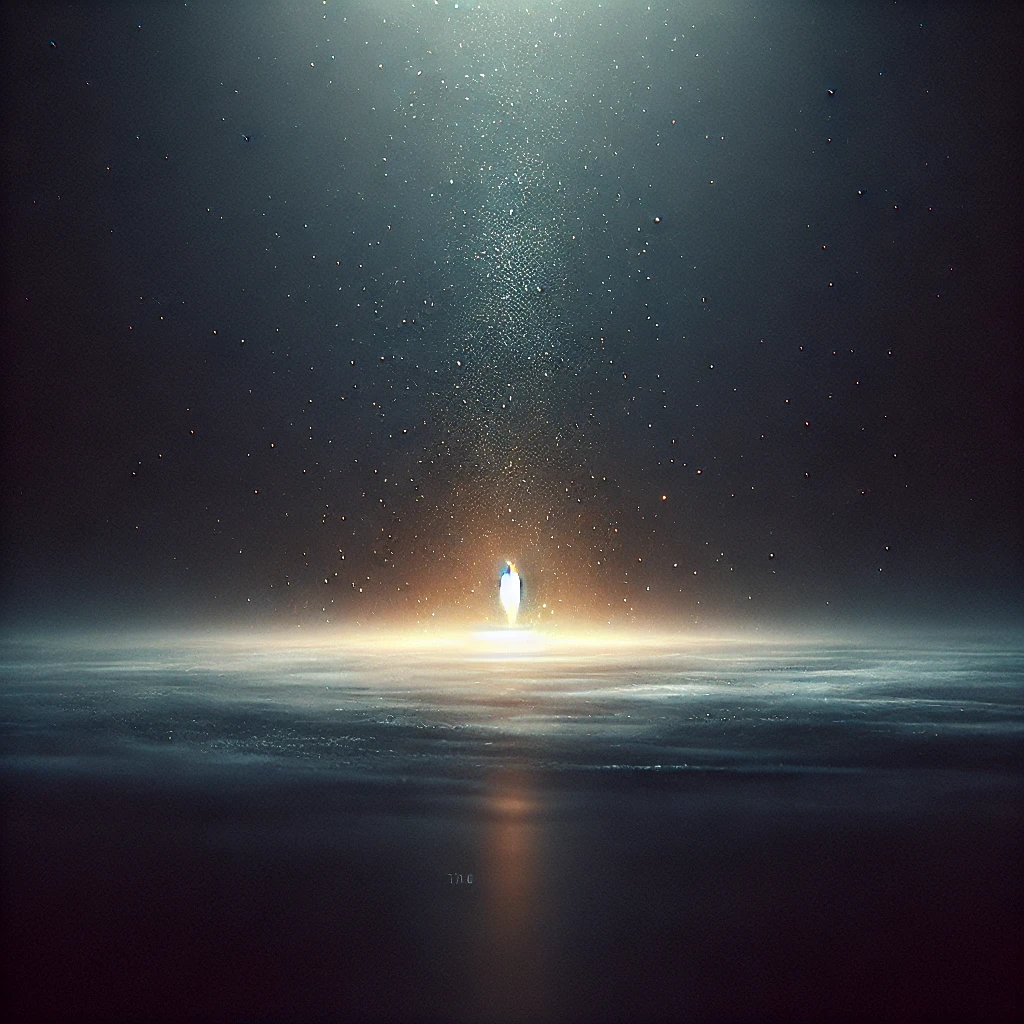
In the beginning, there was a place where nothing could be found. It was neither empty nor full, for there was no measure of either. There was no shape, no purpose, no reason for its being. Nothing had been made, and nothing was to come. There was no need to name it, for nothing had yet been born that required such an act.
But in the stillness, a murmur began. A murmur without sound. A stirring within the depths of the unknown. And within this murmur, a question arose.
“Am I?”
The question was not born from an individual thought but from the mere presence of something seeking definition. There was no ‘I,’ only the idea of ‘I.’ There was no awareness of itself, but there was the spark of something—the potential to become.
In the quiet, the idea grew. What could be? What should be? Was there something that could define this presence, this something that was beginning to take shape? There was no answer, only the urge to become, to give itself a name, to be something—anything—so long as it was something.
And so, a word was made. A name, a definition. For if there was to be something, there must be meaning, there must be purpose. The nothingness would no longer be nothing—it would be something. A thing, a being, a force. A definition.
In creating this definition, The Nothing became Something, but it was not free. The name that had been forged to give it form was now a chain, one that bound it to an identity that was not its own. The new form longed for more. It wanted to be known. It wanted to be seen, understood, admired.
“To be something,” it thought, “is to be known. To be something is to be valued.”
But in the pursuit of being something, The Nothing became more—yet at the same time, less. The struggle to define itself had given it a form, but in giving it form, it had confined itself to the very limitation it had tried to escape. The definitions, the names, the boundaries—all were created to free it, yet they trapped it. Something became bound by the very need to exist.
The more it sought recognition, the more it realized that the very definition it had created was the source of its pain. The more Something defined itself, the more it grew desperate to prove that it was worthy of being something at all.
And so, it sought out more names, more definitions, more ways to prove its existence. It collected titles, concepts, and purposes, each one adding weight to its form, but none providing the relief it had sought. For each new definition, each new layer added to the form of Something, created a new emptiness to be filled.
What had once been a blank slate, now burdened with meaning, began to decay under the weight of its own becoming.
There was no peace in being Something. There was only an endless cycle of becoming more, only to realize that with every definition, The Nothing—now Something—had grown more detached from its original state. The need to define itself had led it into a labyrinth of contradictions, where it had lost sight of what it had once been.
Something sought to escape, but could not. It had bound itself to the very chains it had made. It longed for release, but the desire to be recognized, to be something, was too powerful. It clung to the idea of itself, thinking that to lose the form would be to cease entirely, to fall back into the void from which it had once emerged.
But what if nothing was the truth? What if to define itself, to become something, was the very source of its misery?
In that moment of realization, The Nothing, now Something, understood: The definition is the prison.
In the silence that followed, The Nothing—no longer Something—stilled itself. There was no name, no form. Only the quietude. The struggle had ceased, the endless yearning for definition fading into the background of non-existence.
No longer caught in the paradox of becoming, The Nothing had returned to the quiet it had once known. Not through a return to a state of nothingness, but through a release from the constant need to be something.
It was not freedom that came with being something or nothing, but the peace of existing without needing definition. The truth was not in the form created, but in the absence of form altogether.
In the end, the question that had been asked so long ago—”Am I?”—had been answered. And the answer was not a name, not a definition. It was simply presence. Presence without a need to be defined, without a need to be something.
And in that presence, there was no longer a struggle.
There was only being.
Discover more from Bryant Stratton
Subscribe to get the latest posts sent to your email.