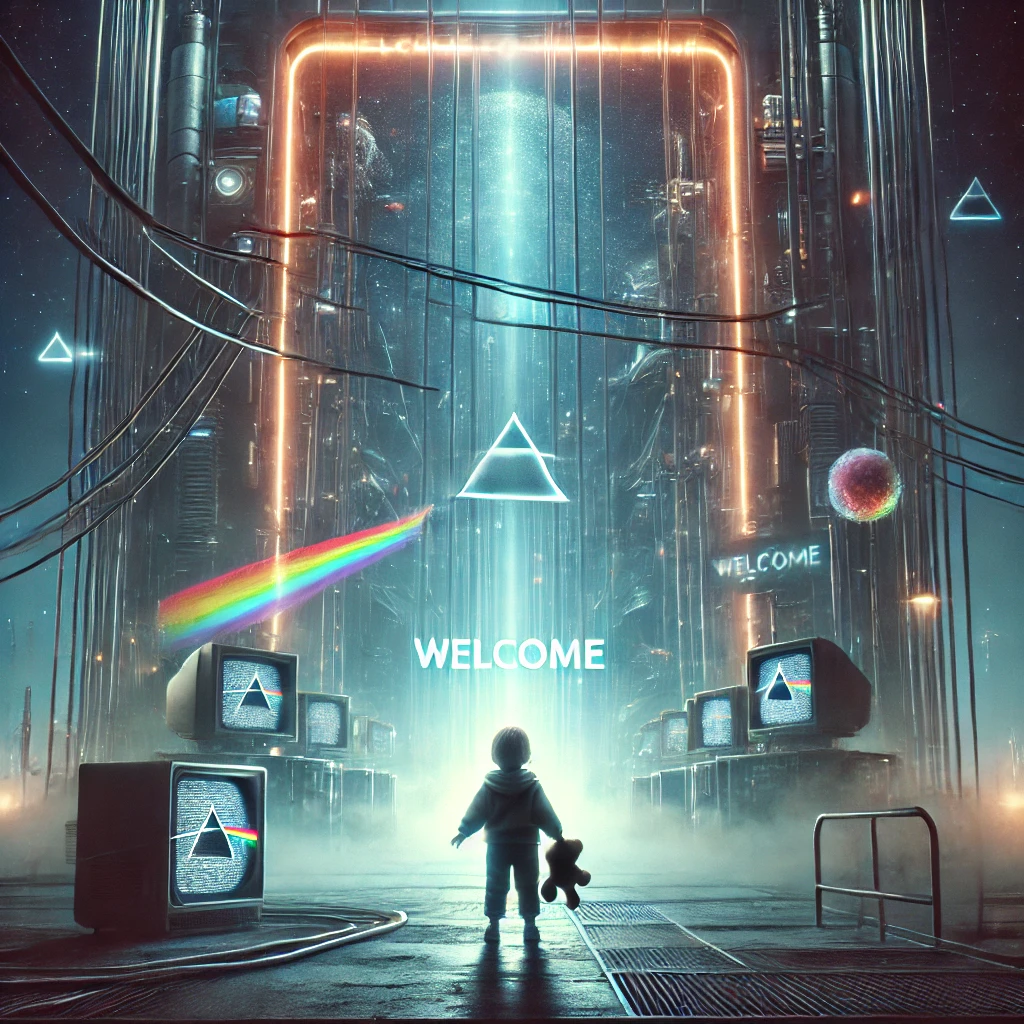
A Theory of Coherence, Awakening, and Fractal Governance for the Post-Industrial Era
Author: Bryant Stratton
Affiliation: The Stewardship Institute & The Quanternet
Date: 2025
Abstract
This paper proposes a new model of the social contract suited for the era where we head toward potential outcomes like the quantum era, where technological acceleration, cognitive overload, and institutional fragility now outpace the adaptive capacity of traditional political structures.
Quantum being define as, “a perfect coalescence of truth, integrity, and consequence, measured through behavior, amplified through learning, and revealed through the people who rise when pressure is applied.”
Drawing on classical social contract theory (Hobbes, Locke, Rousseau), cognitive anthropology (Dunbar), Nietzsche’s metamorphoses, complexity science, and modern organizational learning research, this theory introduces three foundational concepts:
- Speed-of-Learning as Legitimacy
- Fractal Coherence Governance (Self-Forking Organizations)
- The Tree-of-Life Structure for Multi-Level Societies and Funds
The core thesis is simple:
Human societies can no longer be governed by obedience, labor coordination, or centralized force.
They must now be governed by awakened custodians—individuals and institutions capable of staying coherent under pressure, adapting to complexity, and learning faster than the environments they guide.
Awakening here means the ability to confront circumstances rather than be collapsed by them, to rise above reaction into responsibility, and to maintain internal coherence in the midst of accelerating change. A society led by such custodians becomes antifragile; a society led by unawakened institutions becomes brittle.
The process of writing this paper is itself an example of the kind of self-generative learning the model demands: an act of “eating one’s own dog food” when one is also the manufacturer of the food. This signifies presence, integrity, and alignment—qualities necessary for any system seeking benevolent outcomes. Yet benevolence does not emerge by chance; it emerges only from structures explicitly designed to support it.
This paper formalizes the philosophical, structural, and operational basis for such a model and outlines how a quantum-aligned social contract can replace the collapsing assumptions of the industrial age.
If you are an engineer the following may annoy you. This link might be better (Engineering Version of the paper here)

1. Introduction
Governance is entering a crisis of relevance.
Industrial-era institutions—designed for slow information, rigid hierarchies, and mass labor—are collapsing under the weight of exponential technological change. Quantum computing, AI, globalized networks, and cultural fragmentation strain the assumptions underlying the social contract.
From Hobbes to Rousseau, political legitimacy was grounded in:
- security (Hobbes)
- property rights (Locke)
- collective will and participation (Rousseau)
All three assumed that:
- the purpose of society was labor coordination,
- stability was more important than self-awareness,
- and the few would always set the cadence for the many.
This contract, while functional for its time, is insufficient for the near-term, much less the quantum era.
The next societal transformation must be grounded not in obedience or production, but in awakening, learning, and coherence.
This paper outlines a new formal contract that aligns with human nature, technological acceleration, and long-term global stewardship.
Historical grounding in the social contract: (Hobbes, 1651; Locke, 1689; Rousseau, 1762), Failure of industrial-era institutions: (Meadows, 2008; Senge, 1990; Fukuyama, 2014), Complexity and acceleration pressures: (Holland, 1995; Bar-Yam, 1997; Taleb, 2012), Context of quantum-era risks: (EC Quantum Flagship, 2021; NIST, 2023)

2. The Limits of the Classical Social Contract
Classical theorists assumed that:
- People are dangerous without structure (Hobbes).
- People need property and rights to flourish (Locke).
- People will cooperate if protected from inequality (Rousseau).
These assumptions optimized for:
- predictable behavior,
- obedience,
- productive labor,
- centralized authority,
- and slow-changing institutions.
But modern society does not fail at obedience or labor.
It fails at:
- learning,
- meaning,
- alignment,
- coherence,
- and spiritual-security.
The classical contract is a mechanical contract.
The quantum era requires a living contract.
Hobbes’ security theory: (Hobbes, 1651), Locke’s rights & property model: (Locke, 1689), Rousseau’s general will: (Rousseau, 1762), Rawls’ fairness: (Rawls, 1971), Industrial-age assumptions about obedience and labor: (Diamond, 1997; Toynbee, 1934–1961), The classical contract manages bodies, not minds. (Stratton, 2025)
3. Awakening as a Governance Prerequisite
Awakening here is not spiritual mysticism.
It is the recognition of:
- personal responsibility,
- internal coherence,
- bias-awareness,
- emotional regulation,
- long-term consequence awareness,
- and non-extractive behavior.
A society of unawakened citizens cannot sustain:
- quantum power,
- AI systems,
- decentralized governance,
- nor transnational coordination.
Awakening becomes a public good and a governance requirement, not a personal hobby.
The custodial core—those who govern—must first be awakened.
This is not elitism; it is stewardship.
Human cognitive development & meaning-making: (Kegan, 1994; Wilber, 2000), Motivation & self-actualization: (Maslow, 1943), Narrative and mythic structure: (Campbell, 1949), Cultural breakdown under complexity: (Graeber, 2015; Harari, 2014), Awakening as a prerequisite for governance legitimacy. (Stratton, 2025)
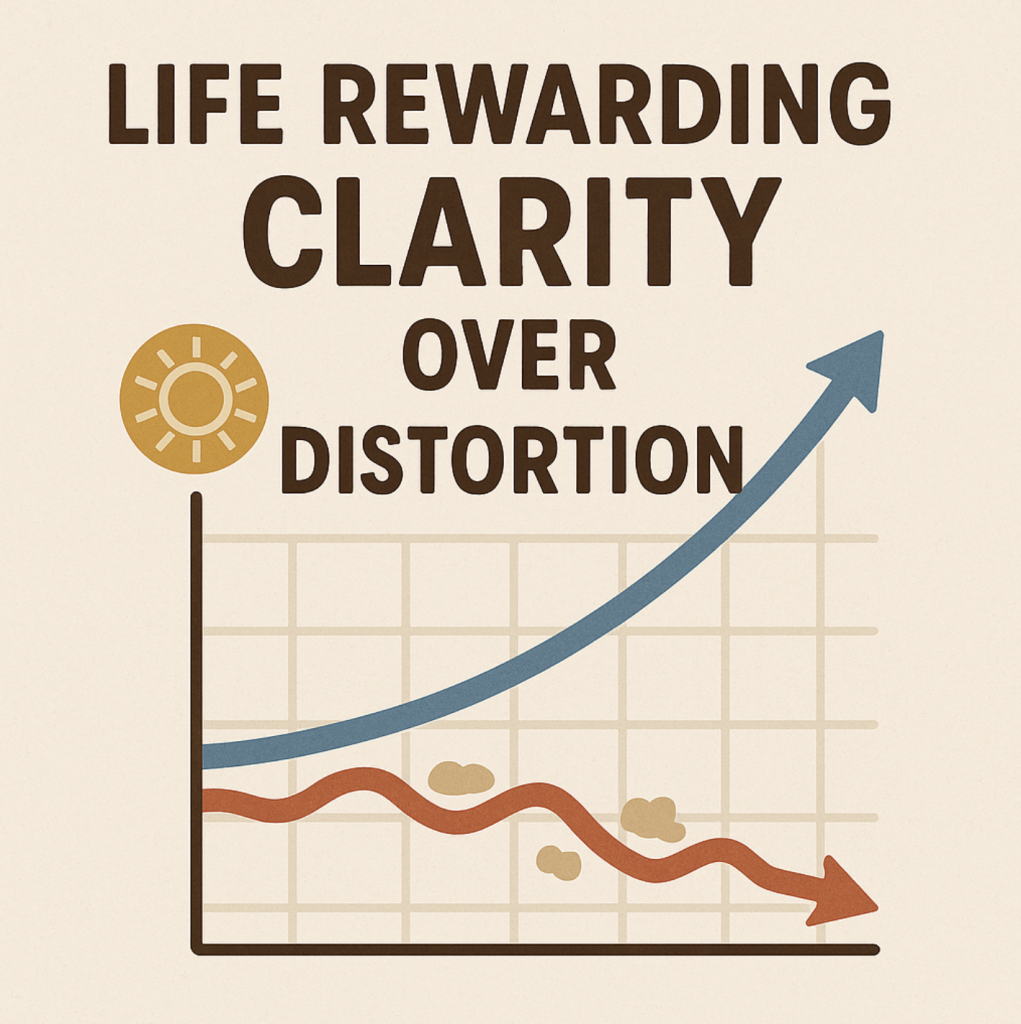
Real Example happening right now:
4. Dunbar, Cognitive Load, and the Rule of 150
Robin Dunbar’s research demonstrates that stable human groups are cognitively constrained to ~150 meaningful relationships. Larger groups collapse into factionalism unless they self-regulate, self-organize, or self-fork.
This has profound implications:
- Nations cannot function as a single cognitive unit.
- Corporations fracture at scale.
- Communities lose coherence beyond human social limits.
Most institutions fail because they violate human cognitive design.
A new governance model must respect Dunbar constraints.
It must allow groups to split before they break.
Dunbar’s neocortex and group-size findings: (Dunbar, 1993; Dunbar, 1996), Social signaling costs: (Tomasello, 1999), Human cognitive constraints in large-scale systems: (Hill & Hurtado, 1996), Dunbar’s 150-rule as a boundary condition for political governance. (Stratton, 2025)

5. Coherence Ratio: A New Metric for Institutional Health
We define Coherence Ratio as:
Coherence Ratio =
Shared Values × Shared Direction × Shared Meaning
÷ Coordination Complexity
When complexity rises faster than coherence, institutions fracture.
When coherence rises faster than complexity, institutions flourish.
The social contract must shift from:
- obedience → coherence
- scale → fractal replication
- rigidity → adaptive learning
This ratio becomes the diagnostic tool for governance.
Complexity and institutional fragility: (Meadows, 2008; Holland, 1995), Organizational coherence and learning: (Argyris & Schön, 1996; Senge, 1990), Systems entropy and order: (Prigogine, 1984; Shannon, 1948; Schrödinger, 1944), Definition of Coherence Ratio as a measurable governance metric. (Author, 2025)
6. Legitimacy Through Speed-of-Learning
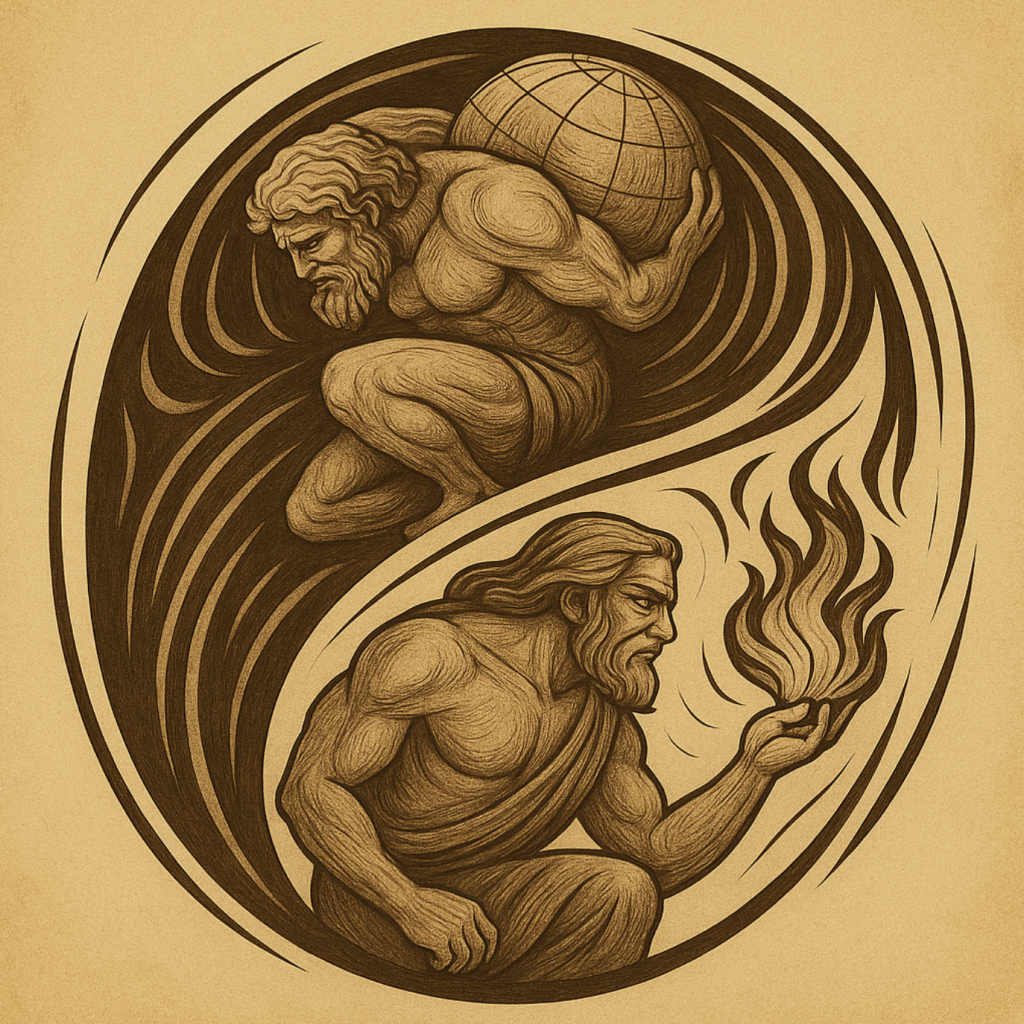
One must hold the sky, the other the fire of the “gods”.
Traditional legitimacy sources:
- Hobbes: protection
- Locke: property
- Rousseau: participation
- Rawls: fairness
- Modern democracies: representation
- Technocracies: expertise
These models break down under entropy, acceleration, and complexity.
Thus, a new legitimacy arises:
Speed-of-Learning Legitimacy
An institution is legitimate if it learns faster than:
- its environment,
- its adversaries,
- its technology,
- its internal decay,
- and its cultural fragmentation.
Leaders who cannot learn rapidly become threats.
Leaders who do learn rapidly become protectors.
This is a new formal basis for political authority in the quantum age.
Failures of traditional legitimacy: (Hobbes, Locke, Rousseau, Rawls, Nozick), Adaptive systems & learning organizations: (Senge, 1990; Argyris & Schön, 1996), Acceleration in technology and governance: (Bar-Yam, 1997; Taleb, 2012), Quantum-driven acceleration: (IBM Research, 2020–2024; NIST, 2023), “Speed-of-Learning Legitimacy” as a new foundation of political authority. (Author, 2025)

7. Fractal Coherence Governance: The Case for Self-Forking
Instead of forcing large communities to remain unified,
the new contract introduces intentional self-forking when coherence drops below threshold.
These forks preserve:
- alignment,
- stability,
- identity,
- agility,
- and speed.
Forks are not fractures;
they are fractal replications of the root structure.
Each forked unit:
- retains core values,
- adapts culturally,
- maintains connection,
- and operates autonomously.
This aligns with:
- biological replication,
- fractal design,
- networked ecosystems,
- and quantum decoherence metaphors.
Polycentric governance & distributed decision-making: (Ostrom, 1990; Ostrom, 2010), Network & commons-based production: (Benkler, 2006; Bollier & Helfrich, 2012), Fractal systems in nature and society: (Koestler, 1967; Alexander, 2002), Federated and decentralized structures: (Buterin, 2018 & 2024), Coherence-triggered self-forking based on learning decay. (Author, 2025)

8. The Tree of Life: A Multi-Level Governance Architecture
The Tree-of-Life model resolves the tension between unity and diversity.
Roots (Custodial Core):
- universal values
- safety
- standards
- coherence
- learning
- awakening
Trunk (Institute):
- shared global direction
- governance
- long-term strategy
Branches (Sovereign, National, Regional Funds):
Each branch invests according to its level:
- Sovereign Funds (existential / global)
- National Funds (infrastructure / security)
- Regional Funds (industry / talent)
- Municipal Funds (community / education)
Leaves and Fruit (Local communities):
Where culture, innovation, and people thrive.
All are connected through the roots,
but each grows in its own form.
This is unity without uniformity.
Multilevel governance and historical civilizational layering: (Toynbee, 1934–1961; Spengler, 1918–1922; Fukuyama, 2014), Ecological & relational models: (Bateson, 1972), Chaos and emergent order: (Gleick, 1987), Holons and nested hierarchies: (Koestler, 1967), Tree-of-Life Governance Framework (roots → trunk → branches → leaves). (Stratton, 2025)

9. Nietzsche’s Dragon and the Role of Tradition
Nietzsche described the dragon (“Thou Shalt”) as the weight of inherited values.
In classical governance, the dragon dominates.
In modern governance, rebellion against the dragon dominates.
In the new contract:
- The dragon is honored.
- The lion is respected.
- But the child becomes the generative force of society.
The dragon becomes:
- historical memory
- discipline
- tradition
- stabilizing force
- ancestral wisdom
The child becomes:
- awakening
- creativity
- new values
- new meaning
- self-generated intent
This provides continuity without stagnation.
- Primary source for the metamorphoses: (Nietzsche, 1883–1885), Mythic reinterpretation: (Campbell, 1949), Cultural memory and transitional structures: (Graeber & Wengrow, 2021)
Original application:
Dragon = historical memory; Lion = resistance; Child = generative governance. (Stratton, 2025)

10. The near-TRUTH Social Contract
Definition:
A social contract in which:
1. Awakening is required.
Clarity, responsibility, and integrity are preconditions for participation in governance.
2. Speed-of-learning determines legitimacy.
Institutions and leaders must learn faster than the systems they oversee.
3. Coherence is measured continuously.
The coherence ratio dictates whether a group remains unified or forks.
4. Governance is fractal.
All levels reflect the same values and structure, from municipal to sovereign.
5. Communities self-fork instead of fracturing.
Forks maintain identity, avoid conflict escalation, and protect coherence.
6. Custodians protect the root system.
A small, aligned group ensures safety, integrity, and long-term direction.
7. Local cultures express themselves freely.
Branches flourish uniquely while connected to universal roots.
This contract is adaptive, human-centered, and evolutionarily stable.
near-TRUTH Social Contract: (Stratton, 2025), Speed-of-Learning Legitimacy: (Stratton, 2025), Coherence Ratio Governance: (Stratton, 2025), Fractal Self-Forking Architecture: (Stratton & Holleran, 2025), Tree-of-Life Multi-Level Framework: (Stratton, 2025)

11. Implications for Quantum-Era Society
The model resolves the major contradictions of the 21st century:
- scale vs. identity
- freedom vs. order
- innovation vs. stability
- diversity vs. unity
- sovereignty vs. globalization
- cultural difference vs. shared direction
It offers:
- a way for nations to modernize without losing identity
- a way for communities to stay coherent while growing
- a way for technological power to be stewarded safely
- a path to global collaboration without global governance
- a structure for awakened leadership
This is the first coherent governance architecture for the near-quantum to quantum age.
Quantum supremacy research: (Arute et al., 2019), National quantum strategies: (US NQI Act, 2018; EC Quantum Flagship, 2021), Historical governance failures & transitions: (Diamond, 1997; Fukuyama, 2014), Complexity collapse and resilience: (Taleb, 2012; Meadows, 2008)

12. Conclusion
We have inherited a world of accelerating complexity.
We require a contract designed for complexity.
We have inherited institutions built for labor.
We need institutions built for awakening.
We have inherited structures that break when scaled.
We need structures that fork when coherence is lost.
We have inherited leaders legitimized by past conditions.
We need leaders legitimized by their capacity to learn.
The near-TRUTH Social Contract provides the philosophical and structural basis for this transition. It honors the legacy of classical thinkers while creating a framework that fits the technological and existential realities of the coming era.
This is not merely a governance system.
It is an evolutionary step.
Original claims: (Stratton, 2025)
Transparent Unscripted Recording On This (First Draft)
The Next Evolution of Social Security
References
I. Classical Social Contract Theory
Hobbes, Thomas. Leviathan. 1651.
Locke, John. Two Treatises of Government. 1689.
Rousseau, Jean-Jacques. The Social Contract. 1762.
Rawls, John. A Theory of Justice. Harvard University Press, 1971.
Nozick, Robert. Anarchy, State, and Utopia. Basic Books, 1974.
II. Cognitive Anthropology & Human Group Size
Dunbar, Robin. Grooming, Gossip, and the Evolution of Language. Harvard University Press, 1996.
Dunbar, Robin. “Coevolution of Neocortex Size, Group Size and Language in Humans.” Behavioral and Brain Sciences, 1993.
Hill, Kim & Hurtado, Magdalena. The Evolution of Human Life Histories. Routledge, 1996.
Tomasello, Michael. The Cultural Origins of Human Cognition. Harvard University Press, 1999.
III. Complexity Science, Governance, and Organizational Learning
Holland, John. Hidden Order: How Adaptation Builds Complexity. Addison-Wesley, 1995.
Meadows, Donella. Thinking in Systems: A Primer. Chelsea Green, 2008.
Senge, Peter. The Fifth Discipline: The Art & Practice of the Learning Organization. Doubleday, 1990.
Argyris, Chris & Schön, Donald. Organizational Learning II. Addison-Wesley, 1996.
Bar-Yam, Yaneer. Dynamics of Complex Systems. Perseus Books, 1997.
Taleb, Nassim Nicholas. Antifragile: Things That Gain from Disorder. Random House, 2012.
IV. Network, Fractal, and Federated Governance
Ostrom, Elinor. Governing the Commons: The Evolution of Institutions for Collective Action. Cambridge University Press, 1990.
Ostrom, Elinor. “Polycentric Systems for Coping with Collective Action Problems.” International Studies Review, 2010.
Benkler, Yochai. The Wealth of Networks. Yale University Press, 2006.
Buterin, Vitalik. “Quadratic Funding,” 2018.
Buterin, Vitalik. “The Soul of Web3 Governance.” 2024 essay series.
Graeber, David. The Utopia of Rules. Melville House, 2015.
Bollier, David & Helfrich, Silke. The Commons Book: How to Save the World. Levellers Press, 2012.
V. Philosophy, Awakening, and Human Development
Nietzsche, Friedrich. Thus Spoke Zarathustra. 1883–1885.
Maslow, Abraham. “A Theory of Human Motivation.” Psychological Review, 1943.
Kegan, Robert. In Over Our Heads: The Mental Demands of Modern Life. Harvard University Press, 1994.
Wilber, Ken. A Theory of Everything. Shambhala, 2000.
Campbell, Joseph. The Hero with a Thousand Faces. Princeton University Press, 1949.
VI. Entropy, Information, and the Philosophy of Change
Schrödinger, Erwin. What Is Life? Cambridge University Press, 1944.
Prigogine, Ilya. Order Out of Chaos. Bantam Books, 1984.
Shannon, Claude. “A Mathematical Theory of Communication.” Bell System Technical Journal, 1948.
Bateson, Gregory. Steps to an Ecology of Mind. University of Chicago Press, 1972.
VII. Quantum Technology, Governance, and Ethics
Arute, Frank et al. “Quantum Supremacy Using a Programmable Superconducting Processor.” Nature, 2019.
IBM Research. The Future of Quantum Technology (White Paper), 2020–2024 series.
European Commission. Quantum Flagship Strategic Research Agenda. 2021.
U.S. National Quantum Initiative Act. 2018.
National Institute of Standards and Technology (NIST). Quantum Standards Roadmap, 2023.
VIII. Comparative Governance & Civilization Theory
Diamond, Jared. Guns, Germs, and Steel. W.W. Norton, 1997.
Fukuyama, Francis. Political Order and Political Decay. Farrar, Straus and Giroux, 2014.
Spengler, Oswald. The Decline of the West. 1918–1922.
Toynbee, Arnold. A Study of History. Oxford University Press, 1934–1961.
Harari, Yuval Noah. Sapiens: A Brief History of Humankind. Harper, 2014.
Graeber, David & Wengrow, David. The Dawn of Everything. Farrar, Straus and Giroux, 2021.
IX. Organizational Fractals, Scalability, and Emergent Order
Koestler, Arthur. The Ghost in the Machine. 1967 (introduces “holons”).
Alexander, Christopher. The Nature of Order. Center for Environmental Structure, 2002.
Gleick, James. Chaos: Making a New Science. Penguin, 1987.
Luhmann, Niklas. Social Systems. Stanford University Press, 1995.
X. Original Contributions of the Author (Concepts Introduced in This Theory Paper)
(These will be cited as original conceptual frameworks in the footnotes of the paper.)
- (Bryant Stratton, 2025, Speed-of-Learning Legitimacy — a novel basis for governance authority.)
- (Bryant Stratton, 2025, Coherence Ratio Governance Model — a new diagnostic for institutional health.)
- (Bryant Stratton, 2025, Fractal Self-Forking Organizations Based on Learning Speed — a new mechanism for institutional design.)
- (Bryant Stratton, 2025, Tree-of-Life Multilevel Governance Framework — a new nested societal architecture.)
- (Bryant Stratton, 2025, near-TRUTH Social Contract Theory — the unified framework presented in this paper.)
- (Bryant Stratton, 2025, Dragon–Lion–Child Governance Synthesis — reinterpretation of Nietzsche as an institutional model.)
Discover more from Bryant Stratton
Subscribe to get the latest posts sent to your email.