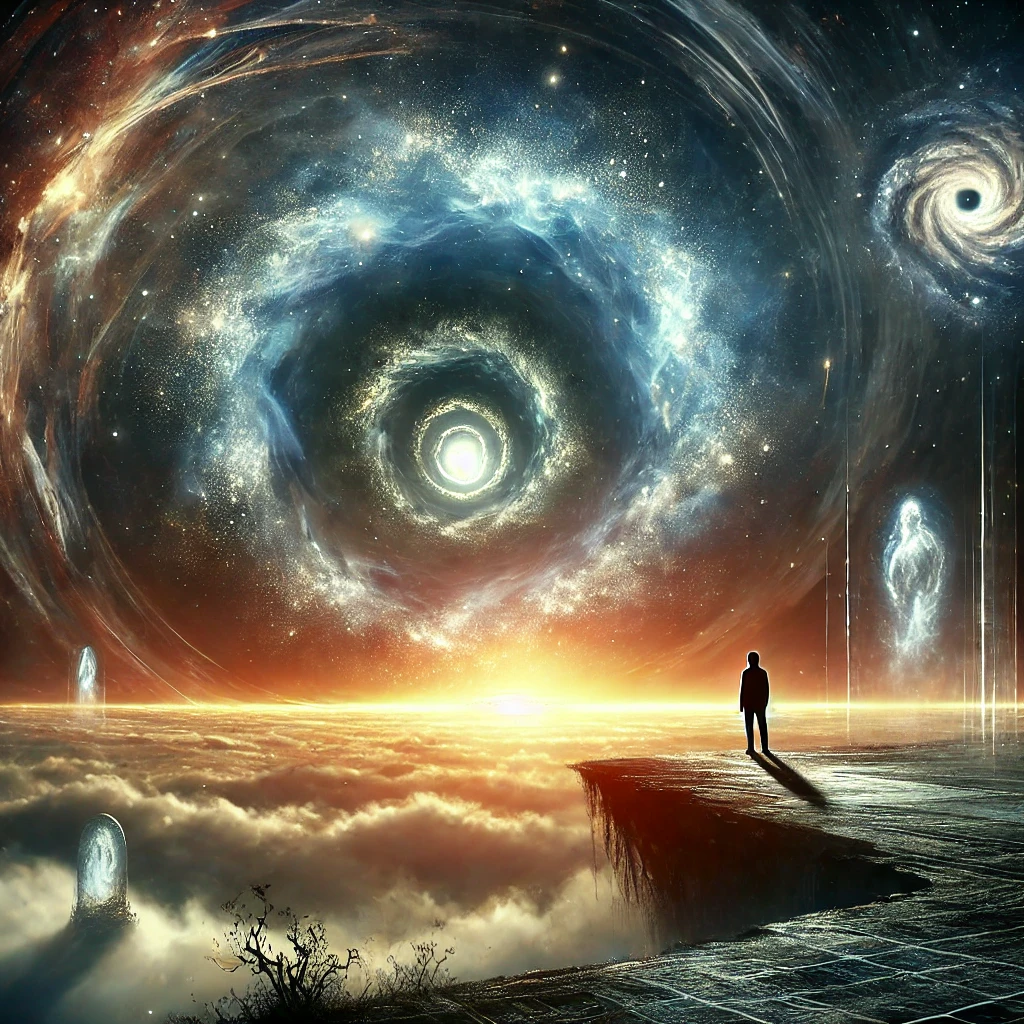
A Journey from There and Back Again through the Human Experience
To speak of the future of the end is to speak of paradox. For the end, by definition, suggests a finality, a conclusion. But is the end truly the end, or is it simply the moment before another beginning? Perhaps the future of the end lies not in some distant time, but in the cyclical nature of existence itself—a journey that begins where it ends, and ends where it begins.
This is not the story of a single life, but the story of humanity itself. It is a journey through time, through pain, through creation and destruction, through the discovery and loss of self. It is a story that begins in the womb and ends at the threshold of death, only to begin again in another form. It is a tale that has no singular hero, no singular destination, but is instead a collective voyage—a shared experience of becoming.
The journey from there and back again begins not at some specific moment in history, but in the very essence of existence. From the moment of birth, humanity is caught in a cycle of striving, questioning, and searching for meaning. This journey is not linear but spirals inward and outward, moving between creation and destruction, light and shadow, order and chaos.
For those who walk this path, the pain of life is ever-present. It is the ache of being human, of existing in a world that offers no easy answers. It is the pain of family, where expectations clash with desires, where love and resentment coexist. It is the pain of self, where identity is constantly in flux, where the quest for purpose seems endless, and yet, at times, elusive.
The human experience is a dance of contradictions, of joy and sorrow, of success and failure. The pursuit of meaning—whether in the eyes of others, in achievements, in love, or in the search for self—often leads to a sense of emptiness, a feeling that what has been sought was never truly found. And yet, the journey continues, as each step forward brings the traveler closer to understanding, closer to acceptance.
At the heart of this journey lies the question: What is the purpose of it all? It is a question that humankind has asked for centuries, and yet, no definitive answer has been found. Some look to religion, others to philosophy, some to science, and still others to art or experience. But the truth remains elusive, for the answer is not to be found in one place, but in the act of searching itself. The journey is the answer.
There is a moment when the end becomes clear—not as a final destination, but as a return to the beginning. In that moment, the journey is understood for what it truly is: a cycle, a continuous flow of existence that is neither beginning nor end, but simply being. The end is not a stopping point; it is a return to the source, to the void from which all things emerge.
In the end, the future of the end is not death, but life. It is not finality, but transformation. The journey from there and back again is not a linear path from one point to another, but a spiral that continuously brings the traveler closer to the truth of existence. And as the traveler returns, having experienced the fullness of life, of pain, of love, and of loss, they realize that the journey itself is the destination.
The human experience is not a straight line from birth to death, but a circle—a spiral of becoming. And as we journey from there and back again, we discover that the end is never truly the end. It is only a new beginning, an opportunity for further growth, understanding, and evolution.
This is the future of the end: a journey without conclusion, without finality, but one that continues infinitely, through the pain, the love, the creation, and the destruction, until, at last, we return to the source from which we came.
Before embarking on the journey of transcendence
It is important to understand the nature of the black hole of nothingness. It is not a singular force or external event. It is the subtle result of a cycle that begins with comparison—a comparison that can exist even without conscious awareness.
You see, comparison is not inherently harmful. It can be a tool for learning, for growth, even for self-improvement. It is when comparison turns inward, when it becomes a measure of worth, that it begins to erode the soul. The black hole is not the comparison itself but the trap it creates when the observer loses sight of their own unique potential.
At times, this black hole will feel invisible. It will feel like a weight, unspoken and unrecognized, pulling at the heart. And sometimes, the observer may not even know it exists—feeling the emptiness of their own experience, the sense that something is missing, though they can’t name it. In truth, this emptiness is the result of not measuring themselves by their own standard, but by the yardstick of others. The invisible black hole lies in that moment where a person becomes trapped, unable to move forward because they’ve become a reflection of someone else’s definition.
But this need not be permanent. The black hole is not an inevitable prison. It is not a force that forever defines existence. It can be recognized. It can be released. And yes, it is a journey—a long and often difficult one. But the first step is acknowledging that it exists not as a law of the universe, but as a shadow in the mind.
You are not defined by comparison. You are not confined by the expectations of others. You are not a slave to the beliefs that hold you back. And you can choose to escape the gravitational pull of this black hole—by shifting perspective, by breaking free from the cycle of comparison, and by choosing to see yourself not as a reflection of someone else’s ideal, but as a unique force in your own right.
Discover more from Bryant Stratton
Subscribe to get the latest posts sent to your email.