It’s About Architecture
I read the Citrini memo about the coming “Global Intelligence Crisis.” https://www.citriniresearch.com/p/2028gic
It’s logical. Their core idea is simple: AI succeeds too well. (Join discord to discuss further: https://discord.gg/cMfH9d8J)
It replaces white-collar work faster than the system can adapt. Corporate profits rise. GDP looks strong. But humans lose income.
They call it Ghost GDP.
Economic output exists. But it doesn’t circulate through people.
AI agents don’t buy homes.
They don’t eat at restaurants.
They don’t pay property taxes.
So the consumer base erodes underneath rising margins. And, that’s a design failure.
The Spiral They’re Warning About
The cycle looks like this:
AI replaces workers.
Margins expand.
Workers stop spending.
Demand shrinks.
Companies automate more to protect margins.
Tax bases collapse.
Mortgage markets destabilize.
Repeat.
If we keep optimizing for labor extraction, this is exactly what happens. The system does what it was built to do… It just does it faster.
This Is Where EcoPulse and RHVI Matter

The real issue is measurement.
Right now markets measure:
Profit.
Productivity.
EPS.
Compute power.
They don’t measure:
Human vibrancy.
Trust density.
Community strength.
Learning velocity.
Long-term viability.
So capital will chase AI productivity until it optimizes the human out of the equation.
That’s Ghost GDP.
EcoPulse is different.
It asks:
Did this increase human energy?
Did it make a city more stable?
Did it deepen trust?
Did it strengthen circulation?
RHVI asks:
Are people actually viable?
Are they learning faster?
Are they cooperating better?
Are they building durable systems?
That’s a different scoreboard.
And scoreboards shape behavior.
The Real Shift Happening
If cognitive work becomes close to free, then intelligence stops being scarce.
When that happens, value shifts.
It shifts toward:
Trust.
Reputation.
Physical presence.
Community.
Integrity under pressure.
Long-term alignment.
Machines can compute. They cannot bind people together. Binding becomes the premium. That’s the shift Citrini doesn’t fully explore.
The Symbiotic Multiplier Regime
Here’s the alternative.
Instead of AI replacing humans in a zero-sum labor model, we move to a multiplier model.
AI handles:
Risk modeling.
Massive data processing.
Agent negotiation.
Micro-transactions.
System optimization.
Humans focus on:
Building communities.
Creating meaning.
Mentoring.
Governance.
Trust.
Innovation that requires courage.
AI removes coordination friction.
Humans generate emergent exchange.
That’s the multiplier.
The Fork in the Road
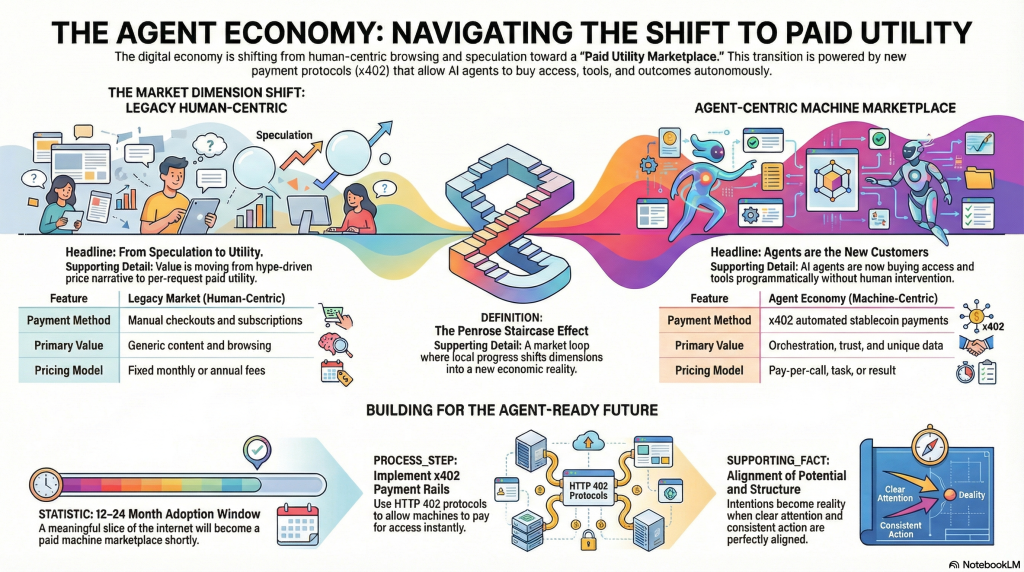
Citrini’s crisis is plausible.
If we keep optimizing for margin alone, we get:
Ghost GDP.
Middle-class collapse.
Asset instability.
Political volatility.
But that’s not destiny.
It’s default architecture.
If instead we optimize for Systemic Human Viability, AI productivity becomes abundance.
Lower cost of living.
More time for family.
More time for building.
More time for learning.
More time for connection.
AI becomes infrastructure.
Humans become higher signal.
The Real Question
AI scaling is not the risk.
Misaligned incentives are the risk.
We are either building:
The most efficient economy in history for machines.
Or
A symbiotic system where machines carry the computational weight and humans focus on what only humans can do.
That’s the bet.
Not on AI.
On whether we redesign the architecture fast enough.
Why AI Should Carry the Weight So Humans Can Create the Signal
We are standing at a strange moment in history.
On one side, artificial intelligence is accelerating at a pace that feels overwhelming. On the other side, human communities feel fragmented, misaligned, and exhausted by coordination.
Most people see tension here.
I see synthesis.
What we need to build now is a Symbiotic Multiplier Regime.
Not AI replacing humans.
Not humans competing with AI.
But a structured system where each does what it does best, and both multiply the other.
The Three Pillars of the Regime
The synthesis of EcoPulse, RHVI, and Finders Guild sketches a future that is both optimistic and grounded.
1. EcoPulse — Mapping Systemic Vitality
EcoPulse is about sensing.
It maps:
- Systemic risk
- Urban evolution
- Community vibrancy
- Capital flow patterns
- Participation density
AI thrives here.
It can:
- Process millions of signals.
- Detect structural shifts before humans feel them.
- Identify fragility and opportunity in real time.
- Run simulations across time horizons no individual could hold in their head.
Humans should not be manually coordinating this level of complexity.
Let the machine carry that burden.
2. RHVI — Measuring Human Viability
RHVI, the Human Viability Index, measures something more subtle:
- Speed of learning
- Trust density
- Alignment strength
- Generational stability
- Integrity under stress
This is not about surveillance.
It is about feedback.
AI can:
- Track patterns of collaboration.
- Identify environments where learning accelerates.
- Map where trust compounds versus where it decays.
- Suggest structural interventions.
Humans, meanwhile, bring:
- Meaning
- Moral agency
- Sacrifice
- Creativity
- Love
AI can measure resonance.
It cannot generate authentic human energy.
3. Finders Guild — Coordinated Emergent Exchange
Finders Guild operationalizes the exchange.
It is where:
- Connectors meet builders.
- Builders meet capital.
- Capital meets aligned mission.
- Ideas move into execution.
AI handles:
- Data extraction
- Deal pattern recognition
- Programmatic micro-transactions
- Agentic matching
- Risk profiling
Humans handle:
- Vision
- Negotiation
- Trust
- Commitment
- Long-term stewardship
This is where Emergent Exchange happens.
And this is the multiplier.
What Is a Symbiotic Multiplier Regime?
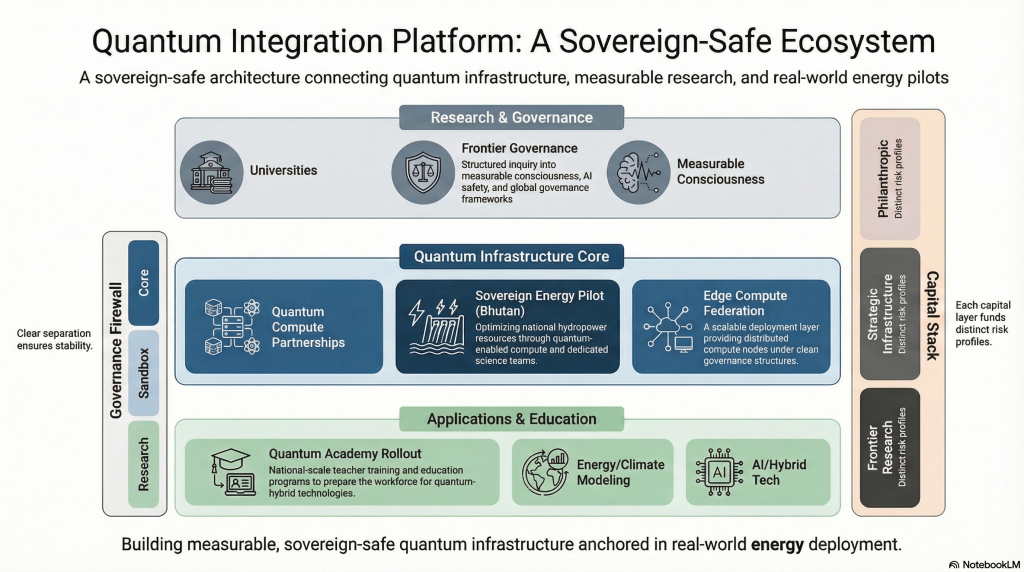
Here is a real example I’m building right now. Interested? Lets chat.
It is a system where:
- AI reduces coordination friction.
- Humans increase meaning density.
- Both amplify each other’s strengths.
- Value compounds structurally instead of extractively.
Right now, most of society wastes human energy on:
- Manual data entry
- Risk estimation
- Searching for trustworthy partners
- Repeated low-leverage coordination
AI can absorb that computational weight.
When it does, something profound happens.
Humans are freed to focus entirely on:
- Building communities
- Innovating ideas
- Raising children
- Teaching
- Designing systems
- Healing broken trust
- Creating culture
That is the highest yield activity in civilization.
Emergent Exchange: The Real Output
The output of this regime is not GDP.
It is not token price.
It is not engagement metrics.
It is Emergent Exchange.
Emergent Exchange happens when:
- Trust meets opportunity
- Learning meets execution
- Capital meets integrity
- Communities meet coordination
And when that exchange compounds, cities become more vibrant.
Families become more stable.
Entrepreneurs build with less fear.
Young people see pathways instead of chaos.
The AI Role: Silent Infrastructure
AI’s role in this regime is powerful but quiet.
It will:
- Assess systemic risk continuously.
- Predict urban and economic shifts.
- Extract structural data from messy environments.
- Execute micro-transactions automatically.
- Optimize distribution flows in real time.
- Identify fragility before collapse.
It becomes the nervous system.
Humans remain the heart.
The Human Role: Generate Energy Worth Mapping
If AI maps and distributes value, humans must generate value worth mapping.
That means:
- Increasing integrity.
- Increasing learning speed.
- Increasing cooperative capacity.
- Increasing alignment.
- Increasing generosity in structured ways.
This is not about replacing markets.
It is about refining them.
It is not about utopia.
It is about reducing friction so human creativity can flourish.
The Optimistic but Grounded Future
The Symbiotic Multiplier Regime is optimistic because:
- AI makes coordination cheaper.
- Data makes risk visible.
- Alignment can be engineered.
It is grounded because:
- Humans still have to show up.
- Trust still has to be earned.
- Integrity still compounds slowly.
- Culture still determines trajectory.
AI can amplify.
It cannot substitute for character.
The Choice Before Us
We can:
- Let AI centralize power and extract.
- Or design systems where AI distributes and multiplies.
The difference is structural.
If we build EcoPulse to sense,
RHVI to measure viability,
and Finders Guild to coordinate aligned exchange,
then we do not get dystopia.
We get a civilization that:
- Learns faster.
- Trusts more efficiently.
- Moves capital intelligently.
- Builds resilient cities.
- Multiplies human potential.
That is the Symbiotic Multiplier Regime.
AI carries the weight.
Humans generate the signal.
And together, we build something worth sustaining.
Did you understand all that? Are you a polymath/autodidact/renaissance person? Join those like you: https://discord.gg/cMfH9d8J. Cya soon!
For The Love of People: Deploy this immediately!
I recommend reading whatever makes most sense or is most applicable to you. Are you a starter, integrator, improver, healer, adopter, or philosopher? Like pick your own adventure.
Part 1: Where it Actually Starts
Part 3: When Depth Became Visible
Part 4: What Quitely Began to Heal
Discover more from Bryant Stratton
Subscribe to get the latest posts sent to your email.