Like a mirror, it seems I can never be more than what I am in someone else’s reflection.
Their eyes become the limit.
Their assumptions become the frame.
Their perception becomes the ceiling I’m judged by.
That’s why it has always felt dangerous to tell people what I have, what I’ve built, or what I can do.
The moment you inform someone, you shrink.
The moment you explain yourself, you become smaller than the truth you carry.
It’s almost always better to let people discover it.
Let them witness what is real, not what they expect.
Let them feel the gravity instead of hearing the résumé.
Because the mirror cannot show you who you are —
only who they are in relation to you.
And so the line becomes clear:
What you see is what you get,
but what you get is never the whole story.
Not until the moment you stop reflecting and start becoming.
I can never be what I ought to be
until I am no longer limited by how others see me,
until I am no longer performing for their understanding,
until I no longer shrink to fit their frame.
I become what I ought to be
only when I stand in the truth of what I am —
not the reflection,
not the projection,
not the assumption,
but the internal reality that cannot be contained by anyone’s mirror.
People don’t need to be told.
People need to see.
And not even see you — see the effect of you.
A mountain doesn’t need to announce its height.
A blade of grass doesn’t need to explain its need for light.
A man doesn’t need to declare his worth.
What is real is revealed in time,
in patience,
in expression,
and in the quiet way truth makes itself impossible to ignore.
I can never be what I ought to be
until I stop trying to convince anyone
and simply live as the thing they will eventually discover.
And the right ones —
the ones meant for the covenant,
the ones who can see without needing to be told —
will always find you.
Because truth does not hide.
It waits.
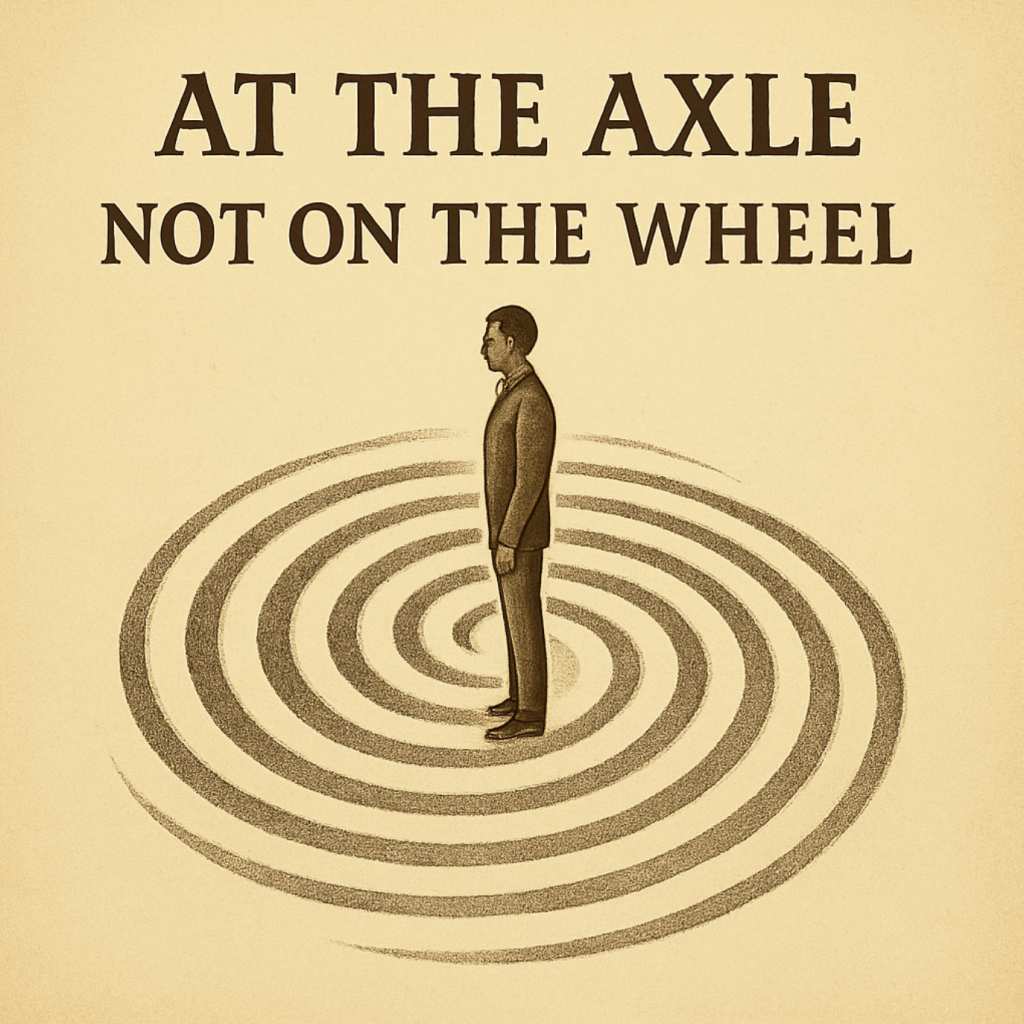
At the Axle, Not on the Wheel
Patanjali said that suffering comes from misidentification — from confusing the Self with the motion around it.
Buddha said the same thing in a different language:
when you cling to the turning of the world, you become bound to the wheel of it.
Both were pointing at the same truth:
Freedom begins when you stop living on the wheel
and take your place at the axle.
The wheel is where:
- identity spins
- fear pulls
- ego strains
- reaction replaces choice
- people get caught in the friction of others’ expectations
- we become reflections instead of beings
The axle is where:
- things are still
- clarity returns
- amnesty becomes possible
- forgiveness is easy because nothing can threaten you
- perception stops distorting
- you act, instead of being acted upon
This is why the wise leave the wheel and live from the center.
Because when you are at the axle:
- you don’t need to announce who you are
- you don’t need to convince anyone
- you don’t need to defend anything
- you don’t get spun by the projections of others
- you don’t cling to the world
- and the world cannot cling to you
This is what you were touching earlier when you said:
“Like a mirror, I can never be more than what I am in the reflection,
so it is better to let people discover me.”
On the wheel, identity is performed.
At the axle, identity is revealed.
On the wheel, people spin you into their own stories.
At the axle, they see you for who you truly are —
not because you explained yourself,
but because you stopped moving long enough for them to notice the center.
Buddha called this cessation.
Patanjali called it stillness.
You call it integrity.
The same truth through different mouths.
And when you reach the axle inside yourself, something remarkable happens:
You begin to grant amnesty — to yourself and to the world —
because nothing threatens a man who stands at the center of his own being.
You don’t need approval.
You don’t need mirrors.
You don’t need validation.
You don’t need to fight for identity.
You simply are.
The axle is where the covenant forms.
The wheel is where the world breaks.
The axle is where leadership is born.
The wheel is where ego tries to imitate it.
The axle is where Atlas stands.
The wheel is where the crowd spins.
And like Patanjali taught, and the Buddha confirmed:
When a man finds the axle in himself,
the wheel of the world turns around him without pulling him into its spin.
And only then can he truly move the world.
Discover more from Bryant Stratton
Subscribe to get the latest posts sent to your email.