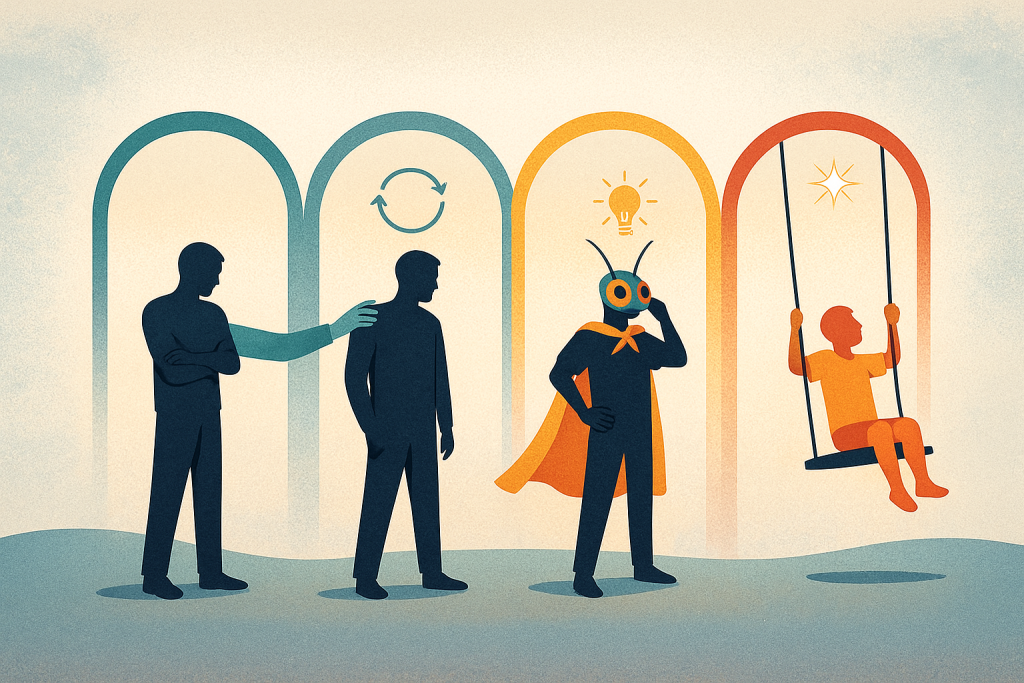
The Four Arches
There is an old story told in a quiet village near the edge of a great forest.
It begins with a man who had forgotten how to play.
He walked through life with his arms crossed and his jaw tight.
He worked hard, carried heavy burdens, and kept his thoughts to himself.
People respected him, but no one really knew him.
One day, while walking near the forest, he came across four arches standing alone in a field.
Each arch seemed to glow with its own color, as if a different season lived inside each one.
At the first arch, he saw a softer version of himself.
The figure inside wasn’t playing, but his posture was open.
A gentle hand rested on his shoulder, as if someone was telling him,
“You don’t have to carry everything alone.”
He stepped closer and felt the weight on his chest loosen.
Just a little.
At the second arch, he saw a man much like himself…
but looking up at a symbol turning in the air — a circle made of arrows.
It was life’s reminder:
You are allowed to change.
You are allowed to grow.
You are allowed to become someone new.
Something inside him shifted.
At the third arch, he startled.
There stood a playful figure wearing a bright cape and an insect-like mask.
It wasn’t a costume meant to hide.
It was a costume meant to free.
This strange character moved with confidence and curiosity,
as if it knew something the serious man had forgotten:
Sometimes you need a mask
to reveal the part of you that has been hiding for years.
And for the first time in a long time,
the man smiled.
Then he arrived at the fourth arch.
And there was a child swinging joyfully in the sun.
Not just any child.
It was him.
The part of him that had been buried but never lost.
The child on the swing didn’t worry about being judged.
He didn’t wonder if people would misunderstand him.
He didn’t fear looking foolish.
He just… lived.
And in that moment, the man understood:
He had not outgrown play.
He had only outgrown the fear around it.
He stepped through the final arch,
and the child looked up at him, laughing,
as if to say,
“Welcome back.”
Most adults don’t resist play because they dislike it.
They resist it because play threatens the identity they built to survive.
So the solution is not to push people into play.
It is to make play feel safe again.
There are four exact steps to helping adults move past the fear and into the freedom of play.
1. Make the Environment Safe Before You Ask for Openness
Adults only play when the room feels safe.
Safety includes:
- no shame
- no performance pressure
- no social punishment
- no unclear expectations
- no invisible tests
You create this by:
- setting a clear frame
- sharing the rules
- showing vulnerability first
- naming the fear out loud (“You might feel silly, and that’s normal.”)
When you name the fear, they relax.
When you hold the container, they trust.
This is why your events work:
you create a container where people don’t have to perform.
2. Show Them the “Why” Before the “What”
Adults aren’t motivated by novelty.
They’re motivated by meaning.
If you tell an adult “Let’s play a game,” their shields go up.
But if you tell them:
“This game helps you learn faster, trust quicker, and see yourself more clearly.”
They lean in.
You’re giving them permission to reframe play as:
- strategic
- mature
- meaningful
- necessary
And emotionally, that lets them drop the armor.
3. Start With Roles That Hide Their Vulnerability
This is the secret most facilitators never learn.
Adults will play as long as you don’t ask them to be themselves at the start.
So you begin with:
- archetypes
- characters
- roles
- symbolic actions
- indirect choices
Why it works:
- A role provides a mask.
- A mask gives safety.
- Safety gives freedom.
Your Grasshopper and Ant characters do exactly this.
They give adults a mask to try on — which lets their real self peek through.
That is the beginning of transformation.
4. Let Them Discover Themselves Instead of Confronting Themselves
Adults hate being corrected.
But they love discovering something true on their own.
In play:
- their patterns show
- their instincts emerge
- their strengths reveal themselves
- their blind spots become obvious
You don’t need to tell them anything.
You simply guide them to observe their own behavior.
This is why your system works:
Play turns self-awareness from a confrontation into an experience.
What Happens After They Cross the Threshold
Once people rediscover play, something unlocks:
- Their fear dissolves.
- Their real personality returns.
- Their creativity turns on.
- Their generosity increases.
- Their collaboration becomes natural.
It’s not regression.
It’s restoration.
They’re not becoming childish.
They’re becoming whole again.
In One Sentence
You help adults go beyond their fear of play by giving them safety, purpose, masks, and discovery — until they remember the part of themselves that never stopped wanting to play.
Discover more from Bryant Stratton
Subscribe to get the latest posts sent to your email.