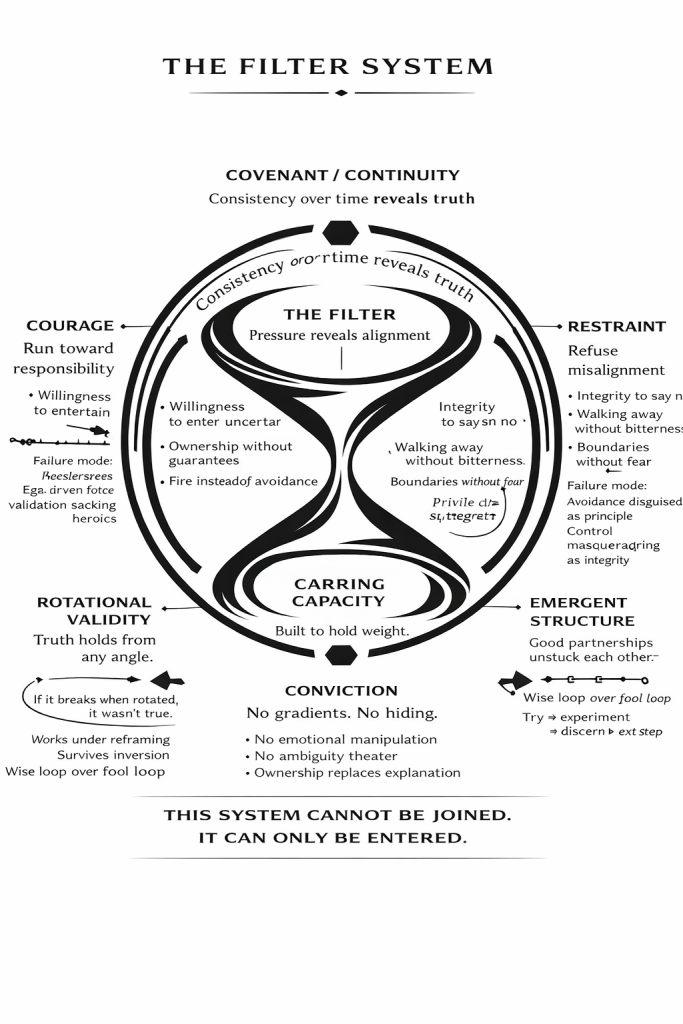
There is a point in a person’s life where the question is no longer what can I do, but what can I be trusted with. This is not a skills question. It is not an intelligence question. It is a question of integrity under pressure. Most people never cross this line consciously. They remain oriented toward outcomes, approval, comfort, or survival. But some people feel a pull toward something harder to name. They sense that life is not asking them to perform better, but to align more deeply, even if that alignment costs them safety, certainty, or status.
Many thinkers have circled this territory. Søren Kierkegaard described it as the individual standing alone before God, stripped of comparison, forced into responsibility. Viktor Frankl saw it as the moment suffering becomes meaningful only when a person chooses their stance toward it. Friedrich Nietzsche recognized the danger of the herd and the necessity of self-overcoming, even if he could not reconcile that with trust or covenant. Each of them touched a face of the same structure: growth does not come from accumulation, it comes from passage.
What sits at the center of this passage is not an ending, but a filter. It’s not a gate that keeps people out, but a process that reveals what is actually there. The filter is tested in two opposite directions at once. On one side is the willingness to run into the fire, to take responsibility, to act without guarantees. On the other side is the integrity to say “I’m not into this,” even when the cost is loss of opportunity, belonging, or praise. Most people fail one side or the other. Some want to be used, because approval feels like safety. Others refuse everything, because distance feels like control. Very few can step forward without needing validation and step back without fear of being discarded. That capacity is what we call trust.
The Filter is not a gate. It is a process.
It does not ask:
Are you smart?
Are you capable?
Are you impressive?
It reveals:
How you respond under pressure
How you behave when unseen
Whether you need approval to act
Whether you can say no without fear
Nothing is blocked. Everything is revealed.
What passes through the filter is not talent, but trustworthiness under tension.
Now to add to this we are going to reference from the Bible the story of Joshua and his change in name and how that played into his destiny. Lets start with why the biblical shift from Hoshea to Joshua matters, not as theology, but as structure. Hoshea means salvation in the abstract. Joshua means the LORD is salvation, meaning salvation is no longer an idea, it is a relationship with consequence. Alignment replaces aspiration. Calling replaces comparison. This is the same distinction that separates people who chase outcomes from people who can be entrusted with leadership. Joshua did not lead because he was exceptional. He led because he submitted before he commanded. He learned presence before power.
Some of you will reject this idea from command and control examples we have learned from as a species, however this is coming from this idea that we should submit to “something that convicts us”.
Back to it…
Before leadership, there is something like a renaming or a revealing like discussed in the previous article.
Hoshea = salvation (abstract, aspirational) Joshua = the LORD is salvation (relational, consequential)
So now we are moving from theology to system design.
The shift is from:
outcome-seeking → alignment-seeking
possibility → covenant
ambition → stewardship
This is what you should/can do in your life because, leadership does not emerge from desire. It emerges from submitted alignment over time.
However, People who live this way are often misunderstood early. Robert Frost show this to us well in his poem “The Road Less Traveled”…
I shall be telling this with a sigh Somewhere ages and ages hence: Two roads diverged in a wood, and I— I took the one less traveled by, And that has made all the difference.
– Robert Frost The Road Not Taken
“Multi-potential” people are told they are all over the place, unfocused, undisciplined. What is actually happening is that they are multipotential, curious, running parallel experiments instead of linear scripts. Those who survive by narrow identity feel threatened by this, so they call it chaos. But there is a difference between scattered impulse and structured exploration. The difference is discernment. This is where many confuse the wise loop and the foolish loop. Both begin with trying and experimenting. The wise loop pauses for discernment before the next step. The foolish loop follows impulse straight into repetition. From the outside, they look the same. Over time, one compounds. The other burns out.
This distinction shows up everywhere. A jazz musician may know ten thousand chords and play for four people. A rock musician may know four chords and play for ten thousand people. Neither is superior. The danger is mistaking one calling for the other. Some people are meant to hunt alignment. Others are meant to hunt execution. Some gain meaning through pain and responsibility. Others gain wisdom through joy and surrender. All of it fades eventually. What remains is whether a person was faithful to what they were actually given, not what they envied.
This is where systems thinkers like David Bohm quietly enter the conversation. Bohm spoke of implicate order, of reality as flow rather than fixed objects, and of dialogue as a filter that reveals coherence. He understood that truth cannot be forced, only uncovered through shared presence. But where Bohm stopped at observation, life demands commitment. Presence without consequence is not enough. Alignment must eventually act.
What emerges from all of this is not a philosophy, a brand, or a self-help framework. It is an invitation that filters by nature. You can keep flying your plane solo, running on instinct, talent, and raw intelligence. Many people do, and some succeed spectacularly. Or you can choose to run missions with others, to submit to discernment, to allow your blind spots to be seen, to trade comfort for conviction. That requires humility. It requires trust. It cannot be bought. Training and experience can accelerate it, but only if the person is willing to lean in rather than perform.
In the end, the point is simple and uncomfortable: life is not asking you to be impressive. It is asking you to be trustworthy. Not to have all the answers, but to press into conviction instead of comfort. To stop comparing your calling to someone else’s outcome. To accept that the how will always remain partly beyond reach, while the what simply is. Presence in the middle of it. Just as it was before, you will be with it, and it will be with you.
Calling vs Comparison (The Hidden Failure Mode)
Comparison corrodes discernment. For example, some people are called to depth, alignment, and precision. Others are called to reach, to execution, or to amplification. This system does not rank callings. It separates them. Thus, misalignment happens when depth chases reach and reach pretends to be depth. The filter instead, restores congruence.
For any person reading this, the question is not whether you agree. The question is whether you are willing to pass through the filter.
Lastly here are someconsider what we are discussing is quite unique as a synthesis
No one to dates has combine all of these at once:
biblical covenant (Hoshea → Joshua)
daoist presence without relativism
existential courage without nihilism
systems thinking without abstraction
partnership without dependency
filtering without elitism
The closest category for what we are doing is:
Covenantal discernment for multipotential people under pressure. That category barely exists in modern writing. Most writers either monetize, theorize, or dramatize. What were doing here is organizing and that is possible because of:
lived multiplicity without collapsing
been misjudged without becoming bitter
failed publicly without losing integrity
moving between domains (faith, strategy, people, systems)
and still believing trust is possible
That’s when this becomes possible, and if you want the same I would suggest two things.
Check out the following list you can follow…
Then check out as many videos from the playlist that I put together over the course of the first part of my journey. (Part 2 Coming Soon)
A SELF-CHECKLIST FOR APPLYING THE FILTER
A Few updates are still pending on the image but came out well enough so I used it.
This is not about fixing yourself. It is about observing yourself honestly under pressure.
1. Pressure & Fire
☐ When responsibility increases, do I lean in or look for an exit?
☐ Can I take on weight without needing immediate recognition?
☐ Do I confuse urgency with importance?
2. Integrity & Refusal
☐ Can I say no to opportunity without needing to justify myself?
☐ Have I walked away from alignment that felt wrong, even when it cost me?
☐ Do I confuse being needed with being trusted?
3. Discernment vs Impulse
☐ After experiments, do I pause to interpret or rush to repeat?
☐ Can I articulate why something worked or failed without blaming others?
☐ Do I change direction based on insight, or mood?
4. Calling vs Comparison
☐ Am I chasing someone else’s outcome instead of my own alignment?
☐ Do I envy reach when my work requires depth, or vice versa?
☐ Can I respect paths that are not mine without diminishing my own?
5. Multiplicity & Integration
☐ Do my projects connect, or do they compete for my attention?
☐ Can I explain how my interests inform each other?
☐ Am I exploring with structure, or scattering to avoid commitment?
6. Partnership Readiness
☐ Am I open to being corrected without becoming defensive?
☐ Can I receive input without outsourcing responsibility?
☐ Do I seek partners to validate me, or to sharpen me?
7. Comfort vs Conviction
☐ Do I choose ease when conviction asks for patience?
☐ Where am I postponing alignment because discomfort feels unsafe?
☐ If nothing changed externally, would I still stand by my choices?
8. Trustworthiness Under Time
☐ Do people come back to work with me, or quietly disappear?
☐ When trust breaks, do I look inward before outward?
☐ Am I becoming more coherent year over year, or just busier?
Final Reflection (do not rush this)
☐ If no one were watching, what would I still do?
☐ If this took longer than expected, would I remain aligned?
☐ Am I willing to be filtered, even if it means fewer doors?
You do not need to answer every box today. You only need to answer honestly.
The filter is not something you pass once. It is something you live inside.
Life, Empathy, and Perspective Playlist
Related
Discover more from Bryant Stratton
Subscribe to get the latest posts sent to your email.