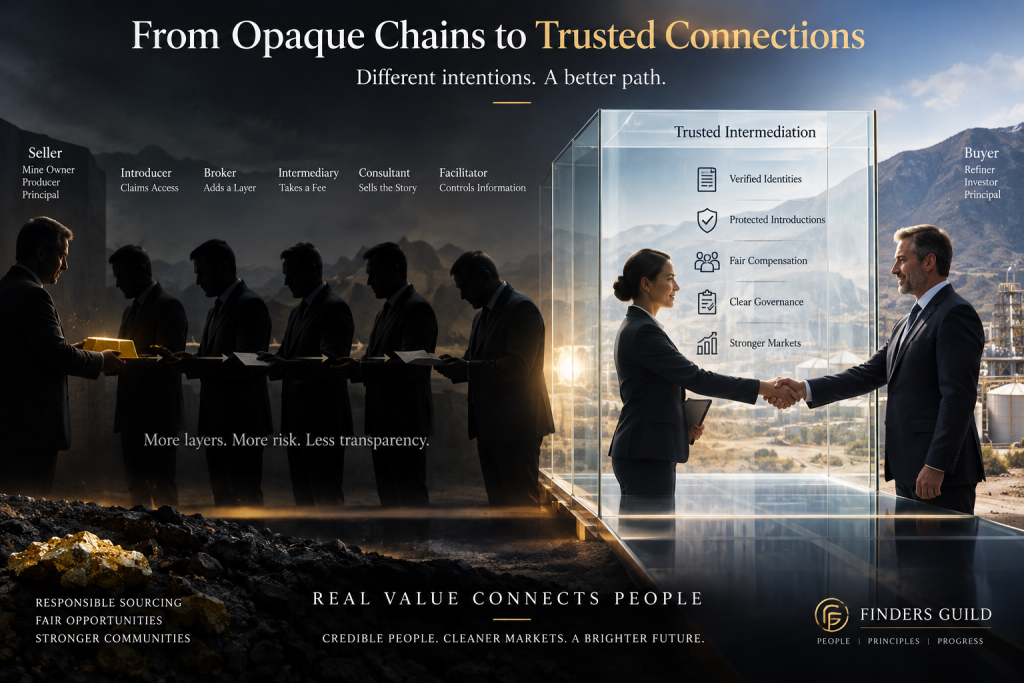
In opaque markets like gold and commodities, the people who seem least desperate to control the deal can sometimes gain the most direct access to principals. The reason may be less about good intentions and more about transparent incentives, low-extraction behavior, and the ability to walk away.
Today we’re gonna talk about commodities, gold trading, broker chains, fraud risk, principal relationships, incentive transparency, Finders Guild, non-predatory intermediation, deal governance, and trust in markets.
To begin…
There is a strange pattern I have started noticing in commodities.
The people who seem most able to get close to the actual principals are not always the people trying hardest to make money from the transaction.
Sometimes it is the opposite.
I have been spending time around commodities, particularly gold, for reasons that are somewhat different from the people around me. I am interested in transactions, but I am also interested in behavior. Highly intermediated, fraud-prone markets create an unusually concentrated environment for studying trust, incentives, misrepresentation, desperation, status, and cooperation.
That difference in motive appears to change the conversations.
I have noticed similar behavior among people working around mining for reasons other than simply extracting commissions. Some are trying to advocate for miners. Some are concerned with exploitation or vulnerable populations. Others are trying to help operators obtain better equipment, financial instruments, risk reduction, or access to legitimate buyers.
They often seem to reach the actual people behind the transaction surprisingly quickly.
The obvious explanation would be that sincere people somehow bypass broker chains.
I do not think that explanation is precise enough.
The deeper issue may be that people behave differently around someone who does not appear hungry for control.
High-fraud markets produce defensive behavior for understandable reasons.
A mine owner may be wondering who is actually representing the buyer.
A buyer may wonder whether the seller possesses the commodity at all.
A broker may be protecting a relationship because bypassing is common.
An introducer may be worried that once two principals meet, everyone between them will disappear from the economics.
Documents get passed through chains of people whose authority is often unclear. Someone says they know the mandate. Someone else knows the person who knows the mandate. Another person has a document. Another has a WhatsApp message.
Eventually everyone starts evaluating everyone else.
Who is real?
Who is exaggerating?
Who wants the fee?
Who is shopping the documents?
Who actually controls anything?
In that environment, one behavior becomes surprisingly powerful:
Not needing the deal badly enough to distort reality.
Someone who is capable of walking away communicates something important.
They can say that a document is insufficient.
They can admit that they do not know something.
They can tell a buyer that the seller has not yet been verified.
They can tell a seller that the buyer has not demonstrated capacity.
They can allow a transaction to die without trying to manufacture momentum.
That changes the relationship.
The principal may not consciously think, “This person is altruistic.”
They may simply notice something more practical:
This person does not seem to need to manipulate me.
That is a very different signal.
There is a mistake we could make here, however.
Direct access to a principal does not automatically mean the principal is legitimate.
Sometimes intermediary layers exist because they perform necessary functions: compliance, logistics, verification, relationship management, sanctions screening, title confirmation, refinery coordination, or financing.
Circumventing those functions is not sophistication.
It is risk.
So the lesson is not that brokers are unnecessary or that the goal should be to bypass them.
The more useful distinction is between intermediation and extraction.
Good intermediaries reduce uncertainty.
Bad intermediaries increase uncertainty while trying to capture economics.
That distinction matters.
The best introducer may know almost nothing about metallurgy, but they know two trustworthy people who should speak.
The best broker may protect both sides from wasting months on an impossible transaction.
The best facilitator may coordinate documents, meetings, diligence, and expectations.
Those are real contributions.
The problem begins when access itself becomes the product.
Then every layer has an incentive to prevent the two people who can actually make the decision from speaking directly.
The transaction becomes a chain of toll booths.
This may explain another pattern I have noticed.
Mission-oriented people frequently ask different questions.
A conventional intermediary may naturally begin with:
Can this close?
What is my commission?
Where do I sit in the chain?
Who protects my fee?
Those are not inherently improper questions. Economics have to be handled.
But someone approaching the same situation from a problem-solving perspective may begin somewhere else:
Is the mine real?
What does the operator actually need?
Why is the transaction structured this way?
What is preventing the buyer from verifying the seller?
What would reduce risk for both sides?
Who actually has decision authority?
Those questions are often much more interesting to a principal.
And once the conversation moves toward solving the principal’s actual problem, the intermediary relationship changes.
You stop being merely another person asking for access.
You become useful.
There may be a game-theoretical reason for this.
Imagine that most participants in a transaction are optimizing something like:
Probability of closing × expected commission.
Their behavior becomes predictable.
They push the transaction forward.
They defend their position in the chain.
They interpret uncertainty in ways favorable to closing.
They may unconsciously avoid information that threatens the deal.
Now imagine another participant whose incentives are broader:
Truth discovered + useful relationships + system learned + legitimate transaction value.
That person can behave differently.
They can challenge the transaction.
They can expose inconsistencies.
They can introduce two parties without needing to own their relationship forever.
They can ask questions that make everyone uncomfortable.
Most importantly, they can let the transaction fail.
That ability is extraordinarily valuable.
Because a market filled with people who need every transaction to be real desperately needs participants who are allowed to discover that some transactions are not.
This has changed how I think about the work we are building around Finders Guild.
At first glance, a network like this might appear to be about deal flow.
Who has buyers?
Who has sellers?
Who knows mines?
Who knows governments?
Who knows capital?
But those relationships are not actually the scarce resource.
There are enormous numbers of people claiming relationships.
The scarce resource may be credible non-predatory intermediation.
That means building an environment where useful intermediaries are compensated, relationships are protected, contributions are recorded, misconduct has consequences, verification is expected, and principals can eventually communicate without everyone fearing that doing so destroys the economics.
Under that model, governance is not administrative overhead.
Governance is the product.
If people know that an introduction will be remembered, a contribution will be attributed, a commission structure will be respected, circumvention will have consequences, and bad behavior can remove someone from a transaction, then fewer people need to control information simply to protect themselves.
That reduces friction.
And when friction falls, principals can get closer to one another.
There is still one warning I have to apply to my own observation.
Sincerity is not evidence.
A person can sincerely believe they are helping while still creating chaos.
Markets cannot inspect internal motives anyway.
They can only observe behavior.
So the useful question is not:
“Am I here for the right reasons?”
The useful question is:
What behaviors would demonstrate that my incentives are different?
That can actually be measured.
Do principals continue talking to me after a transaction fails?
Do they voluntarily introduce me to other principals?
Do people provide more information once they realize I am willing to reject a transaction?
Do relationships survive when there is no immediate commission available?
Does direct communication increase verification rather than encourage circumvention?
Do participants feel safer because contribution and economics are documented?
Those are observable outcomes.
If the pattern continues, then what initially looked like an accident may be pointing toward something much larger.
The people who gain the deepest access in high-trust environments are not necessarily the people who want the least.
They may simply be the people whose incentives are easiest to understand.
And in a market where everyone suspects everyone else of having a hidden motive, an intelligible motive is an enormous competitive advantage.
The practical rule I am beginning to adopt is simple:
Do not try to look trustworthy. Build structures that make predatory behavior unnecessary.
Protect introductions.
Document contributions.
Verify claims.
Pay people for actual value.
Allow principals to communicate.
Make room for a deal to fail.
And never become so dependent on the transaction that you lose the ability to tell the truth about it.
That may be one of the simplest ways to create trust in a market that has very little of it.
Discover more from Bryant Stratton
Subscribe to get the latest posts sent to your email.