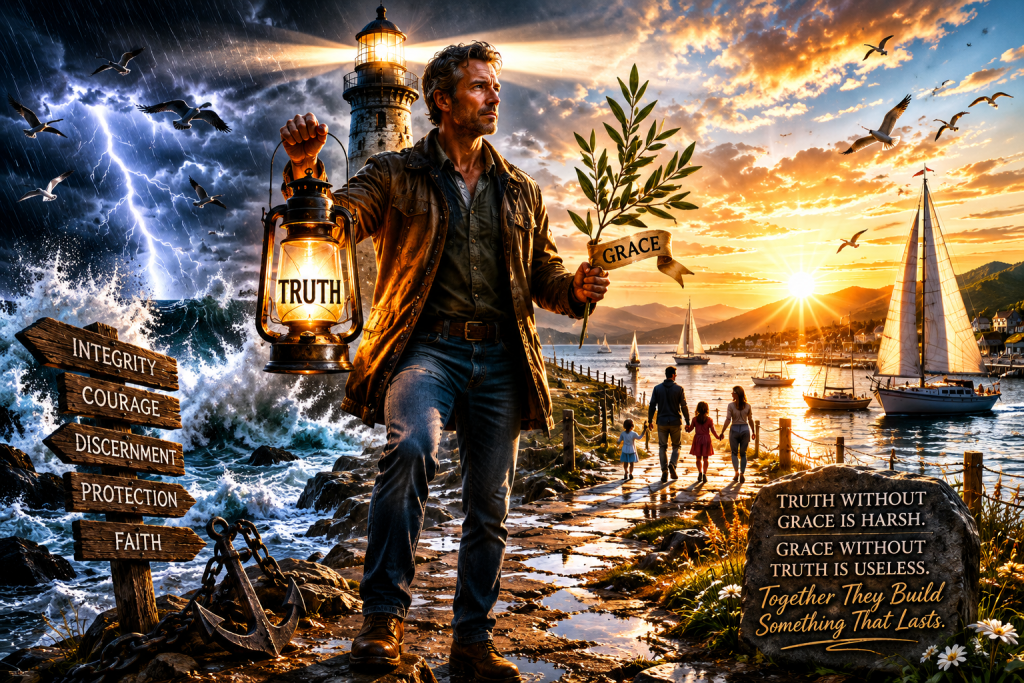
Were going to talk about biblical boundaries, forgiveness and consequences, Christian leadership, discernment, trust and stewardship, conflict resolution, grace and truth, masculine responsibility
The courage it takes
There is a particular kind of pain that comes when someone misrepresents your intentions.
Not when they simply disagree with you.
Not when they choose another path.
But when they take the trust you extended, interpret your actions through suspicion, and tell a story about your character that does not match reality.
In those moments, something in us cries out for justice.
We want the record set straight.
We want the people involved to understand what really happened.
We want consequences.
And if we’re honest, sometimes we want the people who hurt us to hurt too.
Yet there is a tension here that every man eventually faces.
What does strength look like when you’ve been wronged?
For some men, strength becomes passivity. They convince themselves that forgiveness means pretending nothing happened. They call it grace, but underneath is fear. They tolerate betrayal, ignore warning signs, and continue exposing the people they love to unnecessary harm.
Other men move to the opposite extreme. They become judges, juries, and executioners. Every wound becomes proof that people cannot be trusted. Every disagreement becomes war. Every consequence becomes vengeance disguised as righteousness.
Neither path leads to wisdom.
Biblically, grace and consequences have always existed together.
David was forgiven, yet consequences remained.
Peter denied Christ, yet he was restored through repentance and responsibility.
Paul warned others about people who had caused harm while continuing to pray for them as brothers.
Even Jesus, who embodied perfect grace, did not entrust Himself to everyone because He knew what was in the hearts of men.
Forgiveness was freely offered.
Trust was stewarded wisely.
This distinction matters.
When pressure enters our lives, people reveal themselves. Expectations emerge. Communication patterns surface. Fear becomes visible. Sometimes courage appears. Sometimes insecurity. Sometimes selfishness.
Pressure reveals signal.
That signal is not an invitation to condemnation.
It is an invitation to discernment.
Perhaps the blessing hidden inside painful situations is clarity.
We discover who we can build with.
We discover who requires stronger boundaries.
We discover where our own blind spots live.
We discover whether we are more interested in being right or in becoming righteous.
The mature response is not to remove consequences.
The mature response is to ensure that consequences serve restoration, protection, and wisdom rather than revenge.
Sometimes restoration means reconciliation.
Sometimes restoration means changing the structure of the relationship.
Sometimes restoration means stepping away while sincerely wishing another person well.
Those decisions are not signs of weakness.
They are signs of stewardship.
Because leadership is not merely the ability to create opportunity.
Leadership is the willingness to protect what has been entrusted to you.
Your family.
Your clients.
Your community.
Your reputation.
Your own soul.
Rudyard Kipling wrote:
“If you can bear to hear the truth you’ve spoken
Twisted by knaves to make a trap for fools…”
Most people stop reading there.
But Kipling was describing something much deeper than endurance.
He was describing the formation of character.
The world is not healed merely by building better systems.
The world is healed when men and women become the kind of people who can carry responsibility without being consumed by pride, bitterness, fear, or vengeance.
There is an old story about a father who tears apart a picture of the world and gives the pieces to his son. The son quickly reassembles it.
Surprised, the father asks how he did it so quickly.
The boy replies:
“There was a picture of a man on the other side. When I put the man back together, the world came together too.”
Perhaps that is our task.
Not to control every outcome.
Not to force every relationship.
Not to eliminate every conflict.
But to become the kind of people who can hold truth and grace in the same hands.
To forgive without enabling.
To establish boundaries without hatred.
To seek justice without surrendering to vengeance.
To bless even while walking away.
The world comes together one relationship at a time.
Relationships come together one act of courage at a time.
And courage begins with becoming the sort of person who can stand under pressure, learn from what is revealed, and still choose love guided by wisdom.
That is not weakness.
That is strength under authority.
That is stewardship.
And perhaps, in the end, that is what it means to become a man.
Discover more from Bryant Stratton
Subscribe to get the latest posts sent to your email.