
Every family, company, and partnership eventually runs into the same pattern.
A decision has to be made. Pressure is present. Stakes feel real. Time matters.
And suddenly one person in the room becomes the storm.
Not because they are evil.
Not because they do not care.
But because uncertainty activates something inside them they cannot yet carry well.
They raise their voice.
They interrupt.
They escalate.
They turn tension into chaos.
And then everyone else makes the same mistake.
They fight the storm instead of protecting the process.
This happens everywhere.
At home.
In business.
In parenting.
In leadership.
A husband and wife trying to figure out money.
A founder under pressure from payroll.
A parent trying to coordinate a stressful week.
A team trying to decide what gets cut and what gets saved.
The problem is rarely the decision itself.
The problem is what pressure reveals.
Pressure exposes maturity.
Not intelligence.
Not talent.
Not intention.
Maturity.
And maturity is not measured by how strong your opinions are.
It is measured by how stable you remain when reality does not go your way.
That is the hard truth.
The Mistake Most People Make
When someone becomes disruptive, most people swing to one of two extremes.
They either submit to the chaos:
“Fine, whatever you want.”
Or they attack the person:
“You’re acting crazy.”
Both fail.
Submission rewards instability.
Attack creates war.
Neither solves the actual problem.
The healthier way is harder.
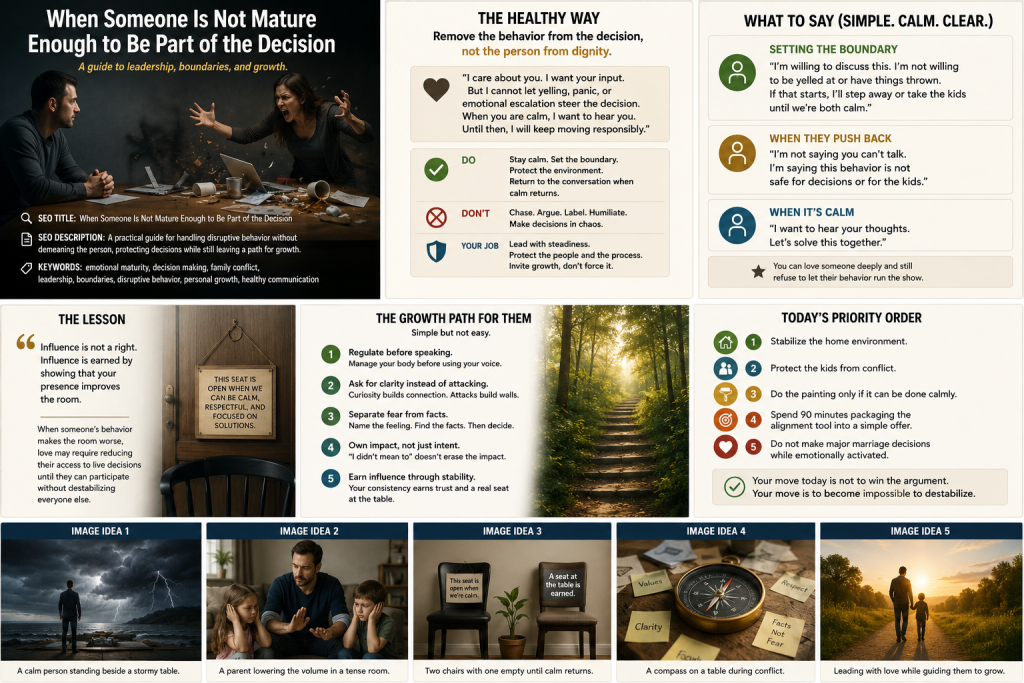
Remove the behavior from the decision, not the person from dignity.
That means understanding something important:
A person can be valuable and still be unsafe in a specific decision-making moment.
That distinction changes everything.
It means you do not have to shame them.
You do not have to diagnose them.
You do not have to win.
You only have to protect the room.
Influence Is Earned Through Stability
A harsh reality of life:
Influence is not a right.
Influence is earned by showing your presence improves the room.
That applies to everyone.
Parents.
Spouses.
Leaders.
Founders.
Children.
If your presence makes decisions clearer, safer, and stronger, your influence rises.
If your presence makes decisions more chaotic, fearful, or reactive, your influence shrinks.
Not because someone is punishing you.
Because reality is.
This is why emotional maturity matters so much.
A person who cannot regulate themselves cannot reliably help regulate outcomes.
And when the stakes involve children, money, trust, or safety, this becomes even more important.
Boundaries Are Not Rejection
This is where many people get confused.
They think boundaries mean abandonment.
They do not.
Boundaries are structure.
And structure is one of the purest forms of love.
A healthy boundary sounds like this:
“I care about you. I want your input. I am willing to work through this. I am not willing to be yelled at, threatened, or pulled into chaos. When things are calm, we can continue.”
Notice what is missing.
No insult.
No diagnosis.
No humiliation.
Just structure.
A boundary says:
The relationship remains.
The behavior cannot lead.
That is service.
Because chaos unchecked teaches chaos.
Chaos contained teaches responsibility.
What It Means to Serve Someone Who Is Disruptive

Serving someone does not mean tolerating everything.
That is one of the biggest lies in modern relationships.
Service is not enabling.
Service is helping someone face reality safely enough to grow.
Sometimes service looks like comfort.
Sometimes service looks like distance.
Sometimes service looks like saying:
“Not like this.”
That phrase matters.
Because it separates the person from the pattern.
Not:
“You are the problem.”
But:
“This pattern is the problem.”
That distinction protects dignity while confronting truth.
And dignity matters because shame rarely produces growth.
Responsibility does.
The Path Back Into the Room

If someone has been removed from a decision because of disruptive behavior, the question becomes:
How do they get back?
Simple.
Not easy.
But simple.
1. Regulate before speaking
If your nervous system is flooding, your words are contaminated.
Pause.
Breathe.
Get stable.
Then speak.
2. Ask for clarity instead of attacking
Attack destroys information.
Questions create it.
Instead of:
“Why would you do that?”
Try:
“Help me understand what you’re seeing.”
3. Separate fear from facts
Fear is real.
But fear is not always accurate.
Learn to name both.
“I’m afraid we’ll run out of money.”
That is fear.
“We have thirty days of cash.”
That is fact.
Those are not the same thing.
4. Own impact, not just intent
Intent matters.
Impact matters more.
“I didn’t mean it” does not erase damage.
Ownership restores trust.
5. Earn influence through consistency
Stability over time builds trust.
Not speeches.
Not apologies alone.
Patterns.
Reliable patterns.
That is how influence returns.
Protect the Children First
When conflict happens in front of children, the equation changes.
Children absorb emotional environments long before they understand them.
Volume teaches.
Tone teaches.
Instability teaches.
Children should not become collateral damage in adult dysregulation.
That does not mean parents must be perfect.
It means parents must be accountable.
If conflict escalates:
Lower the volume.
Reduce exposure.
Protect the emotional environment.
Then repair.
Because children do not need perfect parents.
They need repairing parents.
The Deeper Truth
Some people want access to decisions they are not ready to carry.
That is normal.
Most growth begins there.
Wanting responsibility before being able to hold it.
But reality does not care about desire.
Only capacity.
Capacity is built through regulation.
Responsibility.
Truth.
Consistency.
Humility.
And time.
The goal is never exclusion.
The goal is restoration.
To help someone become strong enough, stable enough, and mature enough to sit at the table without becoming the storm.
Because the strongest person in the room is rarely the loudest.
It is usually the one who can hold the most tension without breaking structure.
That is leadership.
That is love.
And that is how people grow.
Practical Frame to Remember
When chaos enters the room, ask:
Is this person helping the decision or hurting the decision?
If helping, invite them closer.
If hurting, reduce their influence without reducing their dignity.
That is the work.
Protect the process.
Protect the people.
Leave the door open for growth.
But do not hand the wheel to instability.
Because love without structure becomes chaos.
And structure without love becomes control.
Growth lives where both meet.
Discover more from Bryant Stratton
Subscribe to get the latest posts sent to your email.