We are walking into a future where more and more things feel unreal. AI can write the perfect apology, the perfect argument, the perfect plan. It can generate a confident voice for a confused mind. It can manufacture sincerity, and it can manufacture outrage. It can make it easy to perform, easy to deflect, easy to say “it wasn’t me.”
That is the trap. When nothing feels at stake, people drift. They hide behind irony. They hide behind “just posting.” They hide behind “the agent did it.” They hide behind vibes. The answer is not to become grim. The answer is to learn how to play wholeheartedly without becoming irresponsible.
The Rule
Play like nothing is at stake.
Live like your impact is.
Wholehearted play is safe and generative only when one thing stays at stake: ownership of impact. Ownership means you do not outsource responsibility to:
- the algorithm
- the crowd
- the mood
- the persona
- the excuse
- the agent
You can experiment. You can joke. You can build weird projects. You can take creative risks. But you own what happens next.
What “Ownership of Impact” Looks Like
It is not a feeling. It is a set of behaviors.
- You claim authorship of effects. If your words move people, confuse them, or harm them, you do not hide behind “it was a joke.”
- You do the repair. If you break trust, you name it and you fix what you can.
- You pay the cost. Time, apology, money, effort, reputation. Ownership is proven by what you are willing to pay.
This is the difference between play that builds culture and play that rots it.
Why this matters More in an AI future is in the old world, friction enforced reality. You had to show up. You had to learn. You had to suffer embarrassment in public. In the new world, friction is optional. Output is cheap. Performance is cheap. Confident nonsense is cheap.
So the real signal shifts from words to ownership. If you want a future where people can build freely, experiment boldly, and still trust each other, you need one thing to stay expensive: dodging responsibility.
The Great Pretending, and the Way Out
The Great Pretending is when people say the right words and avoid the cost of living them.
“We care.”
“We’re raising awareness.”
“We take this seriously.”
“We’re authentic.”
“The agent wrote it.”
Sometimes those phrases are true. Often they are shields. Humor can expose this without turning into cruelty, if it always includes an exit ramp. Not humiliation, not callouts, not character assassination.
Pattern, not person and truth, not sadism. And then the better move…
The Living Example
We are not writing this from a safe distance.
We are building in public. Memes, tools, experiments, weird little projects that help people see the patterns, laugh, and take the next right step. The point is not to “win” online. The point is to practice a culture where play does not become moral escape.
We will mess up sometimes. That is part of the deal.
The test is whether we own it.
What We Don’t Know Yet
We are making a bet, not stating a law of nature.
We do not yet know:
- If people will choose ownership when friction drops. Cheap output and cheap identity masks might train people to dodge responsibility as the default.
- If platforms will reward the wrong behavior. Engagement incentives can pay people to escalate, mislead, and perform, while punishing repair and nuance.
- If “ownership” can scale. It is one thing to own impact in a small group, it is another when content reaches millions and effects are diffuse.
- If AI will blur causality beyond recognition. When agents act, remix, and propagate, responsibility can become genuinely hard to trace.
- If humor can stay merciful at scale. Irony spreads faster than care. A culture that starts as truth-with-grace can degrade into cruelty with better branding.
- If the line between play and harm will stay clear. People will disagree about what “counts” as damage, and bad actors will exploit ambiguity.
So when we say “ownership of impact,” we are not claiming perfect control. We are claiming a posture: refusing to hide behind plausible deniability.
Steelman Counter-Argument
A skeptic would say this entire framework is naive.
In an AI future, the cost of manipulation collapses. The cost of appearing competent collapses. The cost of producing persuasive nonsense collapses. When the cheapest strategy is to perform, most people will perform. When the cheapest strategy is to defect, most people will defect.
“Ownership” then becomes a boutique virtue, practiced by a minority in small circles, while the larger system selects for the opposite: deniability, blame shifting, and cynical optimization.
A skeptic would also argue that “ownership of impact” is too vague to function as a norm. Impact is hard to measure, delayed, and contested. People will claim innocence because they “didn’t intend it,” and they will claim righteousness because they “meant well.” Meanwhile, actual harm scales faster than repair.
In that view, the only reliable solution is not personal virtue, it is hard structure: law, enforcement, verification, traceability, and penalties that make defection expensive. Without that, the culture you want is outcompeted.
The Response, Without Pretending Certainty
We accept the critique. That is why “ownership” cannot be a slogan. It has to become a set of visible behaviors and a set of structural constraints that make the slogan real.
Our claim is narrower:
If we do not deliberately train and reward ownership, the default future is moral outsourcing, plausible deniability, and performative everything. So we are building a living test. Not a utopia, a practice ground.
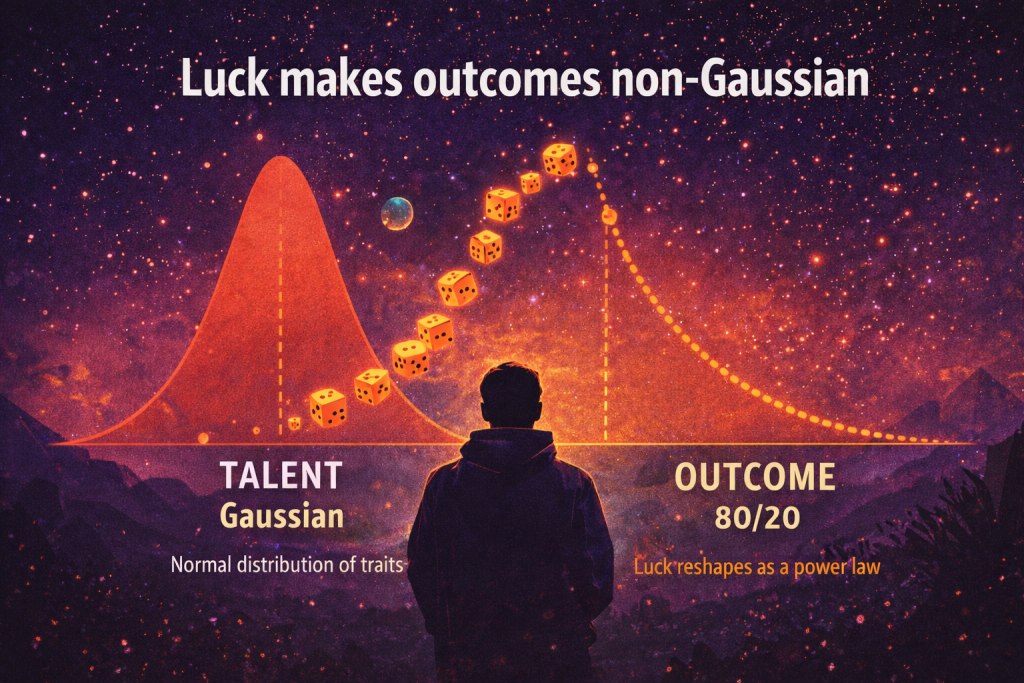
A useful warning comes from a well-known modeling result, “Talent vs Luck.” The model starts with a simple premise: human talent looks roughly Gaussian across a population. Then it adds repeated lucky and unlucky events that compound over time. Even with normally distributed talent, the outcomes become Pareto-shaped, an 80/20 style distribution, because compounding and randomness create extreme winners. In other words, persona traits can be average while outcomes become wildly unequal, and success can be overread as virtue. https://arxiv.org/abs/1802.07068
Steelman counter: If that’s even directionally true, then “ownership of impact” cannot rely on outcomes as evidence of character. It must be measured by behavior under uncertainty, plus structures that reduce defection and prevent winner narratives from laundering responsibility.
Join the Discord
If you want to build this culture with us, join our Discord. Bring your best jokes, your sharpest pattern recognition, and your willingness to own the impact.
We are building a place where:
- humor exposes lies without attacking people
- clarity beats performance
- play is wholehearted
- ownership is non-negotiable
Discord: https://discord.gg/QsGrmes6R
If you join, introduce yourself with one sentence:
What is one place you have been tempted to hide behind “it’s not that serious,” and what would ownership look like instead?
Discover more from Bryant Stratton
Subscribe to get the latest posts sent to your email.